Piercings
Ear Piercing Near Me in Los Angeles
If you're searching for ear piercing near you on the Westside, Apollo is a needle-only ear piercing studio at 2625 Main Street in Santa Monica — lobe, helix, tragus, daith, rook, conch, forward helix and industrial, plus full curated-ear projects in implant-grade titanium and solid gold.
Book a consultationPlacement map
Nine placements. Each one a different anatomy problem.
Good ear piercing in Los Angeles starts with a look at the actual ear — not a reference photo, not an Instagram inspo board. The placements below are the ones we pierce most often, with honest timelines and jewelry notes for each. Want the whole ear mapped at once? Our labeled ear piercing diagram covers all 15 placements with pain levels and healing times.
Lobe
The default starting place
Fleshy, forgiving, and the single most-pierced location on the human body. Standard lobe sits about 6–8mm up from the bottom edge, centered front-to-back. Heals in 6–10 weeks. Holds almost any jewelry style after it downsizes. The correct entry point for a first piercing at any age from five up.
Upper lobe / second lobe
Paired with the standard lobe
A second (or third) piercing in the soft lobe tissue, usually stacked vertically above the first. The stack has to be planned — sloppy spacing is the single most common regret in a curated ear project. Heals like a standard lobe. Holds studs, small hoops, and chained jewelry once settled.
Helix
The outer rim of the ear
The most-requested cartilage piercing. Sits on the upper-outer curve of the ear. Heals in 6–12 months — longer than any lobe. Fine cartilage, so placement precision matters. Tiny studs or small seam rings at install; styling jewelry gets added after the downsize.
Forward helix
Root of the outer helix
Located where the helix meets the head — the small flat panel above the tragus. Commonly done as a stack of two or three in a vertical line. Delicate anatomy; not every ear has space for a triple. Heals on a full cartilage timeline. Small flat-back studs only at install.
Tragus
The nub in front of the ear canal
Small, thick cartilage shelf that guards the canal. Placement is judged by the piercer — feasibility depends on how prominent the tragus is on a given ear. Heals 6–12 months. Holds labret studs beautifully once settled. Not a good first cartilage piercing because the anatomy is anatomy-dependent.
Daith
Innermost curl of the ear
Sits in the innermost fold of cartilage. Needs specific anatomy — a well-defined inner crus. A small seam ring or clicker at install. Heals on full cartilage timeline. Clients sometimes arrive asking about daith for migraines; the honest read is that the evidence is anecdotal, and Apollo will pierce the daith only if the anatomy supports the piercing, not as medical treatment.
Rook
Upper inner ridge
Sits on the small ridge of cartilage between the inner and outer folds of the upper ear. Not every ear has a defined rook — placement depends on visible ridge anatomy. Curved barbell at install. Heals on extended cartilage timeline. Photographs beautifully in curated ear stacks.
Conch (inner and outer)
The large cartilage bowl
Inner conch sits in the deep bowl next to the canal; outer conch sits on the flat cartilage plane above it. Holds studs, larger hoops that wrap the ear, and statement jewelry once downsized. Long healing window because the cartilage is dense. One of the most visually dramatic single piercings when done well.
Industrial
Two helix piercings connected by a barbell
A pair of piercings joined by a straight barbell spanning the upper ear. Every industrial is custom — the angle and length of the bar depend on the specific ear. Not a first cartilage piercing. Heals as two full cartilage piercings, meaning year-plus to fully settle. The most demanding healing of any standard ear piercing.
A curated ear is a composition, not a list. Plan the spacing before you pick the jewelry.
The mall-gun lobe is the #1 piercing we re-pierce at Apollo. Needle-only is not a style choice — it is the standard.
Sleeping on new cartilage is how cartilage ends up crooked. Opposite-side sleep is the cheapest aftercare there is.
The curated ear
Three principles behind every Apollo ear project.
A curated ear is not a list of piercings. It is a planned composition built over time. Three principles guide how we design and execute an ear project.
The ear is a canvas
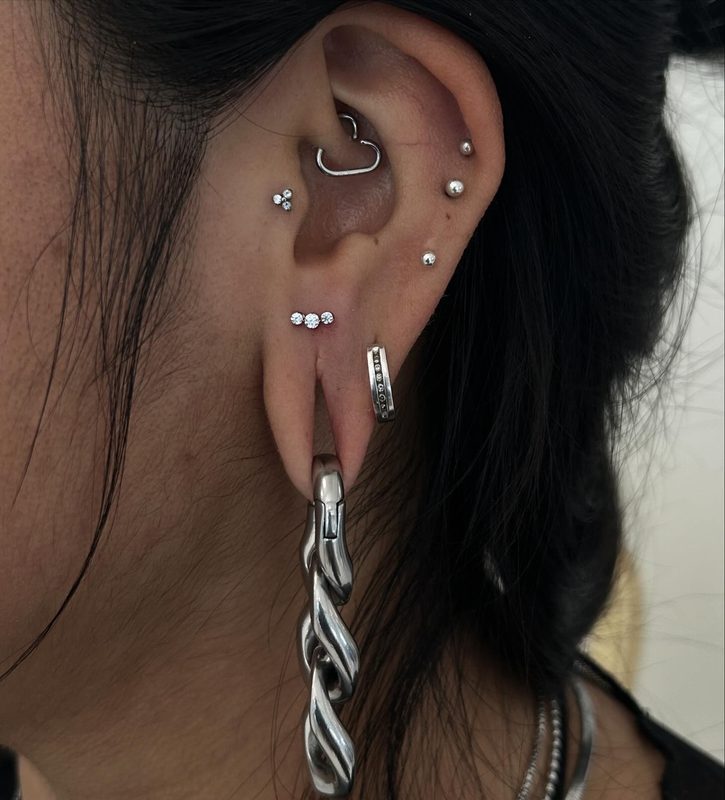
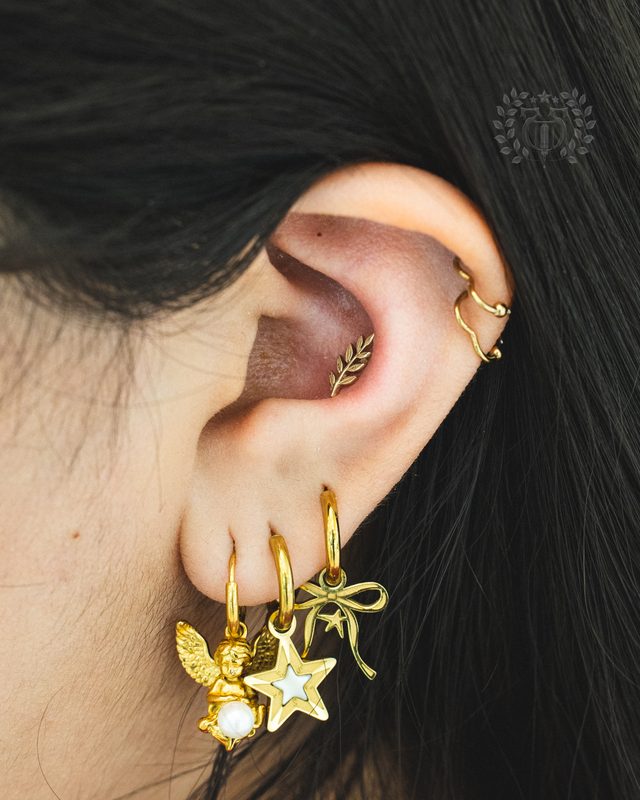
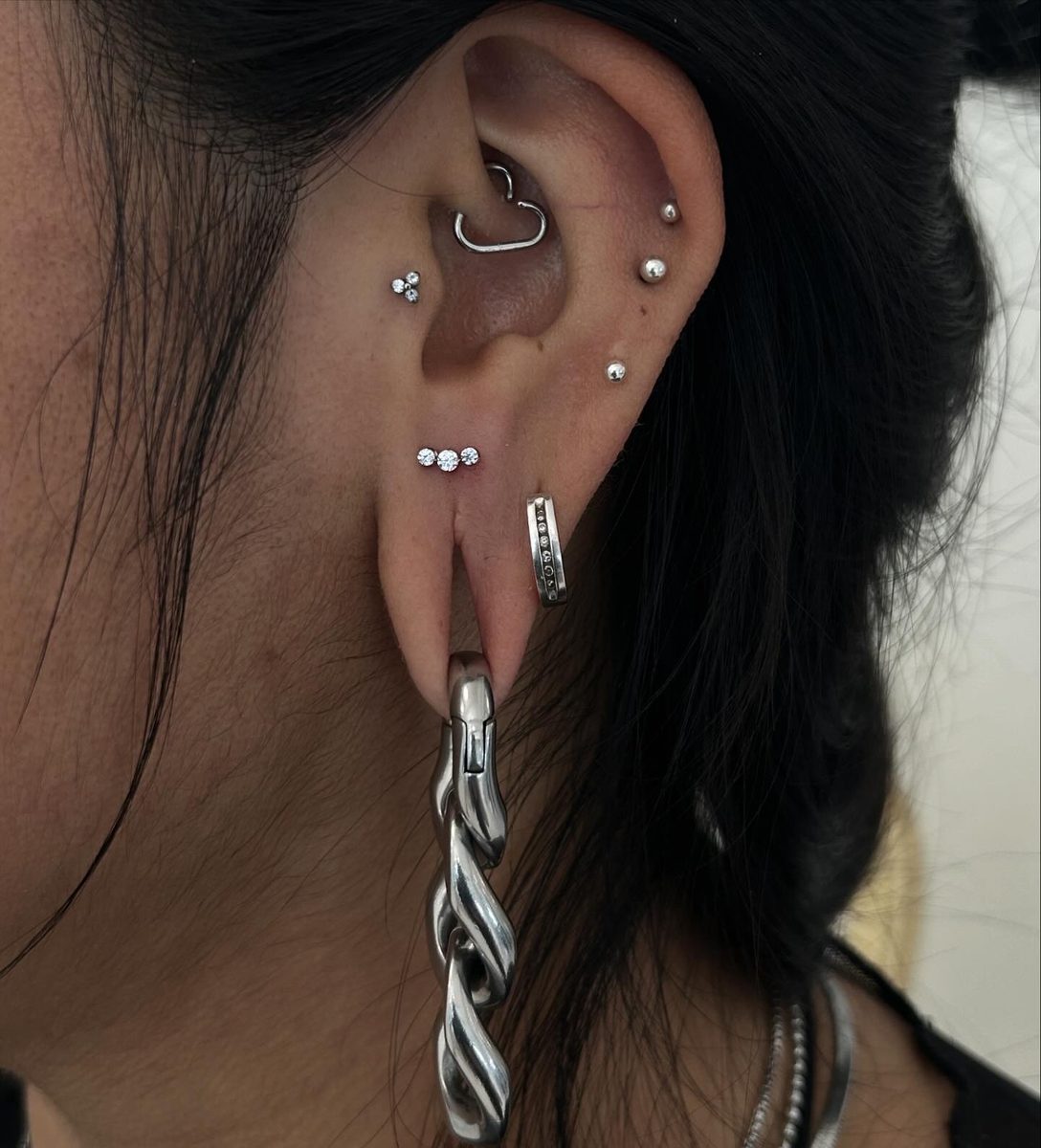
A curated ear is not a list of piercings. It is a composition — balance, spacing, jewelry style across every hole, and how the whole reads at a glance. Apollo approaches ear projects the way a jeweler approaches a bracelet stack: cohesive, planned, not accidental.
One project, many appointments
A full curated ear is not a single-visit build. Each new piercing has its own healing window, and healing cannot be rushed. A typical multi-point ear project unfolds across 6–18 months, with planning locked at the first consultation and jewelry upgraded as pieces settle.
Jewelry is the curation
The metal, the stone, the finish — these do the styling work. Two identical lobe piercings with different jewelry read as two different pieces. The piercer sets the canvas; the jewelry choices, made with the piercer, determine what the final ear looks like.
Jewelry standards
Six rules for what goes in a fresh piercing.
Jewelry at install is not a styling decision — it is a medical decision. The metal that touches a fresh wound determines whether the wound heals cleanly.
Implant-grade titanium (ASTM F-136)
The default first-piercing metal at Apollo. Biocompatible, nickel-free, MRI-safe, and the standard that professional studios endorse for fresh piercings. Available in polished, matte, and anodized color finishes.
Solid 14k or 18k gold
Nickel-free solid gold only — never gold-plated. Allowed at install when the client requests it and the studio stocks the correct internally-threaded piece. Gold patinas differently than titanium; some clients prefer its warmer tone.
Niobium
A hypoallergenic alternative to titanium, often chosen for its subtle dark-gray finish. Holds anodized colors well. Less common at install but available on request.
What Apollo never installs fresh
Sterling silver, gold-plated pieces, surgical steel with nickel content, and any jewelry labeled 'hypoallergenic' without metallurgical certification. These metals are appropriate for fully-healed piercings with downsized jewelry, not for fresh wounds.
Threadless vs threaded
Threadless (push-pin) jewelry is the modern standard for ear piercings because the post is smooth and the insertion is cleaner. Internally-threaded pieces are the professional alternative — the threads sit inside the post rather than on the surface that passes through tissue.
Downsize is required
Every fresh ear piercing gets installed with a longer post to allow for swelling. A downsize appointment (4–10 weeks out, depending on placement) shortens the post to match the settled piercing. Skipping the downsize is how lobes migrate and how cartilage piercings end up crooked.
Healing timeline
Five phases. Cartilage takes most of a year.
The install is the beginning, not the end. Every phase has its own rules — what is normal, what is not, what you do and what you leave alone.
Age policy
Apollo's working minimums for ear piercing.
Age is placement-specific. California law adds a parental consent requirement on top. No gun piercings, no infant piercings, no exceptions for either.
Lobes
Ages 5 and up. Apollo does not pierce infant ears. The developmental window we pierce into is one where the child can understand what is happening, communicate discomfort, and participate in aftercare.
Simple cartilage (helix)
Ages 13 and up. At younger ages, the cartilage is still developing and the aftercare window is too long to sustain through childhood activities. 13 is the working floor at Apollo.
Complex cartilage (tragus, rook, conch, daith)
Ages 14 and up. These placements require more mature anatomy and more disciplined aftercare. The piercer reserves the right to decline any individual case based on anatomy or readiness.
Industrial
Ages 16 and up. A double cartilage piercing with a long healing window — we want a client who can manage the aftercare and the jewelry decisions as an informed participant.
Parental consent
California law requires a custodial parent or legal guardian to be present with government ID for any body art on a minor. Grandparents, aunts, older siblings, and family friends are not legally sufficient under California body-art code.
Needle vs gun
Why Apollo uses single-use sterile needles for every piercing.
Professional studios is explicit on this. Guns crush tissue. Needles remove a clean core. The difference shows up in every healed piercing a decade later.
Needle, not gun
Apollo uses single-use sterile needles for every piercing, every time. Professional studios explicitly opposes piercing guns because they crush tissue rather than removing a clean core, and because most guns cannot be sterilized between clients. The 'mall gun' experience is not what we do and is not what any professional studio does.
Hollow vs solid needles
A piercing needle is hollow — it removes a small core of tissue, leaving clean space for the jewelry. A solid needle pushes tissue aside, which is what a piercing gun does and why gun piercings heal badly. Hollow-needle piercings heal faster, cleaner, and with less scarring.
Single-use, disposed
Every needle is sterile-packaged, opened in front of the client, used once, and disposed in a sharps container on-site. The same is true for jewelry at install — each piece is sealed, sterile, and opened at the chair.
California body art code
All Apollo piercers are registered with LA County under the California Safe Body Art Act. Every station is autoclave-sterilized, every surface is bio-sealed, every client sees the evidence. This is not a marketing claim — it is a legal requirement we comply with publicly.
Aftercare
Six habits that decide how the piercing heals.
Aftercare is part of the piercing. The saline routine is simple; the behavioral discipline is where most piercings are won or lost.
Sterile saline, twice daily
Pre-made sterile saline spray (wound-wash grade, 0.9% sodium chloride). Spray, let sit 30 seconds, pat dry with clean gauze or a single-use non-woven pad. Do not use cotton balls — fibers catch on the jewelry and drag into the wound.
Hands off
Rotating, twisting, or playing with the jewelry introduces bacteria and keeps the wound from closing around the post. Hands on the phone, on door handles, on the keyboard all day — the last thing those hands should touch is a healing piercing.
Sleep discipline
Sleep on the opposite side for 4–8 weeks depending on placement. A travel pillow with a hole cut in the center helps for side-sleepers with cartilage work. Sleeping directly on a new cartilage piercing is the single most common cause of migration and crooked healing.
No pools, hot tubs, lakes, oceans
For the first 4–6 weeks. Chlorine irritates, standing water carries bacteria, salt water delays healing. Showers are fine; submerged soaking is not.
No makeup or hair product on the piercing
Styling products are full of ingredients that healing tissue does not tolerate. Keep hair pulled back while products are being applied. Avoid sunscreen directly on the healing piercing until fully closed.
Watch for infection signals
Normal healing: occasional crust, mild redness at the jewelry, slight tenderness under pressure. Not normal: spreading redness, heat, pus, fever, pain escalating after day 5. Call the studio or your doctor if infection signals appear. We do not dispense medical diagnosis — consult a physician for anything that looks like an infection.
Every new ear piercing gets installed with a long post. The downsize is not optional — it is the piercing finishing the install.
Anatomy sets the placement. If your ear does not have a defined rook, the rook cannot happen. That is honesty, not salesmanship.
Jewelry is the curation. Two identical piercings with different jewelry read as two different pieces.
Consultation
Six questions to bring with you.
Walk into the consult with answers to these and you save yourself an hour and a more limited set of options.
Which placement, specifically?
Walk in with a working preference — lobe, helix, tragus, daith, conch, industrial. Bring a reference photo if you have one. The piercer will confirm whether the anatomy supports the placement and may suggest alternatives that suit your ear better.
One piercing or a project?
Single-point appointments and multi-point ear curation are different conversations. If you want three piercings eventually, tell the piercer at the first consultation — the placement of the first affects where the next two can sit.
Jewelry preference?
Titanium (default), solid gold, or niobium. Stone, plain, or colored anodize. Flat-back stud or hoop at install (note: most cartilage requires a flat-back stud at install and cannot start with a hoop).
Medical flags?
Current medications, nickel allergy, keloid history, immunocompromise, pregnancy, recent illness. Flag all of it at booking so the piercer can plan around it. A pierced client who discloses is always easier than one who hides a relevant history.
What's your healing environment?
Side-sleeper, active gym-goer, swimmer, contact-sport athlete, parent of small children who yank at jewelry. The piercer can steer you toward a placement and jewelry shape that survives your actual life.
Can you commit to the downsize?
Ear piercings require a return visit to downsize the jewelry 4–10 weeks later. If you cannot commit to coming back, the piercing will not settle correctly. This is the moment to be honest about availability.
Common mistakes
Eight execution patterns to watch for.
Most disappointing ear-piercing outcomes trace back to one of these eight patterns. Catching it in the consult prevents it in the chair.
The mall-gun lobe
Piercing guns crush tissue and migrate. A lobe pierced in a shop or at a mall kiosk with a gun often sits too low, at a wrong angle, or with scar tissue that complicates later placements. Fix: if the geometry is off, Apollo can re-pierce adjacent to (not through) the old hole once it closes or heals flush.
Skipping the downsize
Every piercing gets installed with a long post to accommodate swelling. Clients who skip the 4–10 week downsize end up with migrated lobes, tilted helices, and cartilage piercings that heal at the wrong angle. Fix: book the downsize before you leave the first appointment.
Sleeping on new cartilage
The #1 cause of crooked helix, tragus, and conch piercings. Cartilage does not forgive pressure during healing. Fix: opposite-side sleeping for 4–8 weeks, travel pillow for chronic side-sleepers.
Cheap jewelry at install
Sterling silver, gold-plated, or unmarked 'hypoallergenic' pieces contain nickel or flake into the wound. Fix: implant-grade titanium, solid gold, or niobium at install — every time, no exceptions.
Bad anatomy match
Requesting a rook on an ear without a defined rook ridge, or a daith on an ear with a shallow inner curl. Fix: trust the piercer's anatomy read. A good piercer will decline placements that the ear cannot hold.
Rotating the jewelry
Old guidance said 'rotate to keep it open.' Modern guidance says: do not rotate. Rotation pulls crust into the wound and introduces bacteria. Fix: hands off. Saline only.
The Instagram-in-30-days trap
Booking three piercings in one session because they'll look good together on day one. They will — and they will heal badly because the ear is doing triple immune work. Fix: space new work by 6–8 weeks minimum so each piercing gets a clean healing start.
Ignoring allergy history
Clients who assume 'a little nickel is fine' because an old lobe piercing healed OK often end up with contact dermatitis at a fresh cartilage site. Fix: disclose the history, accept titanium or gold, skip the shortcut.
First ear piercing
If this is your first piercing, a standard lobe is the right answer.
Forgiving placement, implant-grade titanium, short-enough healing window that the client finishes the project and comes back for the second and third.
Finding us
What “ear piercing near me” should actually get you.
Apollo is at 2625 Main Street in Santa Monica, and we pierce ears for clients across greater Los Angeles. Proximity is the easiest thing to search for and the least useful thing to choose on.
Here is the thing about a proximity search for a piercing. The nearest studio and the right studio are different questions, and only one of them is answered by a map. A lobe done badly ten minutes from your apartment costs you a year of migration and a scar; a lobe done well across town costs you a parking hassle once. For cartilage — helix, conch, rook, daith, tragus — the gap matters more, because cartilage does not forgive a bad angle the way a lobe does. It heals around whatever you gave it, for six to twelve months.
So the questions worth asking a studio that comes up in your search are not about distance. Do they pierce with a single-use sterile needle rather than a gun? Will they turn you away if the anatomy does not support the placement you asked for? Is the initial jewelry implant-grade titanium or solid gold, threadless or internally threaded — and is the downsize appointment already on the calendar when you leave? A studio that answers those four cleanly is worth a longer drive than one that does not.
Practically: we are on Main Street on the Santa Monica side, which puts us within a short drive of Venice, Ocean Park, Mar Vista, Culver City, Marina del Rey, Playa Vista, Brentwood and West LA. Clients come from further out for curated-ear projects, because those are planned in one sitting and executed over several. If you are piercing a child rather than yourself, our kids and baby ear piercing page covers the age floor, the needle method and the family appointment. For what each placement costs, the piercing prices guide lists type-by-type rates.
FAQ
The questions every ear-piercing consultation surfaces.
Eight questions covering pricing, healing, method, age, jewelry, multi-piercing appointments, sensitive skin, and downsize timing.
How much does ear piercing cost in Los Angeles?
Apollo pricing is discussed at consultation and varies with the placement, the jewelry selected, and whether the visit is a single piercing or a multi-point ear project. Implant-grade titanium is the default install metal; solid 14k/18k gold and niobium are available. Every fresh piercing includes a return downsize appointment. We quote based on the specific ear and jewelry, not a flat rate.
How long does an ear piercing take to heal?
Lobes heal in 6–10 weeks. Simple cartilage (helix, forward helix) heals in 6–12 months. Complex cartilage (tragus, daith, rook, conch, industrial) heals in 8–12+ months. A piercing that feels normal to the touch at week 4 is not fully healed — cartilage in particular can feel settled while the deeper tissue is still repairing. Leave the install jewelry alone until the piercer confirms the downsize at the follow-up visit.
Do you use a gun or a needle?
Apollo uses a single-use sterile hollow needle for every piercing. Professional studios and every reputable industry voice oppose piercing guns because the guns crush tissue, cannot be sterilized between clients, and force jewelry through the ear with compressive pressure rather than removing a clean core. Needle-only is the professional standard, not a stylistic preference.
What's the minimum age for ear piercing at Apollo?
Lobes: five and up. Simple cartilage (helix): 13 and up. Complex cartilage (tragus, rook, conch, daith): 14 and up. Industrial: 16 and up. California law requires a custodial parent or legal guardian to be present with government ID for every body-art appointment on a minor. Apollo does not pierce infant ears — we pierce into an age where the child can understand what is happening and participate in aftercare. For family-focused ear piercing for kids, see our dedicated kids' piercing service.
What jewelry should I start with?
Implant-grade titanium (ASTM F-136) is the default install metal at Apollo — biocompatible, nickel-free, MRI-safe, endorsed by professional studios for fresh piercings. Solid 14k or 18k gold is the allowed alternative when requested. Niobium is a third option. We never install sterling silver, gold-plated jewelry, or unmarked 'hypoallergenic' pieces at a fresh piercing — those metals are for fully-healed ears only.
Can I get multiple ear piercings in one appointment?
Yes, within reason. The working limit is two lobes per session or one cartilage piercing per session at Apollo. Doing three cartilage piercings at once triples the immune load and usually results in slower, less clean healing on all three. A curated ear project is designed to unfold across multiple appointments — we plan the full layout at the first consultation and execute it over 6–18 months so each piercing gets a clean healing start.
What if I have sensitive skin or a nickel allergy?
Flag it at booking. Implant-grade titanium and solid nickel-free gold are the two install metals that accommodate nearly all skin sensitivity and allergy cases — they are the reason we stock those materials exclusively for fresh piercings. For clients with documented severe metal reactivity, we can walk through a patch-test protocol or refer to a dermatologist for allergy testing before the appointment. See our sensitive-skin jewelry guide for more detail.
When should I get the downsize?
Lobes downsize at week 6. Simple cartilage (helix, forward helix) downsizes at month 3. Complex cartilage (tragus, rook, conch, daith) downsizes at month 4. The timing is based on when swelling has fully resolved but before the long install post begins causing migration. Apollo books the downsize before you leave the first appointment, because a piercing without a downsize is a piercing that will not settle correctly.
Ready for the consultation?
Bring the ear you have, the references you like, and the questions you have not yet asked out loud.
Apollo ear-piercing consultations start with a look at the anatomy and end with a plan — single piercing or multi-point curation, jewelry selection, healing expectations, and the downsize appointment on the calendar before you leave.
Studio portfolio
Ear piercings by our piercers
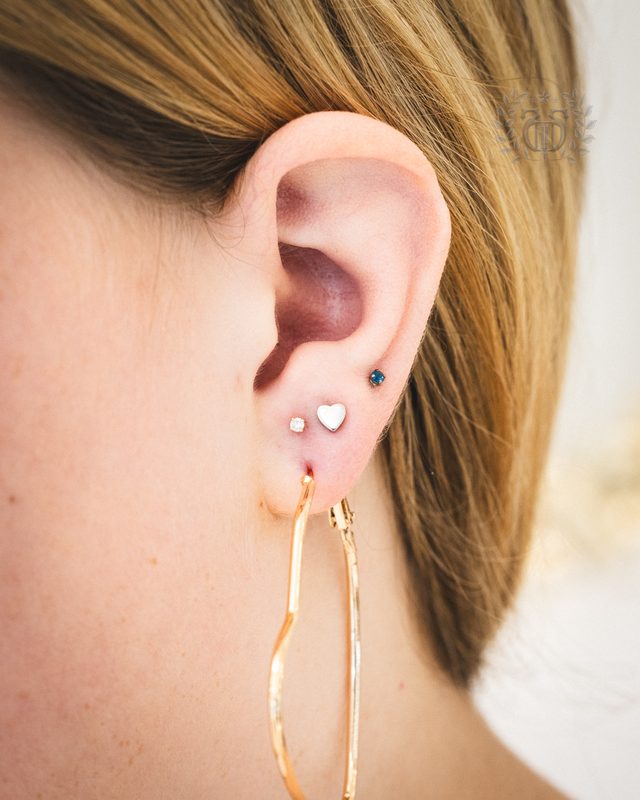
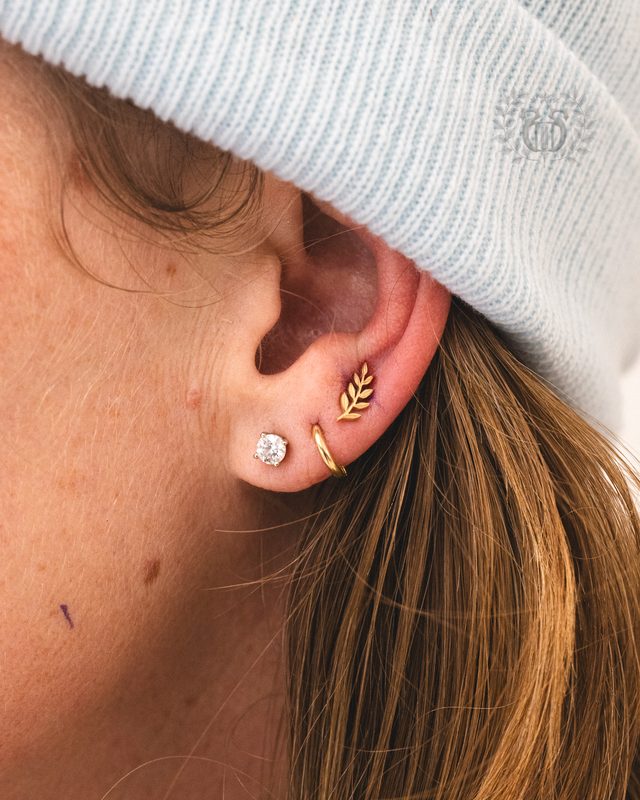
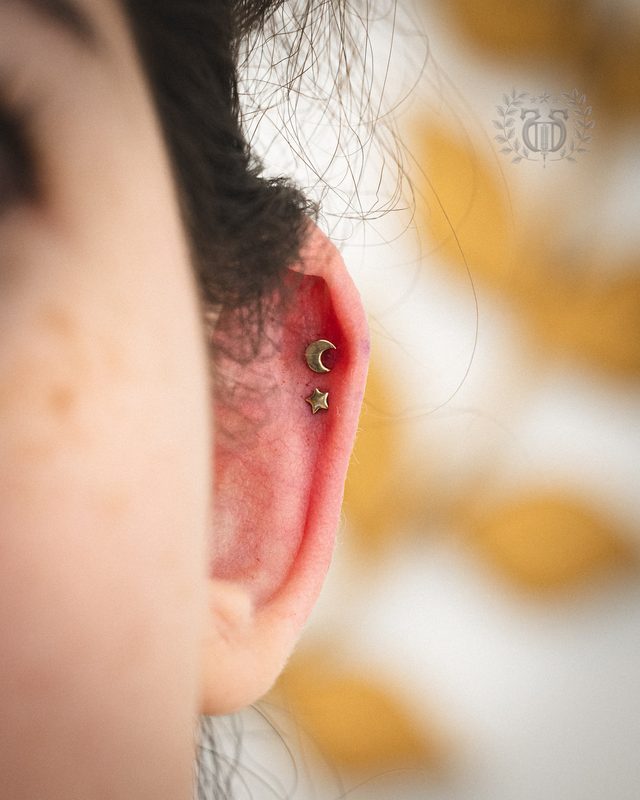
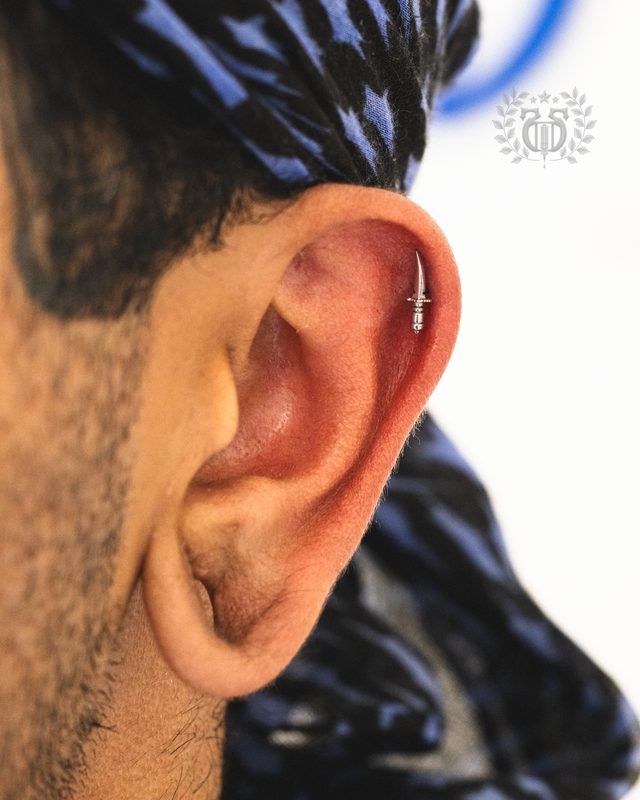
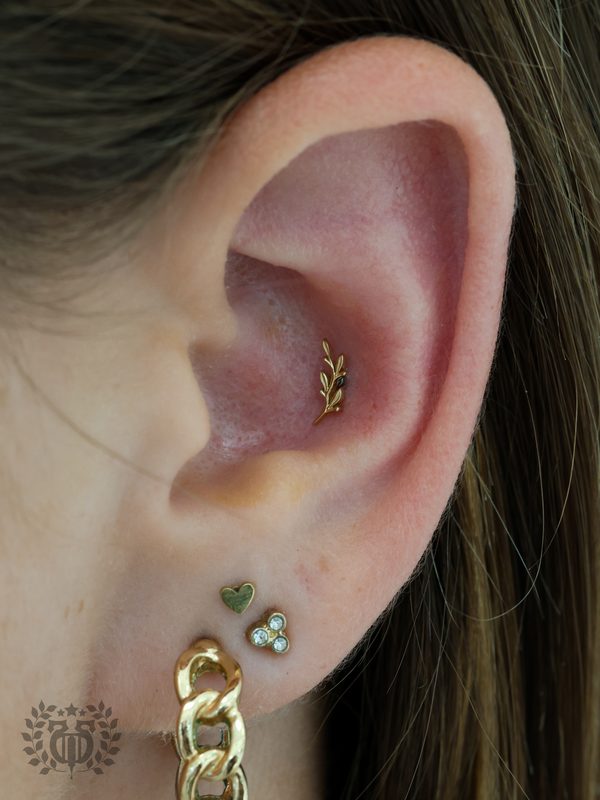
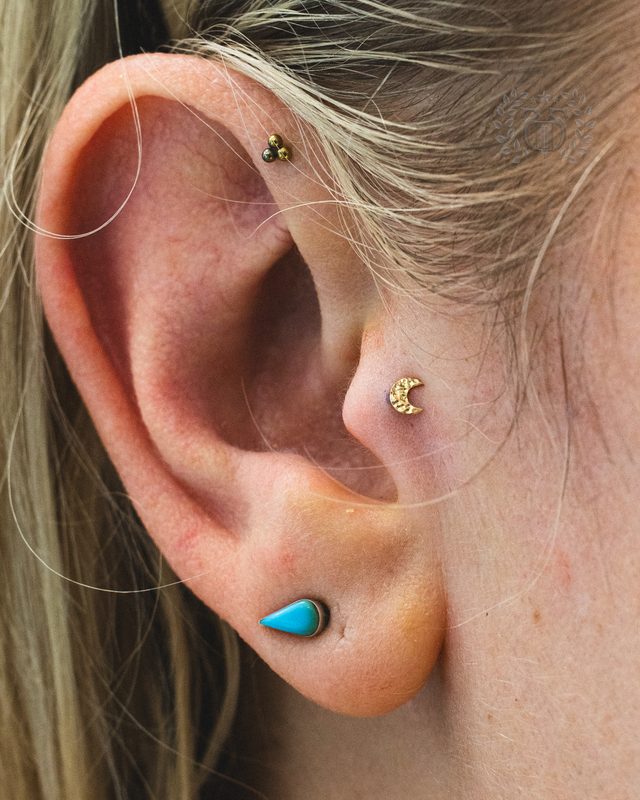
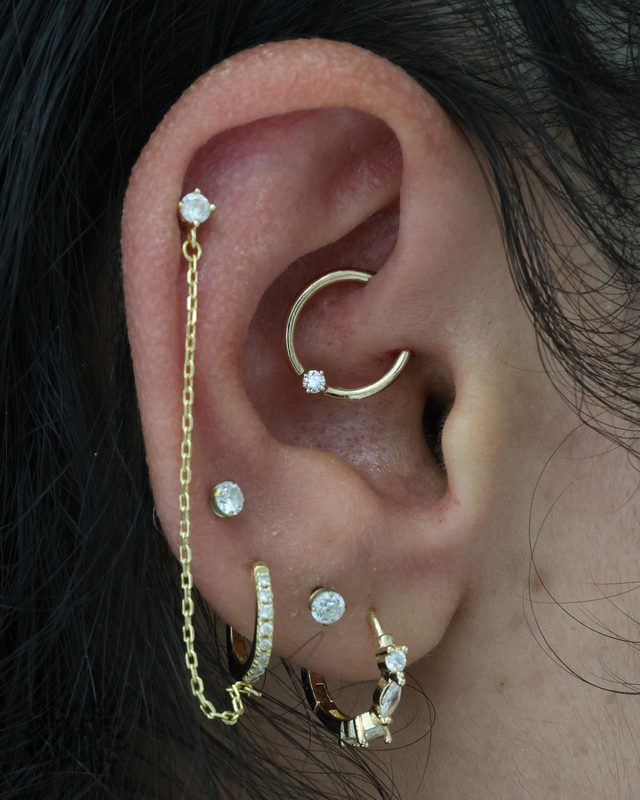
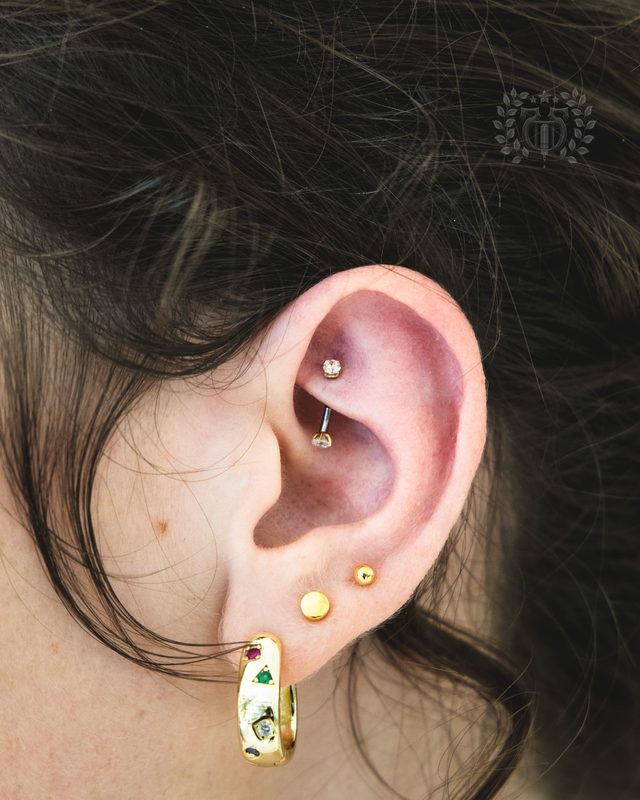
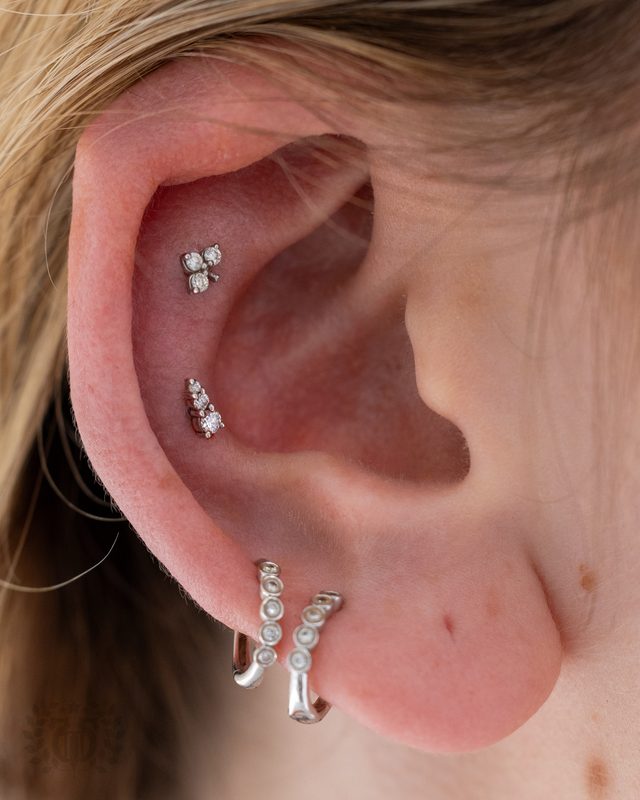
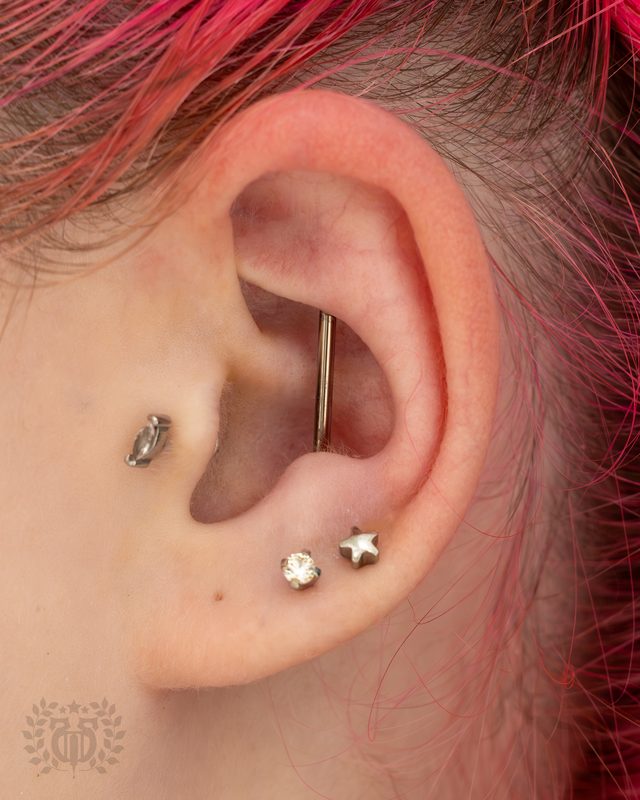
A sample of curated ear work — lobe, helix, conch, tragus, daith, rook, flat and industrial placements in implant-grade titanium and solid gold.