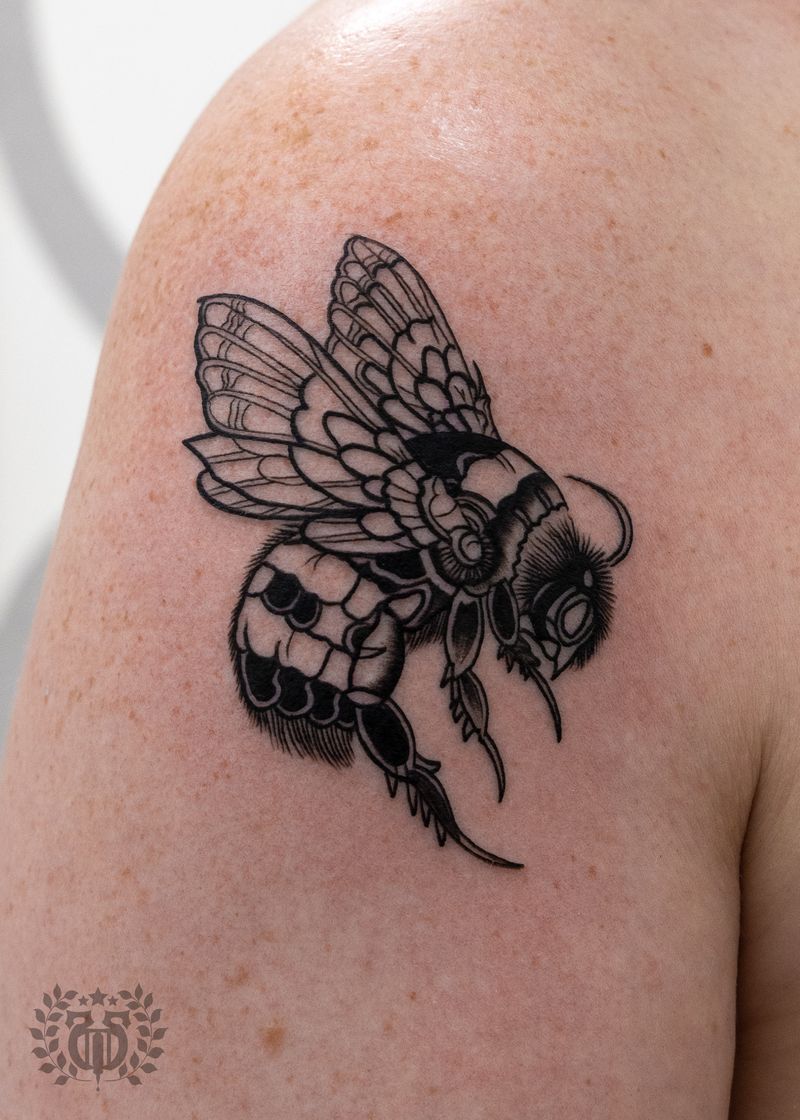
What a tattoo actually is
A controlled wound with pigment inside it.
The machine drives a cluster of small needles through the outer layer of skin — the epidermis — and deposits ink into the dermis. The dermis is the layer that doesn’t fully shed. That’s why a tattoo stays. It also doesn’t fully heal in a day, a week, or even a month.
Looking for the product answer rather than the biology? This page covers how healing works. For whether you can use Vaseline, Neosporin, Aquaphor, coconut oil, a particular lotion, soap or sunscreen — each answered directly and traced to the study, drug label or regulation behind it — read what to put on a tattoo. It is the deep answer on products and this page defers to it.
“Healed” and “fully settled” are two different milestones. Most skin reaches the first around day 14–30. The second often takes 60–90 days. Aftercare isn’t about speeding either up — it’s about not getting in the body’s way.
The healing timeline
What most skin does, most of the time.
No two pieces heal identically. Placement, size, color saturation, skin tone, hydration, sleep, and the artist’s hand all shape the curve. The stages below are the typical pattern — not a promise.
Fresh wrap
Artist finishes cleaning, photographs, and wraps. Cling-film, absorbent pad, or adhesive film. You walk out looking like the tattoo is behind glass — on purpose. The wrap keeps airborne bacteria, other people’s clothes, and your own hands off a fresh wound for the first few hours.
The weep
Plasma, lymph fluid, and a small amount of excess ink push out through fresh needle channels. Traditional wrap comes off in this window (2–4 hours, artist-specified). Adhesive film pools the fluid inside — looks alarming, is exactly what the film is designed to hold.
Darkest window
Swelling, heat, and redness peak. Tattoo can look oversaturated, almost too dark. Area may feel like a mild sunburn. Sleep is hard on ribs, sternum, shoulder blades, or any placement resting on a mattress. The stretch where the tattoo feels most like an injury. Typical.
Scab, flake, itch
Outer layer lifts in papery flakes — black pieces flake black, color pieces flake color. The most misunderstood stage. Pigment-stained flakes look like the tattoo falling out. It’s not. Color lives in the dermis where the needle placed it. What’s lifting is dead epidermis carrying trace pigment. Itch is worst here. So is the temptation to pick.
Matte phase
Outer skin mostly closed. Tattoo looks flat, hazy, sometimes “cloudy.” The haze is a thin layer of newly regenerated epidermis over the settled ink — the body’s fresh windowpane over the color. Looks dull compared to day one. Clears on its own. The stage clients most often text worried the tattoo looks wrong.
The settle
Color brightens, lines sharpen, haze thins. Deeper dermal layers still knitting even when the surface feels fine. Most skin cleared for full sun, gym friction, and open water by day 30 — artist- and placement-dependent. Heavily saturated or large-scale pieces may want another week.
Fully healed, still settling
Large color work, cover-ups, and dense black-and-gray pieces often keep settling quietly into month three. Some tattoos look subtly different at 90 days than at 30 — a touch softer, the contrast slightly reshuffled as the dermis fully compacts around the pigment.
Long-term care mode
Past the 90-day mark, the piece is skin now. UV exposure, hydration, weight changes, and time do the rest of the shaping. Long-term care becomes a different discipline.
Two aftercare methods
Second Skin film for 5–7 days. Unscented water-based lotion if the film isn’t an option.
Apollo’s preferred protocol is Second Skin — a medical-grade adhesive film, worn continuously for 5–7 days, that lets the piece heal in a sealed, breathing environment. The open-air lotion method is the fallback when an allergy, placement, or client preference rules the film out. This is a conversation to have with your artist, not a decision to make alone on the internet. Whichever your artist sent you home with, their aftercare sheet wins.
Second Skin adhesive film
Apollo’s preferred method
Your artist applies a medical-grade adhesive film (Saniderm, Recovery Derm Shield, Recovery Aquaphor-Derm, or an equivalent “Second Skin”) directly over the clean, fresh tattoo before you leave. The film stays on continuously for 5–7 days — not removed each day. The film breathes while containing the plasma and lymph the body pushes out during early healing, so the piece heals in a sealed, clean environment. The film will fill with cloudy fluid in the first 48–72 hours — that’s normal, and it’s the body’s work happening under a protective layer. Only change it if the seal breaks at an edge, a corner leaks through, or something is clearly irritating the skin underneath. On day 5–7, peel the final film slowly in a warm shower — running water helps release the adhesive. Wash the piece once with fragrance-free, dye-free liquid soap. Pat dry with a clean paper towel. Transition to unscented water-based lotion, thin coat, twice daily.
Important. If a replacement film change becomes necessary, wash the piece gently with lukewarm water and fragrance-free, dye-free liquid soap, pat dry with a paper towel, let air-dry 5–10 minutes, then apply a fresh film with at least 1 inch of margin around the tattoo. Not suitable for confirmed adhesive allergy or placements where the film won’t hold a seal.
Unscented water-based lotion (fallback)
If Second Skin isn’t an option
Traditional open-air healing with unscented water-based lotion only — used when an adhesive allergy, session placement, or client preference makes the film impractical. Remove the initial cling wrap on your artist’s specified timing. Wash once with lukewarm water and fragrance-free, dye-free liquid soap, clean hands only, no washcloths or loofahs. Pat dry with a clean paper towel. Apply a thin layer of unscented water-based lotion — Lubriderm Daily Moisture Fragrance-Free, Cetaphil Moisturizing Lotion, CeraVe Daily Moisturizing Lotion, or Eucerin Original Healing — 2–3 times a day from day 1 through day 30. Wash twice a day, lukewarm water, fragrance-free dye-free liquid soap. Thin is the operative word: if the tattoo looks shiny, it’s too much.
Important. No petroleum-based ointments. No A&D, no Aquaphor, no Hustle Butter as a primary, no Vaseline. These are occlusive, trap moisture, and can macerate healing skin — outside Apollo’s current recommendation. No baths, pools, ocean, lakes, rivers, or hot tubs for 2+ weeks. Showers are fine.
The LITHA principle
Leave It The Heck Alone.
The governing principle of modern body-art aftercare — endorsed across the professional piercing industry and shared almost word-for-word by experienced tattooers. Most aftercare problems don’t come from under-cleaning. They come from over-handling.
Clients who peel the Second Skin on day two to peek, lift the corners every few hours to check the color, pick at flakes once the film is off, poke the area to see if it still hurts, or swap products mid-heal are statistically more likely to end up with patchy color, irritation, or a stretched-out scab phase than clients who leave the film alone for the full 5–7 days and otherwise let it be. The body is better at healing itself than you are at helping it. Trust the film, transition to unscented water-based lotion when it comes off, and keep your hands elsewhere.
The don’t list
Twelve things that quietly damage a healing tattoo.
These aren’t rules to be heroic about. They’re what actually separates a tattoo that settles cleanly from one that needs a touch-up before it was supposed to.
Don’t pick or peel
Picking pulls pigment out with the scab and leaves patchy, light spots that require a touch-up. The flake lifts when ready.
Don’t scratch
Itch is normal; shredding the healing surface with fingernails is not. If the itch is unbearable, slap gently through clothing.
Don’t submerge
2–3 full weeks before baths, pools, ocean, hot tubs, lakes, or rivers. Soaking softens scabs prematurely and carries bacteria into open needle channels. Showers are fine.
Don’t direct-sun
No sun or tanning beds on the fresh piece for a full month. After it’s healed, SPF 50+ forever. UV is the single biggest fade driver.
Don’t use petroleum-based products
A&D, Aquaphor, Vaseline, and Hustle Butter as a primary all trap moisture and can macerate healing skin — outside Apollo’s current protocol. Scented lotions, lanolin, essential oils, tea tree oil, alcohol, and hydrogen peroxide all irritate or damage a tattoo in progress.
Don’t over-manage the film
If you went home in Second Skin, leave it alone for the full 5–7 days. Don’t peel to peek, don’t lift the edge to check color, don’t swap it on a schedule. On the lotion protocol: thin coats only — if the tattoo looks shiny, you used too much.
Don’t wear rough fabric
Seams, tags, bra straps, waistbands, and synthetic gym fabrics rub. Loose cotton for 10–14 days.
Don’t work out hard
5–7 days off heavy training. Sweat is salt water on a wound, and heavy stretching near joints/ribs pulls at settling skin.
Don’t shave or wax
Not over the area until fully healed — six weeks or more.
Don’t apply makeup or tanner
No makeup, self-tanner, or sunscreen over a healing tattoo. Save all three for after the heal.
Don’t re-wrap
Once the initial wrap comes off, don’t put plastic back on. Trapped moisture under plastic is a bacterial greenhouse.
Don’t sleep directly on it
For the first week. Clean sheets, gentle positioning.
A tattoo is a controlled wound with pigment inside it. “Healed” and “fully settled” are two different milestones — most skin reaches the first around day 14–30, the second often takes 60–90 days.
Clients see pigment-stained flakes falling off and panic that the tattoo is falling out. It’s not. The color lives deeper, in the dermis, where the needle placed it.
The body is better at healing itself than you are at helping it. Less is more.
Normal vs warning signs
Know which column.
The difference between a normal heal and a developing problem is usually visible in the first two weeks. A normal tattoo gets a little worse, then steadily better. A problem gets worse on a curve. The studio is not a medical provider — an artist can tell you whether what you’re describing is in the normal band. A physician is who diagnoses and treats anything outside it.
Normal healing
- Redness at the tattoo for 1–3 days
- Mild swelling for 1–3 days
- Localized warmth when you touch the area
- Itching from day 3 through day 10
- Visible scabbing, flaking, or peeling
- Piece cycling through “dark and tight” → “hazy and dull” → “brighter and settled”
- A little pigment in the flakes — surface ink, not the tattoo failing
- Clear or lightly pink-tinged fluid during the first 24–48 hours
See your artist — and a doctor
- Redness spreading outward beyond the tattoo after day 3
- Pus, yellow or green discharge, foul smell
- Fever, chills, body aches
- Red streaking lines moving away from the tattoo (same-day call)
- Pain getting WORSE after day 3 instead of better
- Hard, raised, rope-like lines along tattoo lines
- Swelling persisting past 48 hours or returning
- Rash spreading beyond the outline or intense itching that won’t settle
- Breathing difficulty, body-wide hives, facial swelling (ER, same day)
Complications, in plain terms
Five problems, and where to route them.
Most tattoos heal without incident. When they don’t, the problems tend to fall into one of these five categories — each with its own cause, signs, and correct route.
Infection (bacterial)
Cause. Disrupted skin barrier plus environmental exposure
Signs. Spreading redness, warmth, pus, fever
Route. Urgent care or dermatologist — usually treatable with antibiotics if caught early
Allergic reaction / contact dermatitis
Cause. Reaction to ink pigment (red and yellow most common), aftercare product, or adhesive film
Signs. Persistent itching, raised bumps, rash contained within the tattoo or concentrated on one color
Route. Dermatologist — may require patch testing. Pigment allergies can surface months or years later
Keloid / hypertrophic scarring
Cause. Genetic predisposition; higher incidence in deeper skin tones
Signs. Raised, firm, rope-like tissue along tattoo lines
Route. Dermatologist — steroid injections or surgical revision. Tell your artist before booking if you’ve keloided before
Ink blowout
Cause. Needle pushed too deep; ink migrates beyond the line
Signs. Blurry edges, hazy halo of ink beyond the outline
Route. Your artist — cosmetic, not medical. Often correctable with a touch-up or absorbable into a cover-up
Delayed healing
Cause. Poor aftercare, immune suppression, diabetes, smoking
Signs. Healing taking 2x+ expected timeline
Route. Physician first to rule out an underlying cause, artist second for touch-up planning once cleared
Special situations
Where the standard timeline shifts.
Eight situations where aftercare needs to be adjusted — and where “standard healing” timelines don’t quite apply.
Sensitive / eczema-prone skin
Second-skin adhesives can trigger flares. Mention it at consultation. Patch-test any new aftercare product on a small area first.
Deeper skin tones
Early redness reads differently — often cooler, more purple-brown than the bright red fair-skin guides describe. Trust the timeline and your artist’s visual read. Keloid risk is higher; discuss predisposition before booking.
Cover-ups & heavy color
More pigment means longer settle — 30–90 days. Dense color can look muddy at weeks 2–3 and still clear beautifully. A touch-up at the 6-week mark is standard, not a failure.
Fingers, hands, palms
These placements lose ink. Expect fallout, expect a second pass, don’t panic at week-two patchiness — it’s the nature of the skin there.
Feet
Shoes, socks, and dampness make these the highest-maintenance heal. Open footwear or loose cotton socks, extra diligence on cleaning, no exceptions on the submersion rule.
Joints & stretch zones
Elbows, knees, armpits — skin that moves a lot heals unevenly. Small surface cracking is normal; deeper cracks that weep or bleed are not.
Pregnancy & breastfeeding
Most reputable studios, Apollo included, decline to tattoo during pregnancy. Wait approximately 6 months post-breastfeeding.
Immune-compromised clients
Talk to us openly. Doctor clearance is often the right move, and healing may take significantly longer regardless.
Long-term care
A tattoo is still skin.
Past the 90-day mark, the tattoo becomes part of the skin’s daily life. Whatever happens to the skin happens to the tattoo. Year 1 onward is where the ten- and twenty-year photograph of your piece gets shaped — by UV, hydration, and the decisions you make about placement and body change.
UV is the #1 fader
Sunlight breaks down tattoo pigment over years like it fades a photo in a window. Color fades fastest (reds, yellows, light blues most vulnerable). Black-and-gray holds longest (carbon-based black is the most photostable pigment). Fine line sits in the middle. SPF 50+ broad-spectrum, reapplied every 2 hours of exposure, is the entire long-term-care policy in one line. Car and office windows block UVB but let UVA through — driver’s-side forearm tattoos often age faster than passenger-side.
Hydration shows
Dry, neglected skin reads a tattoo through a haze. The ink hasn’t changed; the window over it has. Fragrance-free moisturizer through the week keeps the image crisp. A 10-year-old tattoo on well-hydrated skin and the same piece on dry, sun-beaten skin are visibly different pieces — and the difference is almost never the artist.
Touch-ups are craft
Fine line refreshes at year 5–7. American Traditional commonly 15–20+ years before attention. Color realism lands 10–15. Watercolor is the highest-maintenance style (3–7 year cycle). Blackwork and ornamental among the longest-lived (20+ years). Signs a piece is ready: lines softening at the edges, color muting, definition dropping, saturation visibly lighter.
Body change reshapes the piece
20+ pounds of weight change can distort lines on abdomen, flanks, upper arms, thighs. Pregnancy affects lower abdomen, hips, lower back most. Significant muscle gain bows lines outward. Clients planning pregnancy or dramatic body change are better served with less stretch-prone placements — upper back, calf, outer thigh, upper arm.
Laser is not erasure
Q-switched and picosecond lasers fade and often clear unwanted tattoos — across 6–12 sessions spaced 6–8 weeks apart, measured in years. Most clients describe laser pain as sharper than the original tattoo. Cleared pieces often leave a ghost outline or slight texture change visible under side light. Cost frequently exceeds the original tattoo. Certain pigments (some whites, neons, metallics) resist laser almost entirely.
Placement longevity
Ages best: upper arm, outer thigh, calf, upper back, non-sun-exposed chest. Moderate: forearm, shoulder, inner bicep, rib. Fastest to fade: hands, fingers, feet, palm, neck — high UV, thin skin, constant friction. Finger tattoos commonly need a refresh inside two years. Not a failure of the artist; anatomy.
Touch-up rhythm by style
Different styles age on different clocks.
Rough cadences most artists recognize. Your specific piece may age faster or slower based on placement, sun exposure, and skin care — but the style sets the baseline.
A normal tattoo gets a little worse, then steadily better. A problem gets worse on a curve. Trust the direction, not just the snapshot.
Your artist is triage. Your doctor is diagnosis. Keep those two roles separate and you’ll make faster, better decisions about your own body.
UV is the single biggest variable separating a ten-year-old tattoo that still reads clean from a ten-year-old tattoo that looks like a rumor of itself.
FAQ
Questions that come up every week.
Seven questions Apollo answers most often around tattoo healing — before, during, and long after the heal.
How long does a tattoo actually take to heal?
Outer skin closes around day 14–30. Deeper dermal layers keep knitting for another 30–60 days after that. Large color, cover-ups, and dense black-and-gray can keep settling quietly into month three. “Healed” — meaning the outer skin has closed and the piece is safe from daily life — and “fully settled” — meaning the deeper tissue has finished and color has reached its final look — are two different milestones. Most skin reaches the first around day 14–30; the second often takes 60–90 days.
Is Second Skin better than the open-air lotion method?
Apollo’s current preferred protocol is Second Skin — a medical-grade adhesive film (Saniderm, Recovery Derm Shield, Recovery Aquaphor-Derm, or an equivalent) applied by your artist at the end of the session and worn continuously for 5–7 days. The film contains plasma and lymph in a sealed, breathing environment, keeps the piece out of reach of fingernails and friction, and lets most clients skip the hands-on daily-wash phase that used to dominate aftercare. The open-air fallback — wash twice a day, thin coats of unscented water-based lotion (Lubriderm Fragrance-Free, CeraVe Daily, Cetaphil, Eucerin Original Healing) from day one through day 30 — is what we recommend for clients with confirmed adhesive allergies, for placements where the film won’t hold a seal, or when a client chooses against the film. Apollo does not use petroleum-based ointments (A&D, Aquaphor, Hustle Butter as a primary, Vaseline) in either version of the protocol — they’re occlusive, can macerate healing skin, and aren’t part of our current recommendation. Whichever method your artist sent you home with, their aftercare sheet wins — advice from the internet, a friend, or a cousin who heals weird is not an upgrade to the person who put the piece in. For why petroleum-based ointments are off the list, with the dermatology guidance and the trial data behind it, see what to put on a tattoo.
My tattoo looks like it’s falling out in flakes. Is that normal?
Yes. Days 3–7 is the scab-and-flake stage, and the flakes come off the color of the tattoo — black pieces flake black, color pieces flake color. This is the most misunderstood stage in the entire timeline. Clients see pigment-stained flakes and panic that the tattoo is failing. It isn’t. The color lives in the dermis where the needle placed it. What’s lifting is dead epidermis carrying trace pigment that never made it deep enough to stay. The piece below is intact. The itch is worst here; the temptation to pick is strongest here. Both need to be ignored.
What’s a warning sign that I should see a doctor?
Spreading redness beyond the piece after day 3, pus or yellow-green discharge, fever or chills, red streaking lines moving away from the tattoo (same-day call), pain that’s getting WORSE after day 3 instead of better, hard rope-like lines along the tattoo, swelling persisting past 48 hours, or rash spreading beyond the outline. Systemic symptoms — difficulty breathing, body-wide hives, facial swelling — are ER, same day. The studio is not a medical provider. An artist can tell you whether what you’re describing is in the normal band or outside it; an urgent care or dermatologist is who diagnoses and treats anything outside.
When can I go back to the gym, pool, or beach?
Gym: plan 5–7 days off for anything that stretches, sweats, or puts friction on the piece. Light cardio with clean clothing over a wrapped tattoo is usually fine. Pool, ocean, lake, hot tub, bath: two full weeks minimum — submersion is the highest-risk activity in the first 14 days because it softens scabs and carries bacteria into healing channels. Showers are fine from day one. Full sun (not indirect) and tanning beds: a full month on the fresh piece, and SPF 50+ on the healed piece forever after.
How often should a tattoo be touched up?
Depends on the style. Fine line refreshes around year 5–7. American Traditional commonly 15–20+ years before attention. Color realism and neo-traditional land 10–15. Watercolor is highest-maintenance (3–7 year cycle without black keylines). Blackwork and ornamental are among the longest-lived (20+ years). Signs a piece is ready: lines softening at the edges, color muting or warming, definition dropping, saturation visibly lighter than original photos. Most studios offer one complimentary or reduced-rate touch-up on their own work within 6–12 months post-healing to cover minor drop-out; decade-later refreshes are priced as new appointments.
Can I ever remove a tattoo completely?
Modern Q-switched and picosecond lasers fade and often clear unwanted tattoos — but the process runs 6–12 sessions spaced 6–8 weeks apart, measured in years. Most clients describe laser pain as sharper than the original tattoo. Even cleared pieces frequently leave a faint ghost outline or slight texture change visible under side light. Cost frequently exceeds the original tattoo, especially on large or dense pieces. Certain pigments (some whites, neons, metallics) resist laser almost entirely. Laser has honest use cases — fading a piece to clean-cover-up level, clearing an old tattoo before a rework, removing a piece that no longer belongs — but it is a tool, not a delete button.
Planning a tattoo the right way?
Good aftercare starts with the right artist and the right piece.
Healing advice is only useful after a consultation that got the design, the placement, and the scale right. Book an Apollo consultation and walk in literate — it’s how the piece ends up easier to care for, not harder.