Tattoo Styles
Watercolor
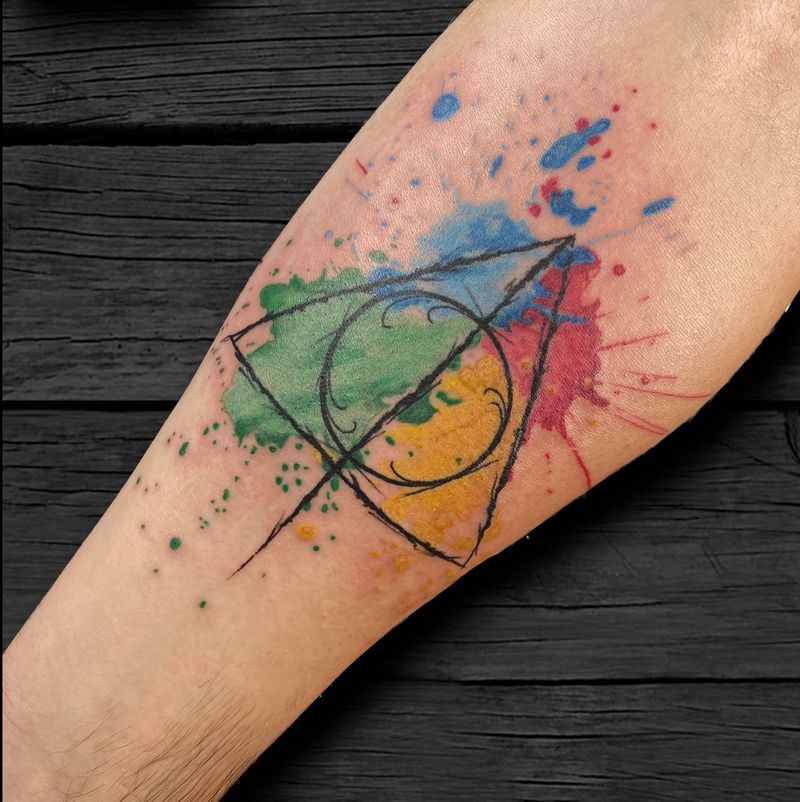
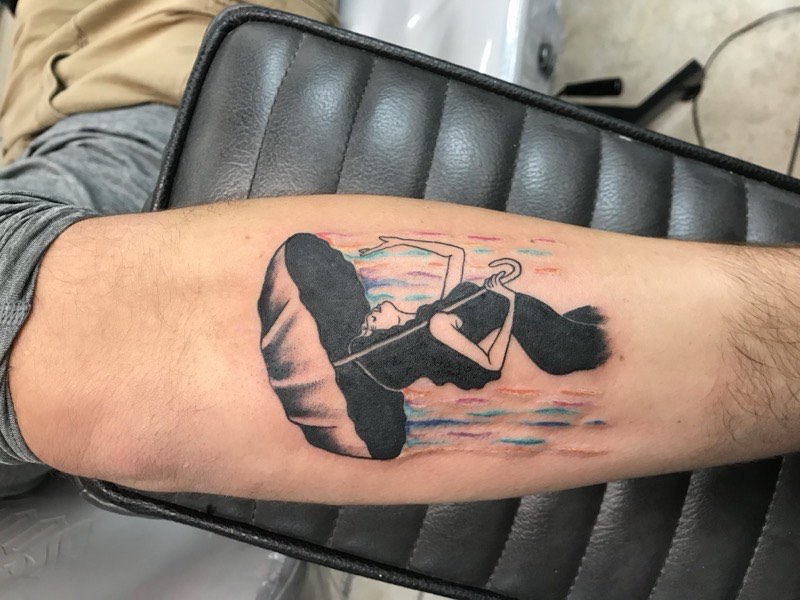
Everything turns on a decision made before the first line goes down: black underneath, or none at all. With a black skeleton the piece keeps its shape for decades. Without one, you are betting on soft edges that have nothing holding them in place.
Book a consultationEdges, or none
Pigment without an edge.
Watercolor is best understood as a disciplined inversion of what traditional tattoo craft was engineered to do. The wrong moves, executed on purpose, by artists who know exactly which rules they're breaking.
Where American traditional was built around bold outlines, saturated solid packs, and black as a structural skeleton — choices optimized to survive forty years in skin — watercolor deliberately removes those guardrails. Broken outlines, pigment flicked past the design boundary, gradient passes that fade into bare skin rather than resolving into a shape. These are not accidents of skill level; they are the style's defining vocabulary.
At the needle, watercolor almost always lives on curved magnums — 9CM, 11CM, 13CM configurations — for laying color in overlapping washes without hard tracking lines. The curved mag's soft edge is why it's the default wash tool. Pigment is loaded lightly; passes are stacked to build density gradually rather than packed solid in a single round. For any residual linework or structural anchoring, artists drop to a 1RL or 3RL. A surprising number of watercolor specialists still do some line or dot-stippled structure even when the finished image reads as linework-free.
Splatter technique — whip-shading or flicking pigment outward beyond the nominal design boundary to mimic a brush-spray — is the signature move. It reads as chaos and costs the artist a reference drawing's worth of control. Most serious watercolor artists pre-compose splatter zones on a stencil, so the \u201Crandomness\u201D is actually bounded. Rotary machines dominate the style because rotaries give the consistent soft hit and low trauma needed to stack thin pigment passes without blowing out the skin.
One framing worth naming up front: watercolor is arguably the first tattoo style essentially built for the photograph. It rewards the camera more than the room — which is both its commercial engine and the source of most of the craft community's skepticism.
The central debate
With or without a black underlayer?
The single most important craft decision inside watercolor, and the question that decides how your piece ages. Artists sort into three camps — you'll want to know which one you're sitting with.
The black-skeleton school
Watercolor must have a structural underlayer — full underdrawing, ghost-line, or restrained black network inside the composition — to age well. Color migrates and softens; black holds shape.
The argument. The black skeleton is why the piece still reads at year fifteen. A piece engineered without a dark anchor risks reading as bruise-like softness after a decade of sun, immune response, and pigment diffusion.
How to spot it. The artist's portfolio shows visible but light linework anchoring the wash. Healed pieces at 5+ years still show compositional bones.
The pure-wash school
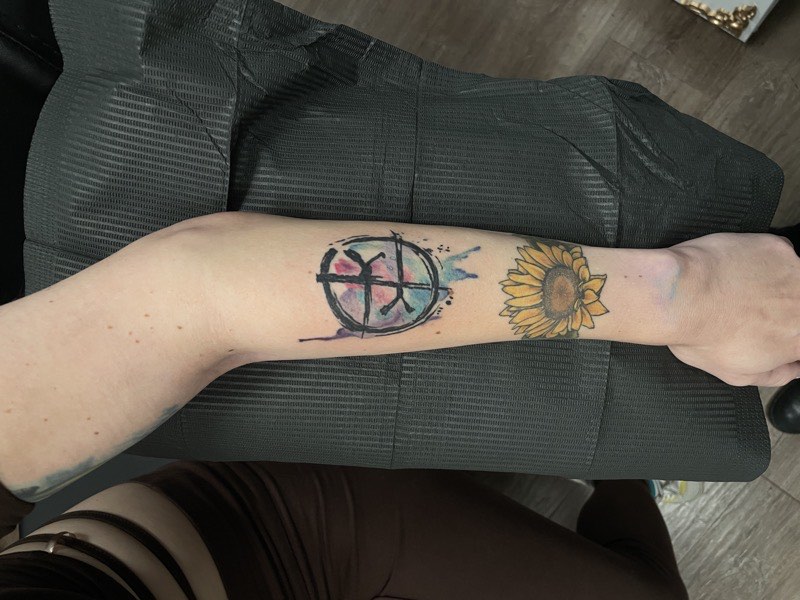
Modern pigment density and disciplined packing can carry the image alone. A visible black underlayer compromises the aesthetic the client came in for — and the fresh-work photography this style is built for.
The argument. The point of watercolor is to look like watercolor. Black linework subtracts from the style's reason for existing. Skews younger, more aesthetically purist — and extremely photogenic in year one.
How to spot it. Portfolio features splashes and washes with zero visible line structure. The healed work at 2+ years is where the bet gets evaluated.
The subtle-keyline compromise
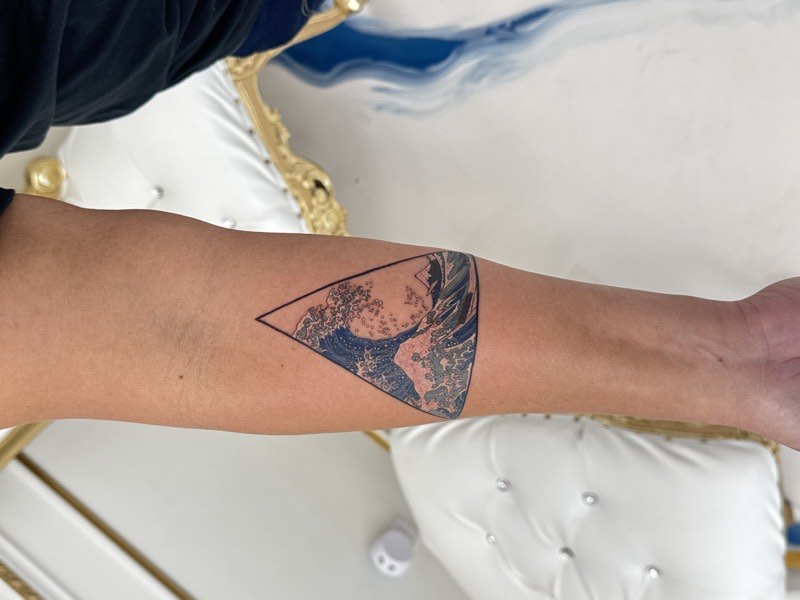
A near-invisible keyline — sometimes in dark brown, burgundy, or desaturated navy rather than true black — gives the piece a structural backbone without the visible outline the style is trying to escape.
The argument. Where most experienced, career-oriented watercolor artists actually live. The quiet hedge. Clients who know to ask for it are usually asking the right question — the piece ages well AND reads as watercolor on day one.
How to spot it. Portfolio shows wash pieces where, on close inspection, a faint non-black line network is holding the composition. Look specifically at healed work 5+ years in.
How to tell which school an artist belongs to before the consultation: look at their 5-to-10-year healed photos, not their fresh work. Fresh watercolor all looks like watercolor. Healed watercolor tells you whether there was a skeleton underneath.
Short history
A recent style with a short history.
Watercolor's lineage is short and traceable — a handful of genre-defining artists who established that a tattoo could be read as a brushstroke rather than an illustration.
The formative figure
Amanda Wachob
Based in New York, widely credited as the style's formative figure — particularly for the abstract, splash-heavy end of the vocabulary. Pushed watercolor into gallery-adjacent territory; her work has been discussed in contexts closer to contemporary painting than conventional tattoo shop culture. Established that a tattoo could be read as a brushstroke rather than an illustration.
The viral moment
Ondrash (Ondřej Konůpčík)
Czech artist widely credited for the expressive realism-watercolor hybrid that went viral across tattoo social media in the mid-2010s. Ondrash's work is where most clients first encountered the \u201Cpainting on skin\u201D aesthetic that drove watercolor's commercial explosion.
The East Coast experimenters
Gene Coffey & contemporaries
Among the earlier New York artists working in a watercolor vein, part of the East Coast color-experimentation cohort that preceded the style's mass moment. Worth naming because watercolor wasn't invented on Instagram — it was brewing in a handful of shops years before social media made it a category.
The cross-style practitioners
Wardin, Unisex & the hybrid wave
Deanna Wardin, Los Angeles-based, bridges watercolor into color realism and is one of the West Coast reference points for the style. Sasha Unisex, Russian-origin, built a distinct lane merging geometric underlayment with watercolor washes — her work is often cited as evidence that watercolor is better understood as a technique that crosses styles than as a style in itself.
The meta-debate worth naming: is watercolor a style at all, or a technique that attaches to other styles? Neo- traditional watercolor, illustrative watercolor, realism-watercolor hybrid. This matters at consultation — the artist you sit with has an opinion, and their answer determines how your piece will be engineered.
What survives paint
What survives being painted.
Watercolor has a narrower range than first-time clients often assume — but within its native territory, nothing else comes close.
Florals & botanicals
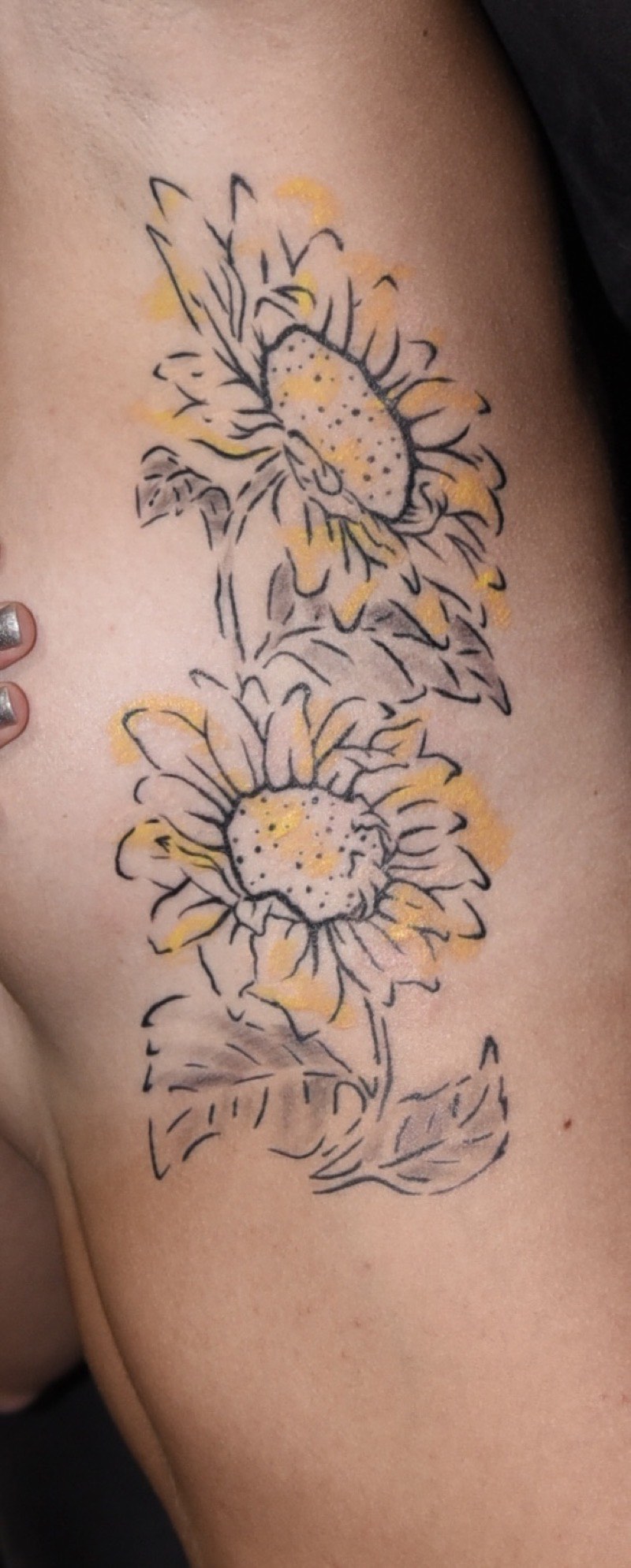
Watercolor's native territory. Single-stem peonies, roses, wildflowers, and trailing botanicals translate because soft petal gradients are exactly what the medium does best. Single-bloom compositions with a trailing leaf-green wash carry better than dense bouquets — watercolor's strength is breath, not density. Single-stem over clustered every time.
Abstract splashes
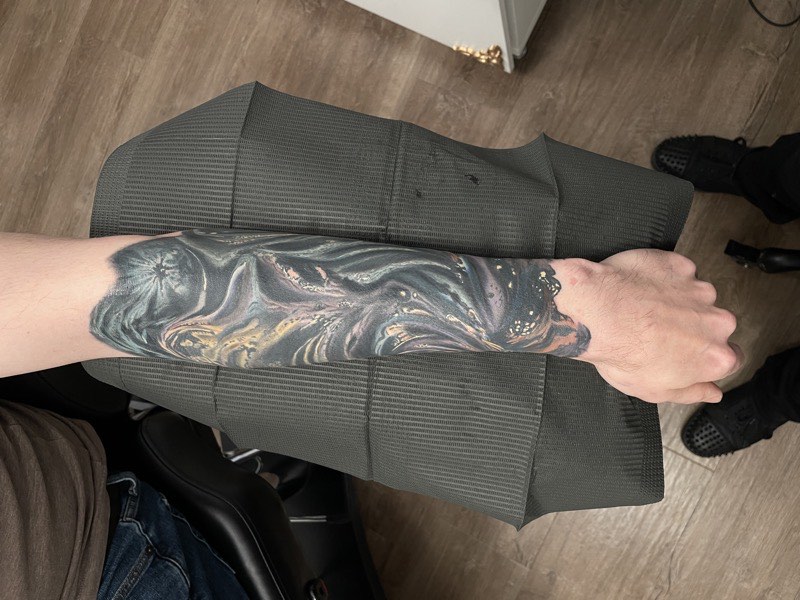
Where watercolor stops imitating and becomes itself. Pure color fields — a three-tone wash across a shoulder blade, a ribboned gradient down a forearm — are non-representational pieces where the subject IS the color behavior. These pieces live or die on palette intentionality. Nothing else to hide behind.
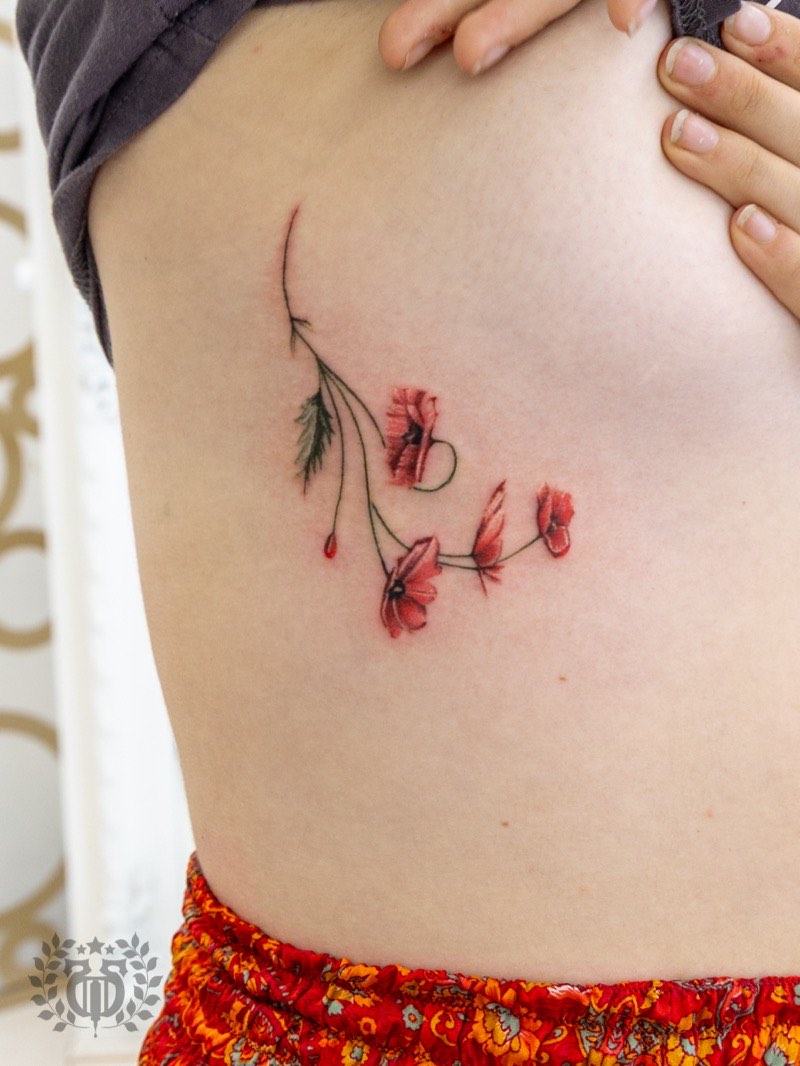
Expressive birds
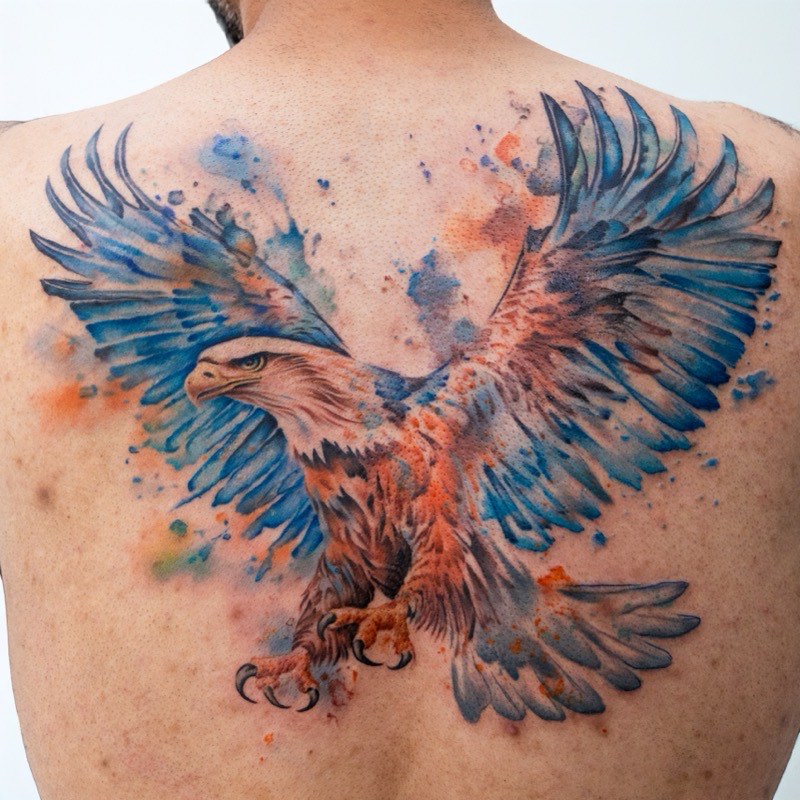
Hummingbirds (wings dissolving into motion-blur splatter), songbirds, stylized eagles. A minimal ink skeleton and a wash body that suggests feather rather than depicts it. The bird becomes an emotional gesture more than a zoological study — and watercolor is uniquely suited to that shift.
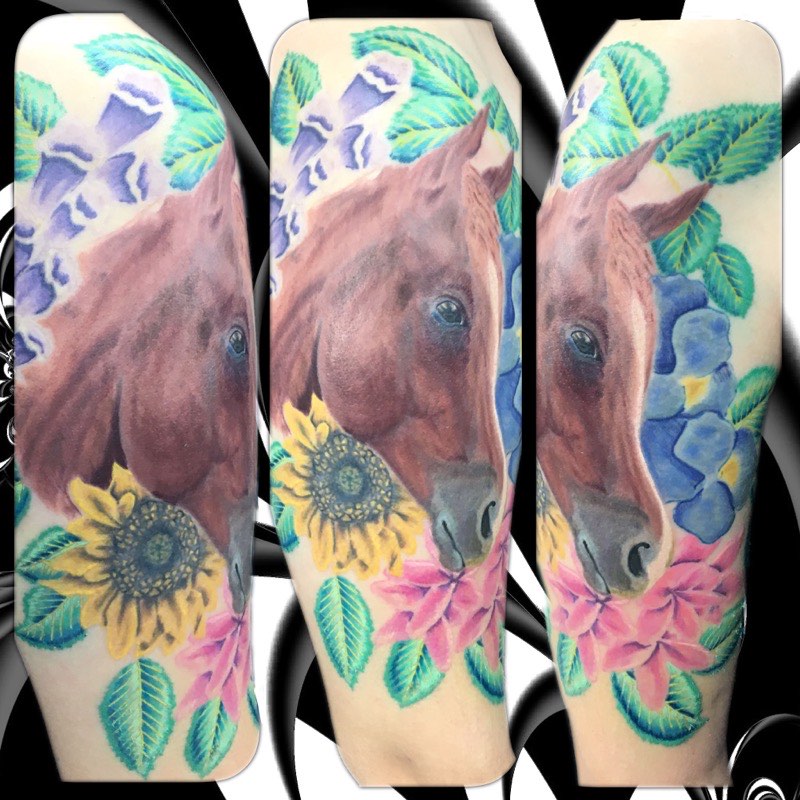
Emotional animals
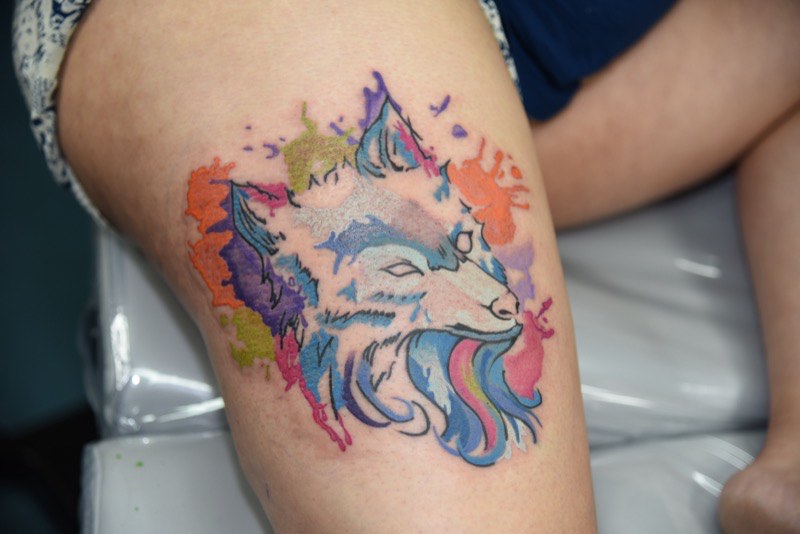
Wolves rendered as the feeling of wolf. Horses mid-gallop dissolving into color. Works when the goal is mood. Realism-adjacent animal portraits — every whisker, every eye glint — fight the medium. The question is always whether you want the animal or the feeling of the animal.
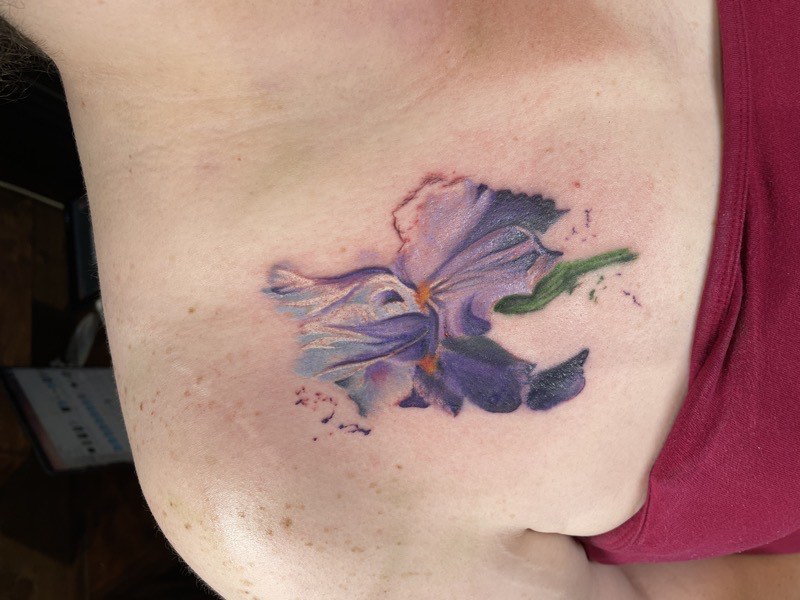
Butterflies & insects
Wings are already translucent, patterned color fields in nature — watercolor is almost documentary here. A butterfly with a light keyline body and wings rendered pure wash reads as the thing itself, not as an illustration of it. Dragonflies and certain beetles work the same way.
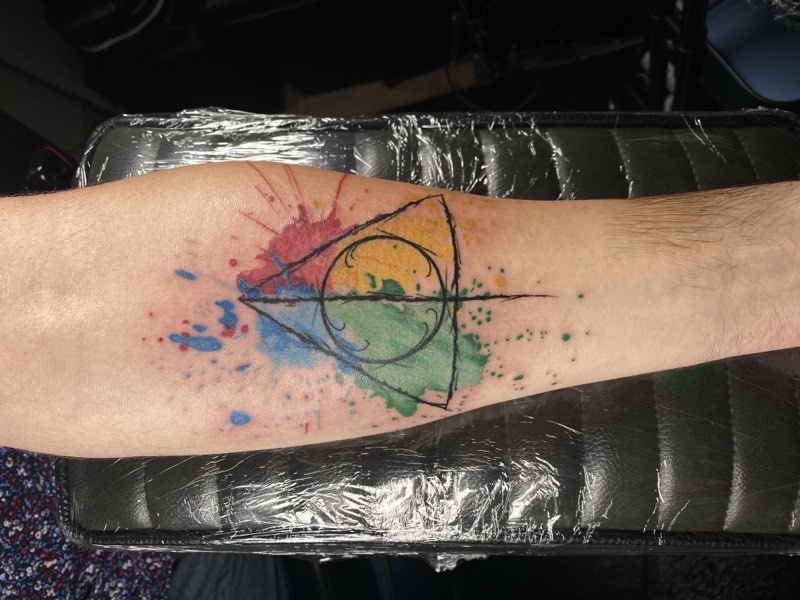
Galaxy & cosmic
Nebulae, starfields, color-drenched deep space. Went viral through the mid-2010s for good reason: space is literally a wash of color with point lights, which is exactly what watercolor does. Pure wash with stippled star anchors, often at larger scales for composition to breathe.
Feather with dissolve
Works when the feather itself is structured — keyline spine, a few barb lines — and the dissolution into color is the visual payoff. The composition has to earn the splash; the feather has to read as a feather before it reads as color.
Portrait + watercolor overlay
The hybrid move — a black-and-gray structural portrait overlaid with watercolor splashes. Sidesteps the realism conflict entirely: the portrait carries likeness, the watercolor carries emotion. A legitimate hedge, and often the right answer for clients who want color without giving up recognizable form.
The trade-off
The trade-off nobody advertises.
Certain subjects refuse to be painted, regardless of the hand. These are the requests where the style fails the subject — not because the artist chose wrong, but because style is not a filter.
Realistic portraits
The face reads through edge precision; watercolor is about edge dissolution. The two are philosophically opposed. Attempts land in uncanny territory — not a portrait, not a watercolor.
Traditional tattoo iconography
Swallows, daggers, pin-ups, nautical stars were designed for bold outline and flat color packing. Rendered in watercolor, they read as costume, not style choice — neither traditional nor convincingly watercolor.
Script & lettering
Text needs edge clarity that watercolor deliberately breaks. Watercolor lettering almost always looks like the tattoo bled, not like an aesthetic decision — even when the artist intended the loose read.
Geometric & sacred geometry
Mathematical precision is the opposite of watercolor's ethos. Geometry built on bleed reads as a mistake; the style's foundation is edge clarity.
Heavy cover-ups on dark ink
Watercolor's low pigment density can't out-value dark existing ink. Cover-ups need saturation and structure, which is precisely what watercolor deliberately lacks.
Pieces that must read across a room
Watercolor is intimate, read-up-close work. Chest pieces meant to carry bold visibility will fail — the style whispers; it doesn't announce.
Floors and ground
Scale is the first decision, not the last.
Small watercolor reads as accident. The rules below are the floor below which the medium and the design start fighting each other.
Floors for wash without a keyline
Smaller than this, the splash reads as a stain rather than intentional composition. Watercolor's low pigment density needs canvas to breathe.
The bloom and the wash need separate breathing room. Below this, the two elements collapse into a single unreadable color patch.
For the composition to read as designed rather than accidental. Abstract work depends on compositional rhythm, which needs scale.
Usually requires a structural underdrawing to hold the composition together. Sleeve-scale watercolor without an armature tends to dissolve visually.
Where wash keeps its shape longest
- Upper arm / bicep. Flat canvas, visible daily, consistent skin — watercolor's go-to placement.
- Outer forearm. Good read, good canvas — watch sun exposure carefully and commit to SPF.
- Shoulder blade. Best for soft-color compositions that don't need to fight body contour.
- Thigh. Large canvas for expressive pieces, low friction, ages as well as watercolor can anywhere.
- Upper chest. Works for floral and expressive animal pieces; fits the intimate read the style calls for.
- Outer calf. Flat, moderate sun, great for compositional watercolor that needs scale.
Where wash has nothing to hold
- Fingers, hands, wrist. High turnover fades watercolor fastest here; tiny splashes look like ink stains.
- Feet. Friction destroys the wash within years — the single worst placement for this style.
- Ribs. Constant skin movement blurs watercolor's already-soft edges faster than any other placement.
- Neck. Not enough canvas for a composition to breathe.
- Direct-sun placements. Top of shoulder, back of hand — UV destroys watercolor pigments faster than it destroys any other style.
The fade curve
The fade curve, without spin.
Watercolor moves through a more pronounced aging arc than almost any other contemporary style. Understanding the honest curve is the single most useful thing a prospective client can do before booking.
Initial settling
What looked bright, wet, and loose at day seven quiets down. Pigment beds into the dermis, the top-layer sheen disappears, colors darken a touch, splash edges soften slightly. At the six-month mark the piece reads a little more contained than it did the day it was photographed. This is normal and expected.
First divergence
Watercolor's signature aging pattern starts surfacing. Edges diffuse a little further into surrounding skin. Less-stable pigments — the bright reds and yellows watercolor relies on — show their first perceptible shift. A piece balanced at year two may now lean slightly cooler or warmer depending on which pigment family moved first.
The inflection point
This is where the longevity debate becomes tangible. Pieces built without any structural anchor — pure wash, no keyline, no dark value holding composition — can start reading as bruise-like softness if the artist didn't plan for fade. Pieces with a subtle structural element continue to read as intentional composition even as color shifts underneath.
Rework territory
A decade-plus watercolor piece almost always benefits from rework unless it was executed at substantial scale with planned touch-ups along the way. Small watercolor pieces frequently read “muddy” by year twelve because there was never enough pigment volume to survive a decade of fade.
Twenty years in, honestly
Very few watercolor pieces completed before 2015 have aged into something that still looks like the original reference. That isn't a failure of the style — it's an honest reflection of pigment chemistry, sun exposure, and the fact that watercolor as a distinct modern style is still young. Modern pigments are meaningfully more stable; 2025-era watercolor will age better than 2015-era did.
Four structural reasons stack on top of each other: no structural outline by design (most styles rely on a keyline to carry the image as color shifts; watercolor deliberately removes that anchor); photobleaching hits color hardest (UV degrades color faster than carbon black, and watercolor is overwhelmingly color); the style's favorite pigments are the least stable (bright reds, yellows, whites — watercolor's backbone — are also the fastest-fading pigment families); and splash naturally diffuses (loose-edged pigment blooms slightly over decades). Modern pigments have improved this, but the fade curve is still the steepest in the trade.
Watercolor in the wild
With and without the keyline.
Structure table
Subject → scale → placement → structure.
Where the structure decision actually gets made. The Structure column is watercolor-specific and important — every row is a starting point, not a rule.
What clients hold
Five assumptions we test.
The assumptions watercolor clients arrive holding. Not judgments — framing for the next tattoo.
“Watercolor looks softer because the pigment is softer.”
It isn't. The technique and needle time are comparable to any other color work. The “softness” is a composition choice, not a pain or pigment advantage.
“I want watercolor because I want color that looks natural.”
Watercolor's bleed is deliberately un-natural — it's a stylized effect, not a realism technique. If you want color that looks like the reference, you want color realism, not watercolor.
“Small watercolor on the wrist is cute.”
It's usually a five-year regret piece. The scale fights the medium, the placement accelerates fade, and what was delicate at day one reads as an ink stain by year five.
“Any style can be “watercolored.””
Style is not a Photoshop filter. Many designs fundamentally resist watercolor treatment — realistic portraits, traditional iconography, script, geometric work all lose their identity inside the wash.
“I want it to look organic — no plan.”
Controlled looseness requires more planning, not less. The splatter looks random; the splatter is never random. Specialists pre-compose splatter zones on the stencil.
Finding honesty
Finding an honest watercolor artist.
Watercolor demands specialization more than any other modern style. The aging curve is the steepest, the controlled-chaos aesthetic requires the most discipline, and color theory matters more here than almost anywhere else in tattooing.
What honest watercolor work shows
- Multi-year healed pieces (5+ years) that are faded but still readable
- Clear articulation of structural approach — pure wash vs subtle keyline — and why for your piece
- Transparent touch-up philosophy and realistic maintenance cadence
- Range of scales in the portfolio — micro through sleeve-scale
- Specific language about pigment choices and color stability
- Willingness to show year-5 examples alongside year-1
- Has declined watercolor projects when the subject didn't fit
Reasons to be cautious
- Portfolio shows only fresh / wet-ink photos — no healed documentation at any age
- Flat stylized color being passed off as watercolor technique
- Splatter that ignores anatomical boundaries and body curvature
- No healed examples of the specific subject category you want
- Single-color “watercolor” pieces — often signals weakness with color relationships
- “Any style” marketing — the highest-risk claim for this style specifically
- Artist can't articulate structural approach — pure wash, keyline, or hybrid
Seven questions worth asking
- What watercolor of yours is at least two years healed, and what has it done since?
- What's your structural approach — pure wash or subtle keyline — and why for my piece?
- Which pigments do you use, and how do you think about color stability?
- What's a realistic maintenance cadence for this piece over ten years?
- At this size and placement, what are you honestly recommending and what would you talk me out of?
- Have you ever refused a watercolor project? What was the situation?
- What does your work look like at year five vs year one — can I see an example?
An artist who answers all seven without defensiveness is a specialist. An artist who deflects on structural approach or healed-work documentation is telling you something.
FAQ
Watercolor, honestly asked.
Seven questions about a style whose entire argument is about whether there is black underneath.
How long do watercolor tattoos actually last?
Modern watercolor done by a specialist, with sun protection and planned touch-ups, still reads at fifteen to twenty years — softer, shifted, but recognizable. What you shouldn't expect is for a watercolor piece to look the same at year fifteen as at year one. The honest expectation is touch-ups every four to six years and a more pronounced aging curve than any other style. Clients who commit to the maintenance relationship end up with pieces they love a decade in. Clients who thought the first session was the whole commitment end up disappointed.
Do watercolor tattoos need a black outline to age well?
This is the central craft debate inside the style, and artists sort into three camps: the black-skeleton school (yes, always), the pure-wash school (no, modern pigment carries it), and the subtle-keyline compromise where most career-oriented specialists actually live. The quiet answer most experienced watercolor artists use is a near-invisible keyline — in dark brown, burgundy, or desaturated navy rather than true black — that gives structural backbone without the visible outline the style is trying to escape. Ask your artist which camp they belong to at consultation; it decides how your piece ages.
Why do watercolor tattoos fade faster than other styles?
Four reasons compound. First, there's no structural outline by design, so nothing carries the composition when color shifts. Second, photobleaching hits color pigments harder than carbon black, and watercolor is overwhelmingly color. Third, the style's signature palette (bright reds, yellows, whites) happens to be the least lightfast pigment family in tattooing. Fourth, loose edges naturally diffuse as skin moves over decades — watercolor's defining feature is also its aging pattern. Modern pigments from Eternal, World Famous, and Solid Ink have improved this meaningfully, but the fade curve is still steeper than any other major style.
What pigments fade first on a watercolor piece?
White highlights almost always disappear within a few years — plan compositions that still read when they're gone. Anthraquinone reds (the bright, clean reds) fade next; you'll often see them shift toward pink or orange before disappearing. Organic yellows typically shift muddy or warm-green. Blacks, earth tones, and some modern blues hold longest, which is why even a subtle structural element in those colors dramatically extends how long the piece reads as designed.
How often will I need touch-ups on a watercolor tattoo?
Budget for a settling touch-up at three to six months — not optional for watercolor; it's how the artist punches back the spots that didn't take during healing. The first major touch-up typically falls at year four to six, shorter than most styles. After that, plan for a refresh roughly every four to six years for as long as you want the piece to read at full strength. The honest investment framing: the initial session is not the whole commitment. Committing to watercolor means committing to the maintenance relationship.
Can watercolor work on darker skin tones?
The style was developed largely on Fitzpatrick I–III skin and carries that bias in its reference library. On Fitzpatrick IV–VI, watercolor reads very differently, and the pigment families watercolor relies on behave differently against higher melanin. An experienced artist will often recommend adjusted palette choices — warmer tones, earthier colors, sometimes a different structural approach — rather than attempt a one-to-one translation. The best signal is an artist whose portfolio shows healed watercolor work across multiple skin tones, not just the ones the style was originally designed for.
Is watercolor a real tattoo style or just a technique?
Career tattooers remain split on this, and it matters at consultation. Some call watercolor a style — a distinct genre with its own vocabulary, just like traditional or Japanese. Others call it a technique that crosses into other styles (neo-traditional watercolor, illustrative watercolor, realism-watercolor hybrid). The answer affects how your piece is engineered. An artist who treats watercolor as a style will build compositions watercolor-first. An artist who treats it as a technique will build a piece in another style's bones and layer watercolor treatment over it — often the right move for longevity. Ask the question at consultation.
The structure question first
Bring the reference, the structural preference, and an honest maintenance commitment.
Watercolor is a specialist's craft and a maintenance relationship. Bring the reference, the subject, the placement, and a realistic view of how often you will come back for touch-ups. Then we settle the black question first, because palette, scale and touch-up cadence all follow from that one decision.