Tattoo Ideas
Sacred Heart Tattoo Meaning & Ideas
What a Sacred Heart tattoo means, element by element — and the twelve design directions, six styles and placement decisions that follow from it.
Book a consultationThe short answer
What does a Sacred Heart tattoo mean?
A Sacred Heart tattoo means love that cost something — the heart of Christ, shown wounded and still burning. It is a Catholic devotional image, popularised after the visions of St. Margaret Mary Alacoque at Paray-le-Monial in 1673, and every part of it is legible: the crown of thorns is the Passion, the flame is divine love, the lance wound is Calvary. On skin it usually carries a second, personal reading on top of the devotional one — a mother, a loss, a vow, a year survived, a faith kept or rebuilt.
Two things settle most of the design before style or placement. First, whether you are wearing the Sacred Heart of Jesus (thorns, cross, flame, lance wound) or the Immaculate Heart of Mary (roses, a sword, sometimes a crown of stars) — they are separate devotions and we don't blend them on one heart. Second, what the piece marks for you, in one sentence. Everything below is the long version: the elements decoded, twelve design directions, six styles, placement, scale and the mistakes worth avoiding.
The iconography
What does each element of a Sacred Heart tattoo mean?
The Sacred Heart is a compound symbol, not a decorative one. Each element says something specific, and leaving one out changes the sentence. This is the decode we walk through in consultation.
| Element | What it means | Design note |
|---|---|---|
| Crown of thorns | The Passion — suffering accepted rather than avoided. On secular pieces it still reads as love that cost something. | Drawn as a continuous woven band, usually seven to nine visible thorns, wrapping once or twice. |
| Flame | Divine love and fervour — love that burns rather than merely persists. | The element most often shrunk to fit a small piece. Shrink the banner instead; the flame carries the reading. |
| Lance wound | The piercing of Christ's side at Calvary. Openness at cost; the heart is not sealed. | Small, off-centre, usually upper right of the heart. Easy to lose below three inches. |
| Cross above the heart | Sacrifice — the explicitly Christological marker. Its presence is what makes the piece unambiguously devotional. | Omit it if you want the image to read as personal rather than confessional. |
| Rays / sunburst | Grace radiating outward — the heart as a source, not a container. | Adds three to four inches of footprint. Decide before placement, not after. |
| Roses | Devotion and tribute. In Marian imagery, roses and white lilies belong to the Immaculate Heart. | Commonly one rose per person being honoured. Say the count out loud before the stencil. |
| Banner | Naming — a person, a date, a vow. What turns a devotional image into a memorial one. | Text sets the minimum size of the whole piece. Write the exact words before scaling anything. |
| Sword (Mary) | Simeon's prophecy in Luke 2 — "a sword shall pierce through thy own soul." Grief carried, not resolved. | Belongs to the Immaculate Heart of Mary. Do not combine it with the crown of thorns on one heart. |
| Crown of twelve stars | Marian attribute, from the woman crowned with twelve stars in Revelation 12. | Optional on Immaculate Heart pieces. Needs six inches or more to stay countable. |
Flash · ready to ink
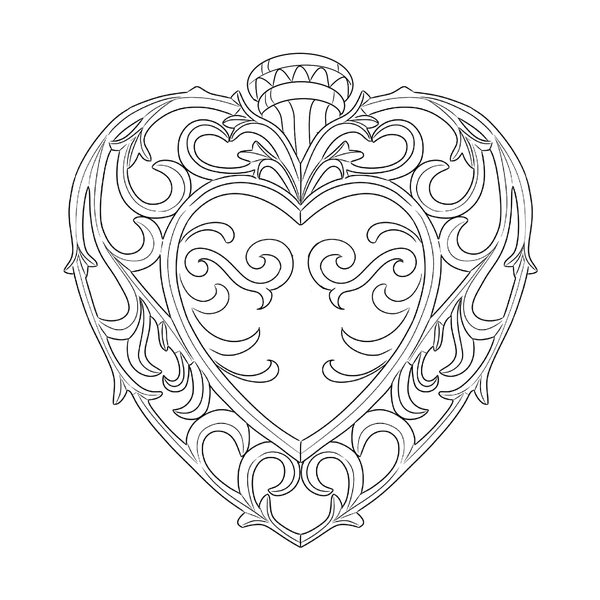
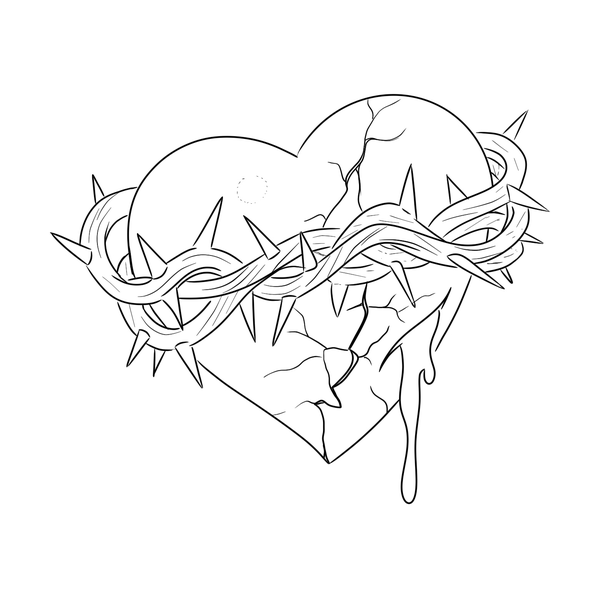
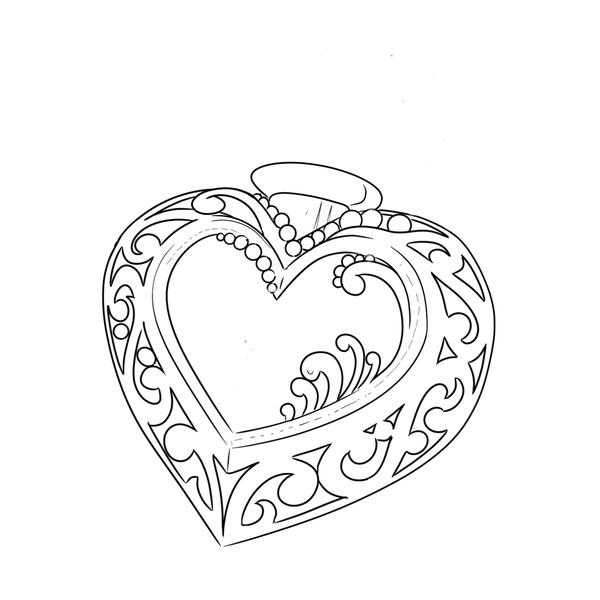
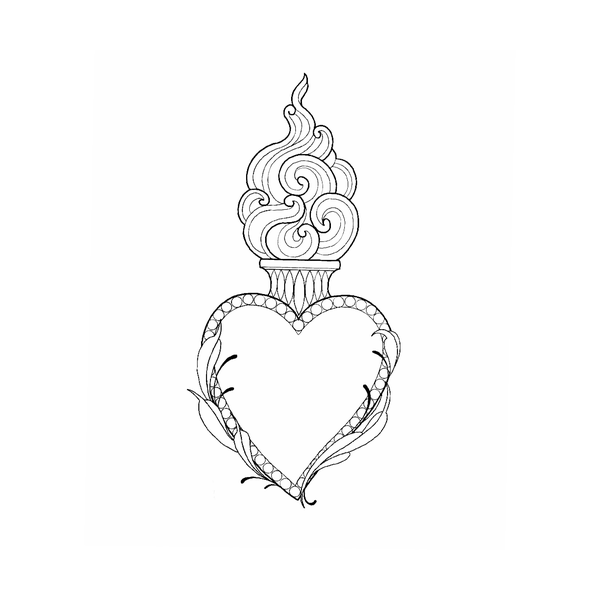
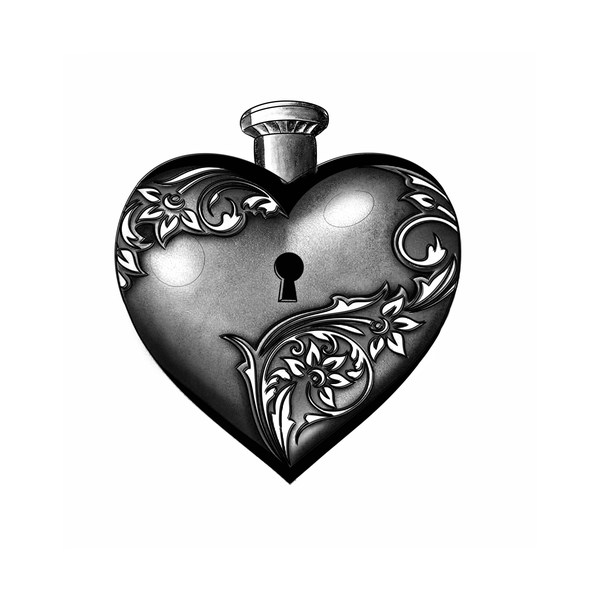
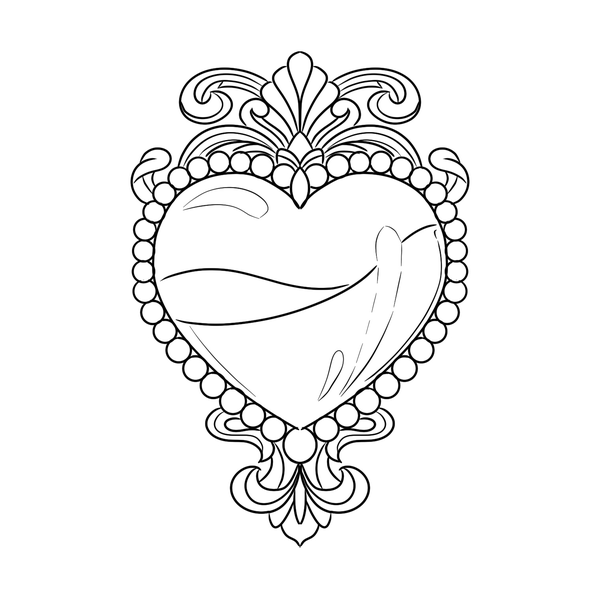
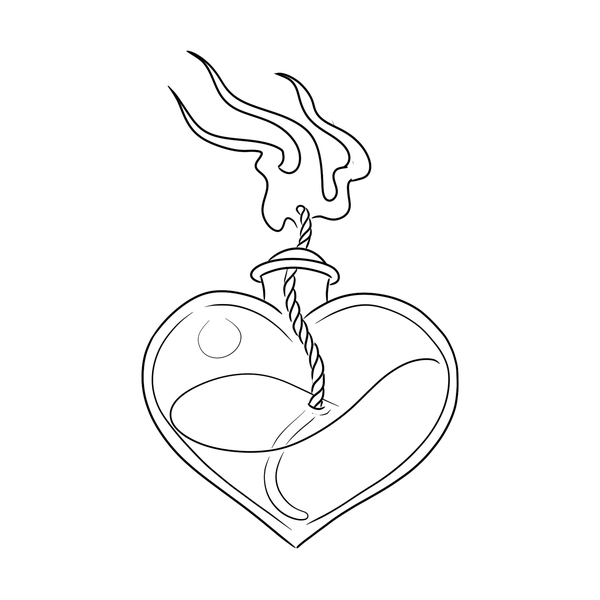
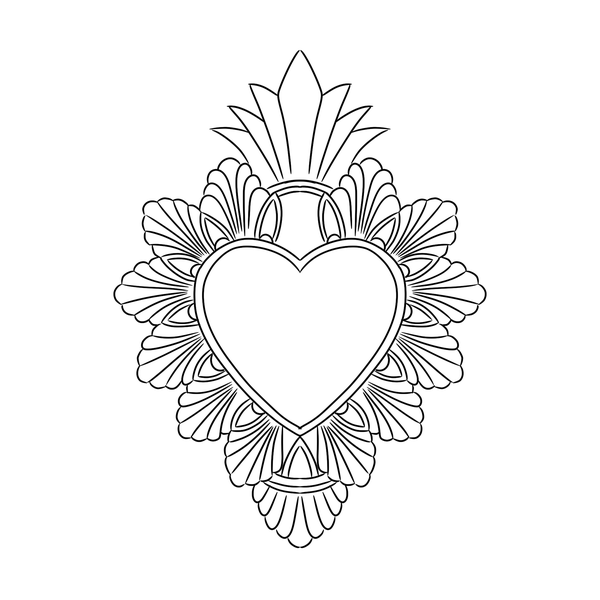
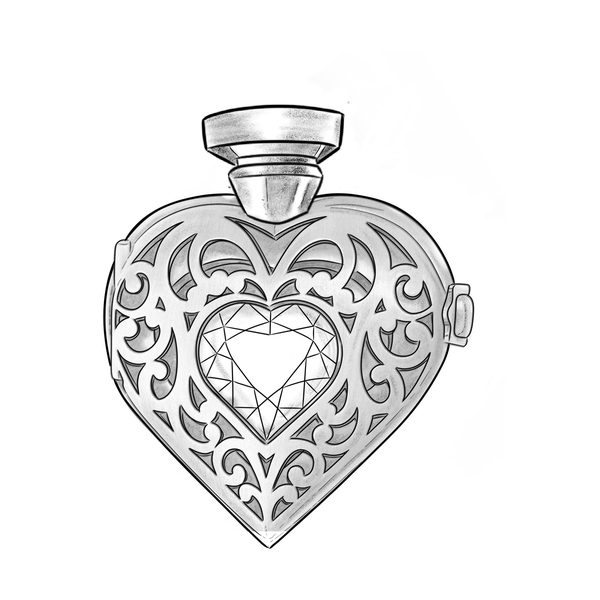
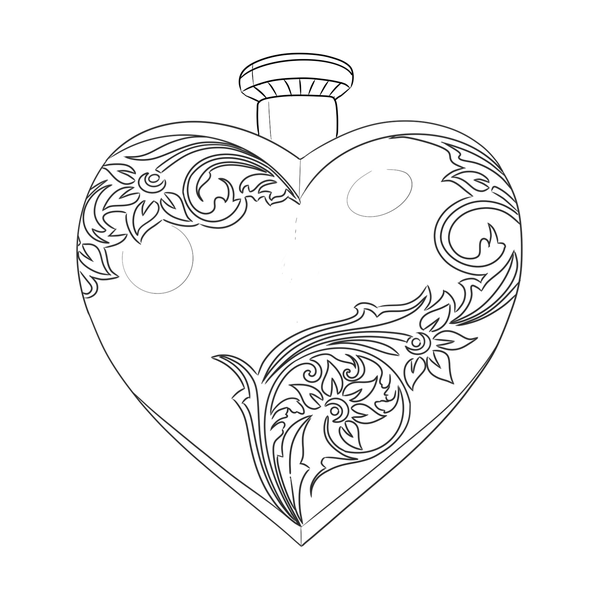
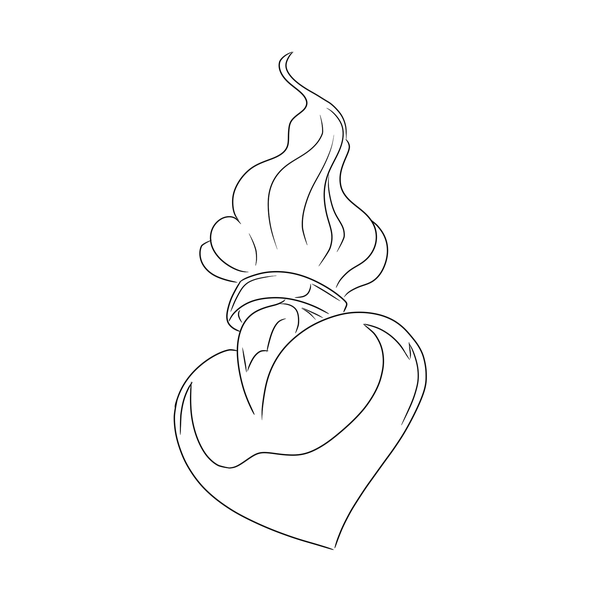
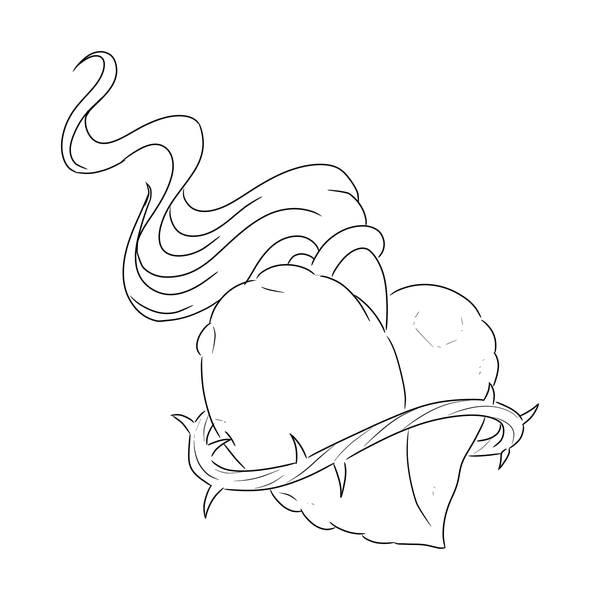
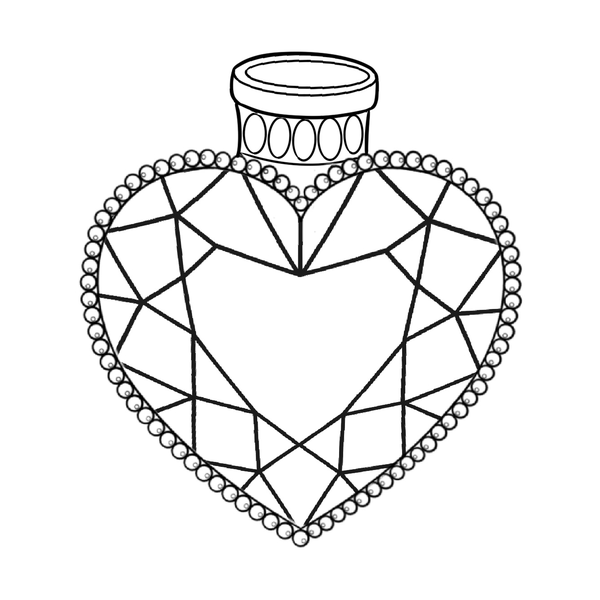
Sacred heart flash designs
15 hand-drawn designs from our flash collection — book any one as-is, or use it as the starting point for a custom piece. Sizing, placement and linework dialed in at your consultation.
Where the image came from
Two separate routes carried this image into tattooing.
The Sacred Heart did not arrive in a tattoo shop by one road. It came through Catholic devotional printing: holy cards, scapulars, framed enthronement prints hung in a front room. From there it went into two tattoo traditions that developed largely independently of each other and still look nothing alike. Knowing which one your reference belongs to is the difference between a Sacred Heart drawn correctly and one assembled from parts.
The devotion, and roughly when it standardized
The modern devotion to the Sacred Heart took its recognizable form after the visions reported by St. Margaret Mary Alacoque at Paray-le-Monial in the 1670s, and it was carried outward largely by the Jesuits. The feast was extended to the whole Church in the nineteenth century, and that is the period in which the visual formula settles: heart, flame, crown of thorns, lance wound, cross above, rays behind. Once it settled, it stopped drifting. A holy card printed in 1890 and one printed in 1990 show the same arrangement, which is why the iconography is worth getting right rather than reinventing.
Route one: the flash sheet
American shop flash absorbed the Sacred Heart the way it absorbed everything else, simplifying it to what a bold outline and four flat colors could carry. Thorns become a woven band of repeated hooks. The flame becomes three or five tongues rather than a fire. Rays become straight spikes. It is a translation, not a copy, and it is a good one: it reads across a room and it holds for forty years. What it does not do is look like the card your grandmother kept in her missal.
Route two: black-and-grey, and Southern California
The other lineage runs through Mexican Catholic imagery and into the fine single-needle black-and-grey work that developed in Southern California, closely associated with East Los Angeles shops in the 1970s. Good Time Charlie’s Tattooland is the address most often named in that history. That tradition keeps the holy card rather than translating it: soft grey wash, delicate thorn work, the flame rendered as light instead of shape. It asks far more of the artist and it is far less forgiving of a shortcut. It is also the version most people from Catholic families recognize as correct.
Your family’s holy card is the best reference in the room
Clients regularly bring a phone full of saved images and forget the one object that would settle the drawing in a minute. If there is an estampita in a wallet, a prayer card from a funeral, a print that hung in a grandparent’s hallway, photograph it and bring it. It tells the artist which lineage you actually mean, which elements matter to you, and often which ones you would notice were missing without ever having been able to name them.
If you were not raised in it
People ask, and the honest answer is that the studio will draw it and will draw it accurately. A Sacred Heart worn without the faith behind it is still legible as what it is: love that cost something, a heart shown wounded and still burning. What we will not do is fix it halfway: borrow the crown of thorns but drop the flame, or hang a sword on Christ’s heart because it looked good in a reference. Wear the image or wear a different one. Ignorance is the only disrespect available here, and it is entirely avoidable.
Red is the pigment this design depends on
Almost every route into this image puts red at the center of it, and red is the color most likely to fade unevenly, to sit stubbornly through healing, and to need a touch-up sooner than the black around it. Ask the artist how their red has held on other Sacred Hearts at the five-year mark, and ask specifically about your skin. On some skin the honest answer is that black-and-grey will look better in a decade than color will, and that is not a downgrade. It is the whole Chicano lineage.
Narrowing the devotion
Whose heart, in which tradition, and how much of the iconography do you keep?
Every Sacred Heart consultation at Apollo starts the same way: five questions, asked in order, each one narrowing the design space by half. Answer them honestly and you save yourself an hour of sketch revisions and a bad first draft.
Faith kept, faith left, or someone you lost?
Every Sacred Heart we book at Apollo marks something — a vow, a loss, a survived year, a faith held or rebuilt. Before we draw anything, we ask you to say it out loud in one sentence. If you can't finish that sentence, the design won't land. We'd rather push your booking a month than ink a placeholder.
Jesus, Mary, or neither figure?
Sacred Heart of Jesus (crown of thorns, cross, flame, lance wound) and Immaculate Heart of Mary (roses, sword, flame, twelve stars) are two separate devotions — we don't blend them on one heart. A secular anatomical heart with flames and a banner is a third path. Pick one before the consult; switching mid-design usually means restarting.
Traditional American or Chicano?
American Traditional runs bold black line, saturated red and yellow, flat fills — built to hold for thirty years. Chicano black-and-grey runs single-needle, soft smoke shading, often a Mary face inside the heart — the Jack Rudy and Freddy Negrete tradition out of East LA. Different artists, different chair time, different aftercare. We staff both. We don't mix the two on one piece.
Visible daily or mostly private?
A forearm Sacred Heart talks to every client, cashier, and in-law you meet. A sternum or upper-thigh heart talks to you and whoever you let in. Neither is more devoted — we've tattooed both on nuns and on bikers — but the placement decision changes size, line weight, and how much explaining you're signing up for.
How much real estate can you give it?
A Sacred Heart under three inches loses the crown-of-thorns detail inside five years — we've seen it, we've covered it. If you only have room for a two-inch piece, we'll steer you toward a simple flame-heart instead of a full Sacred Heart. Give the devotion the space the devotion needs.
Pick the devotion before you pick the design.
A Sacred Heart under three inches loses the thorn detail inside five years. We've seen it. We've covered it.
Jesus and Mary are separate devotions. We don't blend them on one heart.
Twelve compositions
Twelve Sacred Heart compositions, and which tradition each belongs to.
Twelve compositional patterns cover almost every Sacred Heart we've booked in the last five years. They're not interchangeable — a Chicano single-needle Sacred Heart and a Sailor Jerry flash Sacred Heart aren't scaled versions of the same tattoo. They're different design languages.
Classic American Traditional Sacred Heart
Flame, crown of thorns, drop of blood
The heart most of the world knows — symmetrical chest organ wrapped in thorns, crowned with a five-tongue flame, one bead of blood. Bold 3/0 outline, Eternal Ink True Red for the heart, chrome green for thorn leaves, yellow highlight inside the flame. We tattoo this more than any other Sacred Heart, and it's the version we'll bet on aging correctly at year 30. If it's your first, this is the honest answer.
Chicano single-needle Sacred Heart
Black-and-grey, soft smoke, East LA tradition
Freddy Negrete and Jack Rudy tradition — 3RL single-needle, Solid Ink Greywash pulled light, often a Mary medallion inside the heart or a rosary wrapping the thorns. We push the smoke light so it reads delicate rather than muddy at year 10. A mid-scale Chicano Sacred Heart is a two-session piece and worth every minute of the second sitting.
Immaculate Heart of Mary
Roses, sword, lily — not thorns
Mary's heart, not Jesus's. Circled by roses instead of thorns, pierced by a sword (Simeon's prophecy from Luke 2), sometimes a white lily at the side. The composition is softer, more Marian. Neo-Traditional handles it beautifully — burgundy, dusty rose, Fusion Pure White for the lily, steel grey for the blade. Our most-requested variant from women in their 30s marking a conversion, a vow, or a mother.
Anatomical Sacred Heart
Real cardiac rendering with thorns and flame
Devotional imagery on an anatomically correct heart — ventricles, aorta, visible vessels, pulmonary trunk, all wrapped in a braid of thorns and topped with flame. We only take this as a 6-inch-plus piece because the anatomy collapses under that size. Black-and-grey realism is the default. We've steered more than one client away from adding color — it muddies the anatomy and thorns compete with vessels.
Memorial Sacred Heart with banner and dates
Traditional, name across the flame
The grief piece. A Traditional Sacred Heart with a scroll banner crossing over the flame or under the heart, one name and two dates. We set the name in a serif cap weight that will still read at year 20 — we've watched too many script memorials blur by year 8. If the person you're marking mattered enough for a tattoo, they mattered enough for a font that lasts.
Minimalist fine-line crown-and-flame
Sacred Heart reduced to essentials
Single-needle outline, no fill, the heart rendered as pure line with a three-tongue flame and a light thorn ring. Small, 2–3 inches, usually on inner forearm or sternum. Honest caveat — we like this as a second or third tattoo, not a first. Without fill, the design has no scaffolding, so sun and skin flex matter more. Plan a touch-up at year 6.
Sacred Heart with sunburst rays
Holy-card composition with radiating light
The heart centered inside a burst of rays — sometimes thirty-two, sometimes twelve, sometimes a halo that simplifies to dashes. Pulls directly from 19th-century Sulpician holy-card printing. Works in Traditional, Neo-Traditional, or illustrative. The rays anchor the heart on a flat panel like the sternum in a way a stand-alone heart cannot. Symmetry is everything; an artist who can't rule a straight ray field will ruin this design.
Sacred Heart with dagger
Thorns, flame, and a blade through center
One of the oldest Traditional compositions after rose-and-dagger. The heart pierced through the center rather than crowned with thorns alone. The dagger carries its own meaning — sacrifice, betrayal, the sword of sorrow. We run this Traditional or Neo-Traditional. Strong opinion: keep the dagger simple. Ornate hilt work on a 4-inch piece turns into visual noise within a decade.
Sacred Heart with banner across front
Latin motto or single-word declaration
A scroll banner crosses the face of the heart — 'Ave Maria,' 'In Hoc Signo,' 'Mater Dei,' or a single English word. Banner in front, flame and thorns behind. We draw these with the banner oversized relative to the rest of the composition rather than crammed in. A banner that doesn't read at arm's length is a banner we didn't build correctly.
Ornamental Sacred Heart medallion
Heart centered in dotwork frame
A Sacred Heart placed inside a mandala, filigree frame, or ornamental border — Byzantine feel, closer to devotional jewelry than flash. Dotwork and fine line do the frame; the heart itself stays simplified so ornament doesn't overwhelm it. We run this as a sternum or center-chest anchor, usually over two sessions. Most clients who book this one have sat through a smaller piece already.
Double Sacred Heart (Two Hearts)
Immaculate and Sacred, paired
Mary's heart and Jesus's heart, side by side — one crowned with roses and pierced by a sword, the other with thorns and flame. Traditional Catholic 'Two Hearts' pairing. A significant chest piece, not a starter. Needs 8 inches wide minimum to give each heart room to read as its own object. Our senior artists plan these from the first consultation; we won't take this as a same-day walk-in.
Sacred Heart sleeve anchor
Heart as the hub of a larger composition
The Sacred Heart planned from day one as the center of a half or full sleeve — roses, rosary, praying hands, script, radiating filler flowing outward. We book this as a four-to-eight-session commitment, starting with the heart and building outward session by session. The decision we press clients on: pick the heart style first and let everything else match it.
Six styles
Six styles, and how faithfully each keeps the iconography.
The Sacred Heart has been tattooed in every major style American tattooing has invented. The choice isn't which style you like most; it's which style matches how you'll wear the piece for the next thirty years.
American Traditional — flash-sheet Sacred Heart, bold and flat
Sailor Jerry flash, century of evidence
Bold 3/0 liner outline, Eternal Ink True Red heart, chrome green thorns, yellow flame highlight, 9mag for the red fill. Of every Sacred Heart we've laid in at Apollo, the Traditional ones still read correctly at year 30. If you've never been tattooed and you want a Sacred Heart, we'll point you here first.
Chicano black-and-grey — single-needle, holy-card fidelity
Single-needle, smoke wash, Jack Rudy tradition
The West Coast devotional style. 3RL single-needle work, Solid Ink Greywash pulled light, often a Mary face or rosary inside the heart. Freddy Negrete, Jack Rudy, and the Good Time Charlie's Tattooland tradition that built this style on Whittier Boulevard in 1975 — we sit squarely inside that history. Two sessions for anything over 5 inches.
Neo-Traditional — ornament stacked around the crown
Expanded palette, dimensional shading, Marian mood
Burgundy heart, dusty rose thorns, muted gold flame, soft grey rays. Where the Immaculate Heart of Mary lives most comfortably — Neo-Traditional gives you ornament and dimension without committing to realism. We run this with Fusion pigments for the mid-tones because they hold saturation longer than cheaper reds. Two sessions is standard for anything over four inches.
Fine line — the flame is the first element to go
The 2020s minimalist approach
Hairline work, minimal fill, the Sacred Heart reduced to its skeleton. 1RL or 3RL machines, Eternal Ink Lining Black, sometimes one muted red wash inside the heart. Honest caveat we tell every client — fine line on high-flex skin softens faster than Traditional. On sternum or inner forearm, it holds. On the side of the hand, it doesn't. We'll steer you off fingers and feet.
Holy-card realism — the estampita rendered as a portrait
Photorealistic devotional rendering
The Sulpician holy-card look rendered in black-and-grey or full-color realism — the heart treated as a painted object rather than a symbol. 5 inches is the floor; realism doesn't scale down. Bring a specific reference, ideally a holy card or devotional painting. A realism Sacred Heart without a named source reads as inventory, and we can spot it on healed work at a glance.
Ornamental dotwork — rays as pattern rather than light
Byzantine medallion, filigree frame
The heart centered inside a dotwork mandala or filigree medallion — Eastern European, Catholic-baroque feel. Our senior artists run this with a 5RL for the linework and 7RS rounds for the dotwork fields. Ages extremely well because everything is line and dot rather than color saturation. Two-session piece at mid-scale.
What you lose as it shrinks
Four tiers, and which element drops out at each one.
The Sacred Heart is a stack of small elements — thorns, flame, wound, rays, banner — and shrinking the piece doesn’t shrink them evenly. It deletes them one at a time, in a predictable order.
Five placement styles
A Sacred Heart on the chest is a statement of faith. On the ribs it is a private one.
A Sacred Heart on the outer forearm reads differently than the same heart on the sternum, and the difference is who gets to see you carrying it. Devotional images are the one category where placement genuinely changes what the piece is doing, because visibility is part of the tradition — holy cards were carried, enthronement prints were hung. Five placements cover nearly every Sacred Heart booked here.
Shoulder and upper back — the heart worn like a scapular
Shoulder blade · upper back · inner thigh · sternum · hip
The Sacred Heart as ornament against a curve. No Traditional-flash shorthand, no declaration to the room — it sits where a devotional medal would sit under clothing. Reads most naturally in Neo-Traditional, ornamental, or Marian compositions.
Forearm and bicep — the flash-lineage placement
Outer forearm · bicep · chest over heart · outer calf
The Traditional placement and the Traditional style. Reads at six feet and in a t-shirt. If your uncle has a Sacred Heart on the outside of his forearm, you're inheriting from that tradition — and we'll tattoo it on you the same way we tattooed it on him.
Inner forearm and sternum — devotion without a style era
Inner forearm · ribcage · inner bicep · back of upper arm
Placements that read as Sacred Heart without locking the style era. Good for fine line, good for Neo-Traditional, good for ornamental. The inner forearm has become the default 2020s placement for devotional work at our chairs.
Ribs and inner bicep — the private devotion
Underboob · inner bicep · inner thigh · center sternum · nape of neck
The devotional piece the wearer sees before anyone else does. Often paired with fine line or single-needle because the mood matches. The Sacred Heart that lives inside a shirt, not outside one.
Chest and back panels — where the full rays fit
Full chest panel · upper back · full front thigh · sleeve anchor
Not placements so much as compositional commitments. A statement Sacred Heart is the anchor of a larger piece, planned from day one, executed over four to eight sessions. The conversation starts with the artist before the drawing starts.
Eight companion elements
Eight companion elements, and what each adds to the devotion.
The Sacred Heart already arrives loaded. Anything you add is a second statement sitting on top of a first, and some combinations contradict each other outright — a crown of thorns and a piercing sword on the same heart is not a richer image, it is two different Hearts drawn as one. Eight companions that hold.
Sacred Heart + roses
Our most-requested pairing. Roses soften the thorns and pull the composition toward devotion rather than suffering. We usually run three to five blooms — odd numbers read better — in red, black-and-grey, or a muted desaturated palette.
Sacred Heart + banner
A banner grounds the piece and makes it personal. We letter 'Cor Jesu Sacratissimum,' 'Madre,' a mother's name, or a memorial date. Script choice matters — Chicano fine-line hearts get single-weight script; Traditional hearts get bold block banners.
Sacred Heart + dagger
The dagger reads as sacrifice, vow, or grief you chose to carry. Strong on the forearm or sternum. The blade gives a vertical anchor the heart alone can't provide. Photographs beautifully when the dagger crosses diagonally behind the flame.
Sacred Heart + sunburst rays
Radiating rays turn the heart into a monstrance. Traditional flash handles this with solid black rays; our black-and-grey artists build it with fine stippled light. Great for chest centerpieces.
Sacred Heart + praying hands
Hands above or framing the heart — Dürer-style praying hands or Chicano-style clasped hands with a rosary wrapped through the fingers. A six-to-eight chair-hour piece minimum because the hands carry as much detail as the heart.
Sacred Heart + Immaculate Heart
Two hearts, one composition. Jesus on the wearer's right, Mary on the left is traditional. Matching chest panels, mirrored forearms, or a single sternum piece with both hearts sharing a banner. Strong for couples or family memorials.
Sacred Heart + standalone flames
Stripped of thorns and cross, just the heart and a crown of flame. Reads less overtly Catholic, more elementally devotional. We build these in American Traditional with solid reds and yellows, or in ornamental black-and-grey.
Sacred Heart + crown
A royal crown replaces or sits above the crown of thorns — Christ the King composition. Popular with clients who want the devotional weight without the suffering imagery. We recommend adding small jewel details in color; it gives the crown its reason for being.
Banner text sized for the stencil is banner text nobody can read at year seven.
If you can't say what your Sacred Heart marks in one sentence, the design won't land.
A rushed memorial Sacred Heart is the one clients regret. The heart will still be there in six months.
Where Sacred Heart work fails
Eight ways the iconography gets broken, and how to keep it intact.
Half of these are drawing problems and half are literacy problems — an element borrowed from the wrong Heart, a banner sized for paper rather than skin. All eight are cheaper to catch at the sketch than at the needle.
The Pinterest stack
Client shows up with twelve saved Sacred Hearts and wants elements from all of them — this crown from one, this flame from another, this banner font from a third. The result is a composite that belongs to nobody. Fix: pick your single strongest reference and let us design around that one piece, not around the stack.
Mixing Jesus and Mary elements
Roses on a crown-of-thorns heart, a sword through a flame-and-cross heart — these combinations read as confused to anyone who grew up with the actual devotions. Not a deal-breaker for secular clients, but if faith is the reason you're booking, the mix undercuts the meaning. Fix: commit to one devotion at consultation and let the second wait for a future piece.
Thin-line Chicano attempt
Single-needle fine-line Sacred Hearts in Chicano style look immaculate at week two and blurry at year seven. Chicano black-and-grey was built on heavier whip-shading for a reason — it ages. Fix: if you want the fine-line look, book a Traditional heart with clean bold line; if you want Chicano, commit to proper whip-shading with an artist trained in it.
Banner text sized for the stencil
Banner text that looks readable on an eight-inch printout becomes a smudge at three-inch forearm scale once the skin settles. We've rescued four of these in spring 2024 alone. Fix: we size banner text at the final tattoo dimension during consultation, on your actual skin with a marker, and we drop words until it's legible — no exceptions.
Memorial rush inside six months of loss
Grief changes the tattoo you want. Clients who book a Sacred Heart three weeks after losing someone often come back at the one-year mark wanting something different. We don't refuse these, but we push back. Fix: we'll hold your deposit and your date for up to twelve months while you sit with the design — no rebooking fee.
Chosen by reflex, not by meaning
Sacred Heart has become a default 'meaningful' tattoo the way 'live laugh love' became a default wall sign. If you can't say what yours marks, the symbol is doing the work the meaning should do. Fix: we ask the one-sentence question at consultation; if the answer is fuzzy, we recommend a different piece or a second consult in a month.
Skipping the red-ink retention conversation
Clients assume the red we mix today is the red they'll see in 2036. It isn't — reds shift, fade, sometimes drift toward salmon. Studios that don't raise this are setting you up to feel betrayed. Fix: at Apollo we budget a color refresh into the year-five conversation and tell you that upfront, before your deposit clears.
Hand and finger placements
Sacred Hearts on the back of the hand or the fingers lose detail within two to five years regardless of artist skill — friction, sun, and skin turnover eat the thorn detail and banner text. We'll do it, but only with open eyes. Fix: if you want hand visibility, commit to a touch-up every 3–4 years, or move the piece to the forearm.
Before the consult
Six answers we need before a Sacred Heart gets drawn.
These six settle the iconography, the lettering and the red. Come with them answered and the first drawing is close enough to argue with.
Who taught you this devotion?
We ask because a Sacred Heart you inherited from a grandmother reads different than one you found on Pinterest last month. If it came from family, we sometimes ask to see an old prayer card or a photo of the home altar. That reference shapes the banner and flame style more than any mood board.
What's the banner going to say, exactly?
Banner text is where Sacred Hearts age badly. We need the final wording at consultation, not the stencil stage. Latin, Spanish, English, a name, a date, nothing at all — all valid. We'll tell you honestly if your phrase won't fit legibly at your size, and we recommend dropping words before shrinking the font.
Are you open to a second session for color?
A proper Traditional Sacred Heart with saturated red, yellow flame, and green leaves is often two sessions — line and black first, color six to eight weeks later once the skin settles. We ask upfront because some clients want one-and-done. We'll do one-and-done at smaller sizes, but we'll tell you what you're trading.
How does your skin hold red?
Red ink retention varies — some skin holds it twenty years, some fades to pink inside three. We ask about prior red tattoos, sun exposure habits, and pigment sensitivity history. If you've had a red piece fade fast, we'll plan a bolder red base and book a color refresh at year five.
Is anyone else getting a matching piece?
If your partner, sibling, or parent is also booking a Sacred Heart — even at a different studio — we want to know at consultation. Matching hearts need coordinated line weight and scale or they read mismatched in photos forever. We've fixed three of these in 2024 alone.
What's your timeline, honestly?
We ask because 'I want it before my mom's anniversary in six weeks' is a different booking than 'sometime this year.' Rushed Sacred Hearts are the ones clients regret — we'd rather place you on a three-month wait with our Chicano specialist than squeeze you onto next Tuesday.
The first-Sacred-Heart guide
If this is your first, the answer is Traditional at four inches on the forearm.
Keep the full iconography and keep it big enough to read. Eight decisions the first Sacred Heart should make deliberately.
Personalization
The iconography, the addition, and the thing you never say out loud.
A Sacred Heart becomes yours in three layers, and they are not equally weighted. The first is fixed by tradition and the third is known only to you. Nearly everyone arrives having thought hard about the first and never about the third, which is the one that keeps a devotional image from reading as costume.
The fixed iconography — thorns, flame, wound
Layer one is the structural heart everyone will recognize: the shape, the crown of thorns or roses, the flame, the cross or sword. This layer belongs to the tradition, not to you — we draw it the way it's been drawn for a century because that's what makes it legible. Your job is to pick the tradition (American Traditional or Chicano) and stop there.
What you add: a rose count, a date, a saint’s attribute
Layer two is where your piece stops looking like everyone else's. A specific flower tucked behind the heart for a grandmother, a companion element (a small cross, a rosary bead, a saint's initial), a color choice that nods to a home-country flag, a banner in a specific language. We add one — sometimes two — personal elements here. More than that clutters, and the devotion gets buried.
The devotion, or the memory, that you never explain
Layer three is invisible to strangers and that's the point. The date hidden inside the flame's shading. The initial tucked into the thorn pattern. The reason you booked it at all — the marriage survived, the addiction put down, the child carried to term, the faith rebuilt. We'll help you place a private element into the design, but we won't ask you to explain it on consultation day or any day after.
Matching Sacred Hearts
Two Hearts across two people: the Jesus-and-Mary pair.
The Two Hearts pairing is genuinely traditional and it is the one matching request that carries meaning beyond the couple who booked it. Draw both so each one stands alone.
Couples — same piece, drawn twice
For couples booking matching Sacred Hearts we draw both stencils in the same session, at the same scale, with the same line weight. We don't do mirror-image hearts — they date the piece to a specific era of couples-tattoo trends. Identical is better than mirrored.
Parent and child — scale to the body
A Sacred Heart on a parent's forearm and a matching one on an adult child's forearm should share style and color story, not exact size. We scale each to its wearer's frame. Matched pieces that ignore body proportion end up looking oversized on one and undersized on the other.
Jesus-and-Mary pair across two people
The traditional pairing — Sacred Heart of Jesus on one partner, Immaculate Heart of Mary on the other — is one of our favorite bookings. We coordinate flame style and banner treatment so the pair reads as a set in photos, while each heart stays faithful to its own devotion.
Plan for the piece to outlive the relationship
Honest caveat: we've covered up three matching couple hearts in 2024. We'll still book yours — we're not your therapist — but we design matching pieces so each heart stands alone as a complete devotion without the partner's. If the relationship ends, your tattoo doesn't become a scar you're hiding.
FAQ
Ten questions about the devotion, the ink, and who gets to wear it.
Ten questions covering meaning, Catholicism, Jesus vs. Mary, red ink longevity, style choice, memorials, sizing, placement, and the crown of thorns.
What does a Sacred Heart tattoo mean?
At its root it's the heart of Christ — love, sacrifice, devotion, suffering transformed into grace. The thorns are the Passion, the flame is divine love, the wound is the lance at Calvary. For our clients it also carries personal meaning: a mother, a loss, a vow, a faith reclaimed. We always ask what it means to you before we draw.
Do I need to be Catholic to get a Sacred Heart tattoo?
No. The imagery comes from Catholic devotion — St. Margaret Mary Alacoque's visions in 1673 at Paray-le-Monial — but the Sacred Heart belongs to anyone drawn to it. We tattoo practicing Catholics, lapsed Catholics, Protestants, agnostics, and people who just love the symbol. What matters is that you understand what you're wearing and that it means something.
What is the difference between the Sacred Heart of Jesus and the Immaculate Heart of Mary?
Sacred Heart of Jesus: crown of thorns, cross on top, flame, lance wound. Immaculate Heart of Mary: roses around it, a sword piercing through (Simeon's prophecy from Luke 2), sometimes twelve stars. They're distinct Catholic devotions. Some clients get both as a paired piece.
How long do red Sacred Heart tattoos actually last?
Modern reds hold far better than the reds of twenty years ago. We use Eternal and Fusion pigments, both known for red stability. A well-placed, properly-saturated red Sacred Heart on your chest or upper arm will read sharp for ten to fifteen years before needing a color refresh. Sun exposure is the enemy — SPF 50 daily once healed.
Should I get Traditional American or Chicano black-and-grey?
Traditional is bold, graphic, saturated color — Sailor Jerry line weight, built to read from across the room in fifty years. Chicano black-and-grey is the Jack Rudy and Freddy Negrete style out of East LA — soft gradients, single-needle detail, photorealistic shading. We ask what your other tattoos look like and which tradition your eye is drawn to.
Can I get a Sacred Heart as a memorial?
Yes — one of the most common memorial pieces we do. A banner with name and dates, a rose for each child or sibling, a small date tucked into the flame. We build these slowly. Book a consultation, bring photos or keepsakes, and we'll draw something that carries the weight without becoming a billboard.
What size should a Sacred Heart chest piece be?
For a centered sternum Sacred Heart with roses, rays, and a banner, we recommend six to eight inches tall minimum. Smaller than that and the detail work crowds. Full chest panels run eight to twelve inches. Plan on eight to twelve chair hours across one or two sessions depending on color fill and pain tolerance.
Can Sacred Hearts be small and delicate?
Yes, with caveats. A two-inch fine-line Sacred Heart on the inner forearm or behind the bicep works beautifully — we skip the banner, simplify the thorns, keep the flame small. What doesn't work: cramming a traditional five-element Sacred Heart into a one-inch space. It blurs within five years.
What does the crown of thorns mean?
The thorns wrap the heart the way they wrapped Christ's head at the Passion — suffering accepted, love that didn't flinch. Even on non-religious pieces the thorns read as love that cost something. We draw them as a continuous woven band, usually seven to nine visible thorns, wrapping once or twice depending on the composition.
Is it offensive to wear one if I'm not religious?
No. We've talked with Catholic clients, priests, and theologians about this over the years, and the consensus is the Sacred Heart is devotional but not closed. What we ask is that you know what it is — the visions, the thorns, the meaning — so you can answer when someone asks. Ignorance is the only disrespect. Wearing it thoughtfully isn't.
Whose Heart, and how much of it
Bring the holy card if you have one. Bring the exact banner text. Bring an honest number of inches.
Flames, thorns, wound, radiance. Each element means something specific and leaving one out changes the reading, so we go through them one at a time. We'll also settle whether you mean the Sacred Heart or the Immaculate Heart, because they are not the same image.