Tattoo Styles
Neo Traditional
One question separates this from its parent style: is the shading doing sculptural work inside the outline? Traditional says no. Neo says yes — in a ten-color palette, with Mucha's composition sense, and a bold line still holding the whole thing together.
Book a consultationOutline and interior
Bold outline, sculpted interior.
The style kept the bold outline of American Traditional and then pushed everything inside the outline into a second, more ambitious style.
A Traditional piece is built on the rule: flat color, black smoke shading, limited palette. A neo-traditional piece breaks that rule by design. The outline stays — typically pulled with a 5RL, 7RL, or 9RL round-liner to preserve the legibility the genre inherited from its parent — but underneath that outline the artist is sculpting form rather than filling shape.
Five technical expansions define the style. Expanded palette: Traditional works from a disciplined five-to-six-color core. Neo-traditional runs ten or more — teals, muted olives, dusty pinks, mauves, warm grays, ochre, burnt sienna, lavender, off-whites for highlight passes. The palette is closer to illustration color theory than sign- painting color theory. Dimensional sculptural shading: instead of flat fill, the artist models the form with highlights on the side facing the imagined light source, mid-tones, shadows, and often a rim of reflected light on the shadow side.
Magnums carry the interior work. The tool shift from Traditional is the magnum. Artists rely on curved magnums — 9M, 11M, 13M — and soft-edge magnums to pull the gradients and packed color that build the sculpted form. The machine itself (rotary or coil) is not the differentiator; the needle grouping and the way it's used is. Multi-pass construction: a typical neo-traditional area gets two or three passes — initial packed base tone, darker shadow pass to establish form, often a highlight or saturation pass in a later session after the first has settled. The style is planned in layers, not laid in once.
Line-weight hierarchy: Traditional uses a largely uniform outline. Neo-traditional stages line weight — thicker outer silhouette, finer interior linework for feather detail, iris structure, petal veining. The line does compositional work before the color ever enters the skin. That stack is the technical identity of the genre. Everything else downstream — subject matter, composition, placement choices — flows from it.
The diagnostic
Traditional or neo-traditional? One question.
If there is a second color pass or sculptural shading inside the outline, you are looking at neo-traditional. If the interior is flat color with black smoke, you are looking at Traditional. Here's the full side-by-side.
Flash · ready to ink
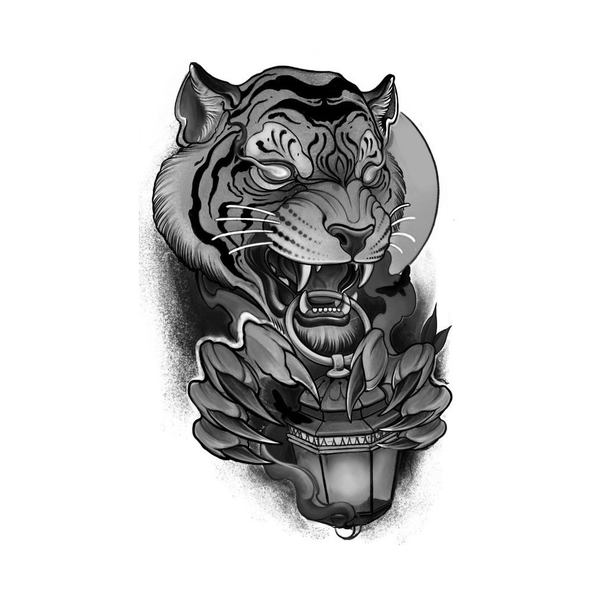
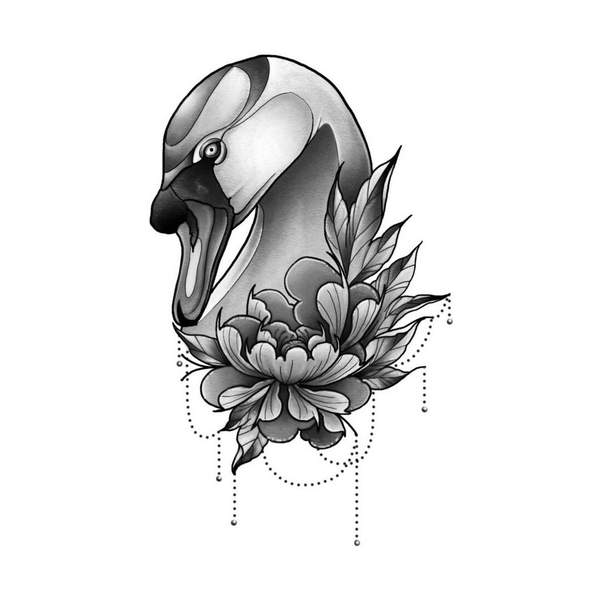
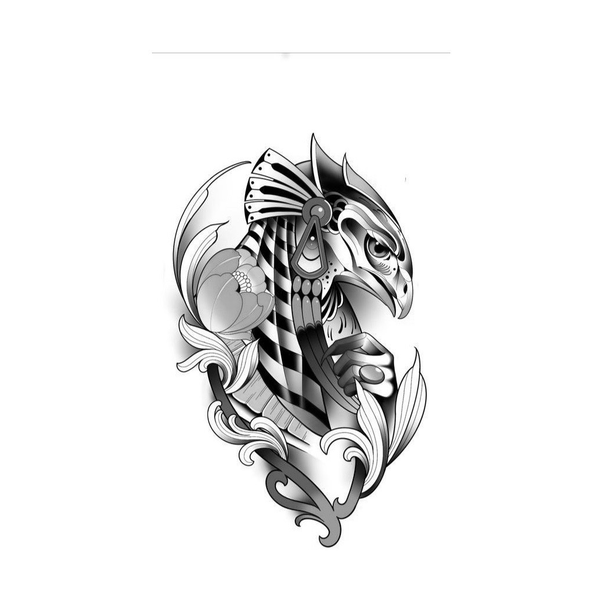
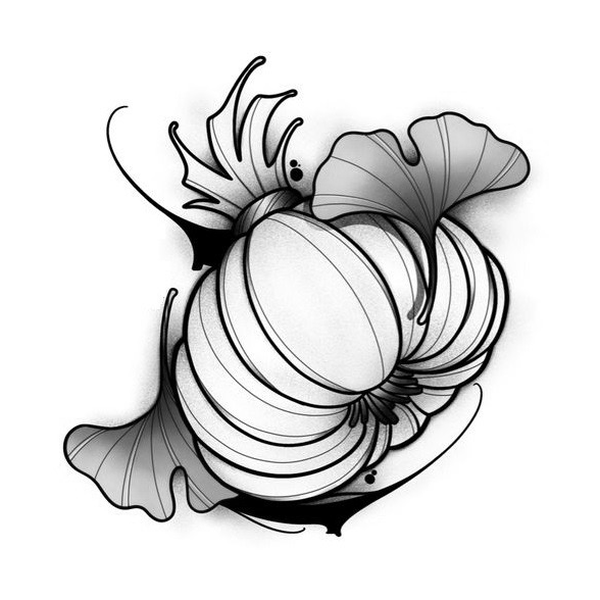
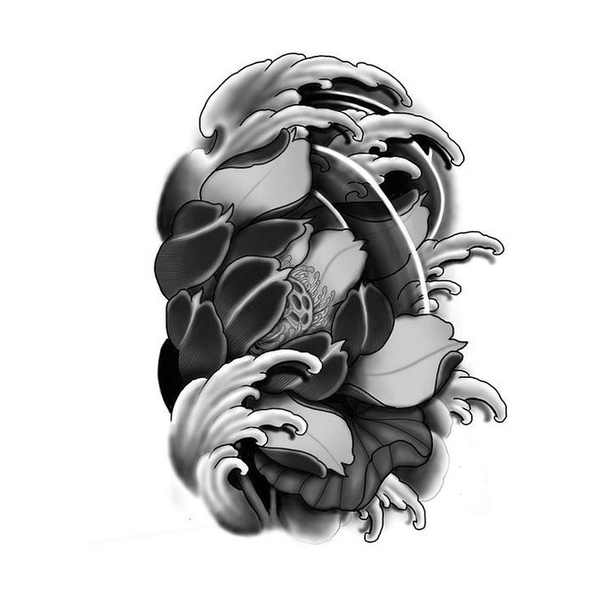
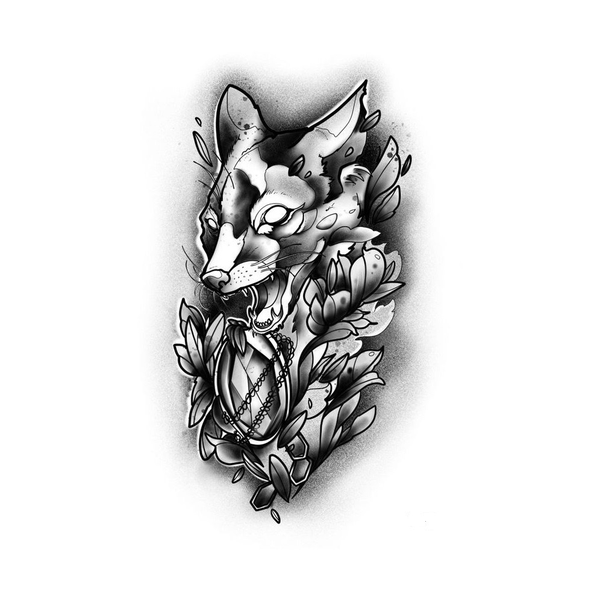
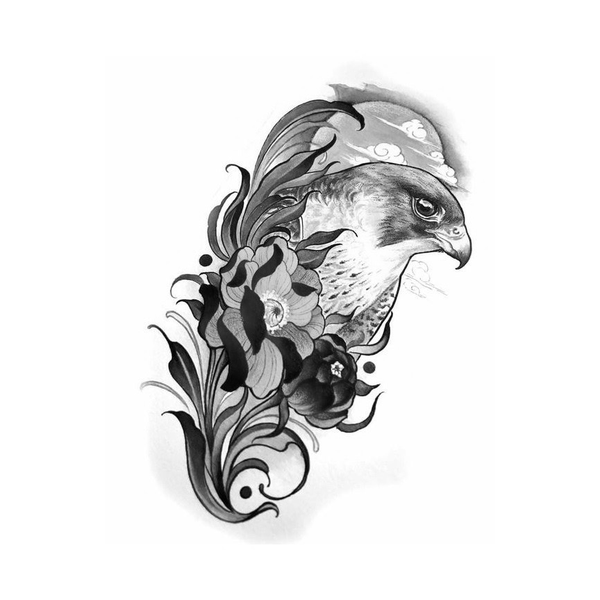
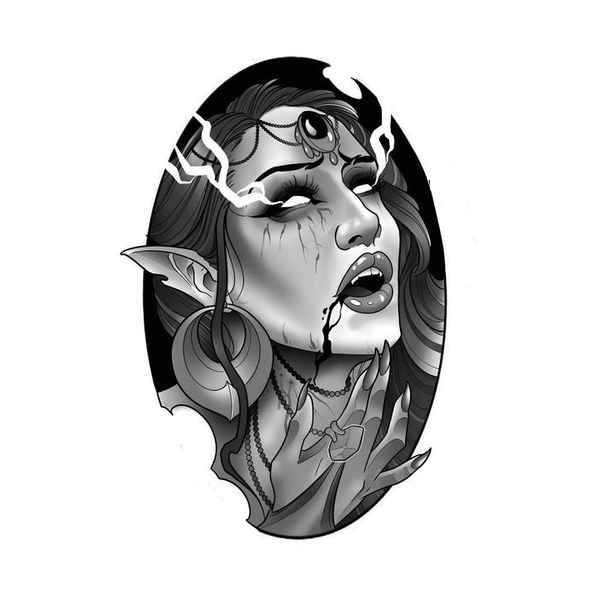
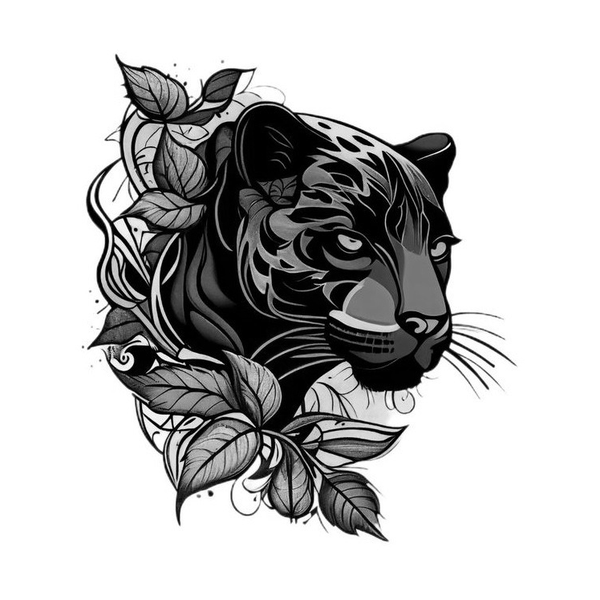
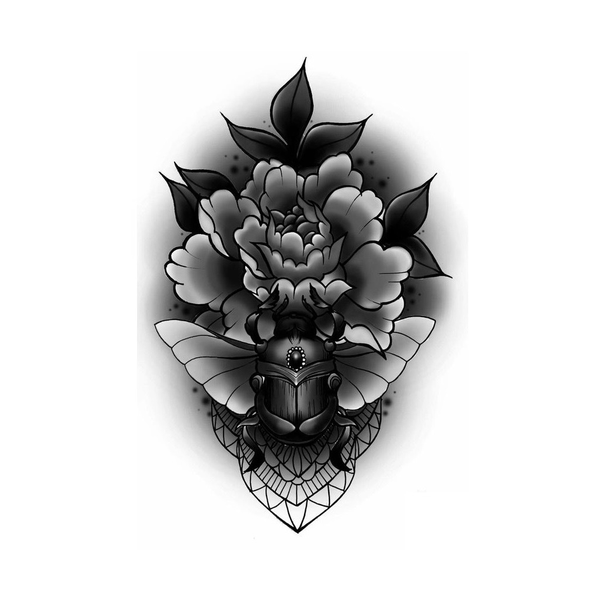
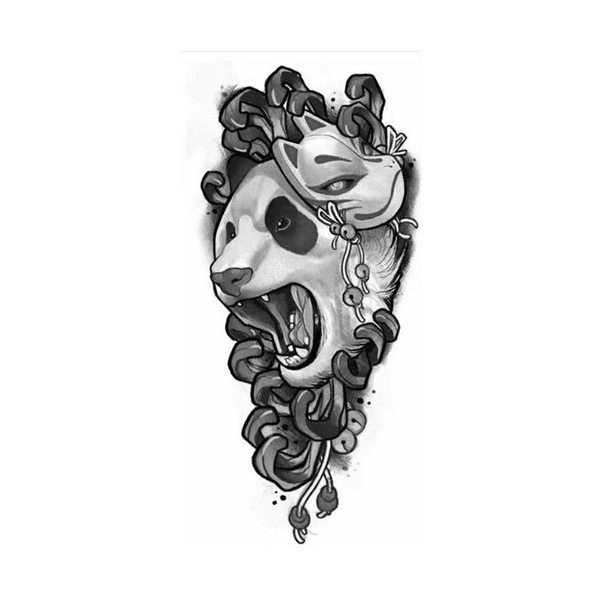
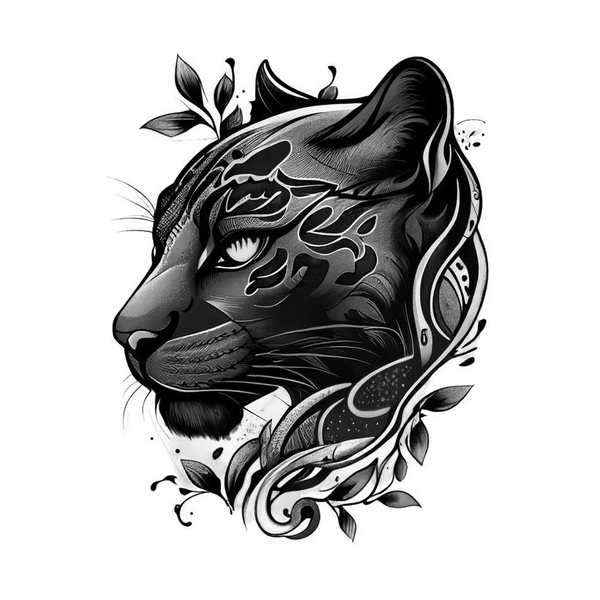
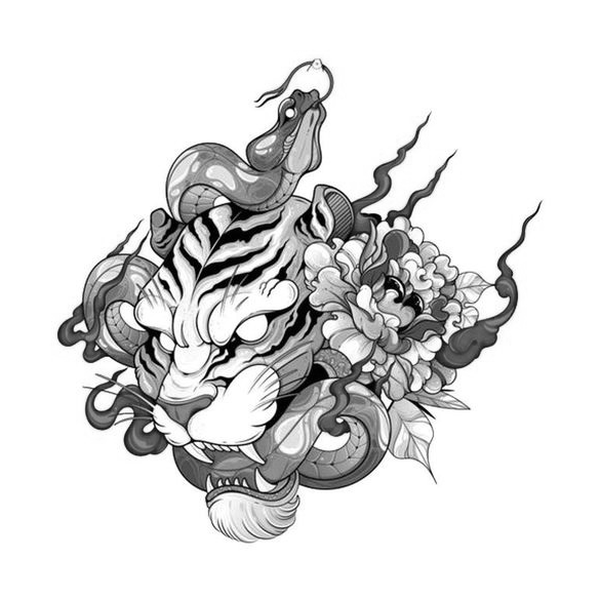
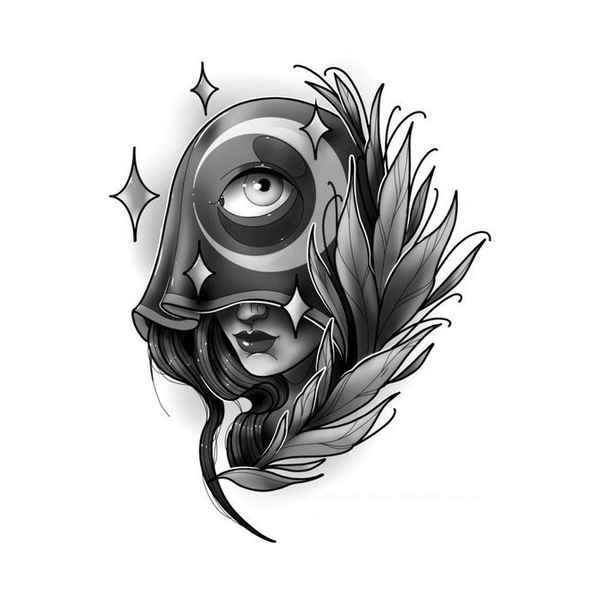
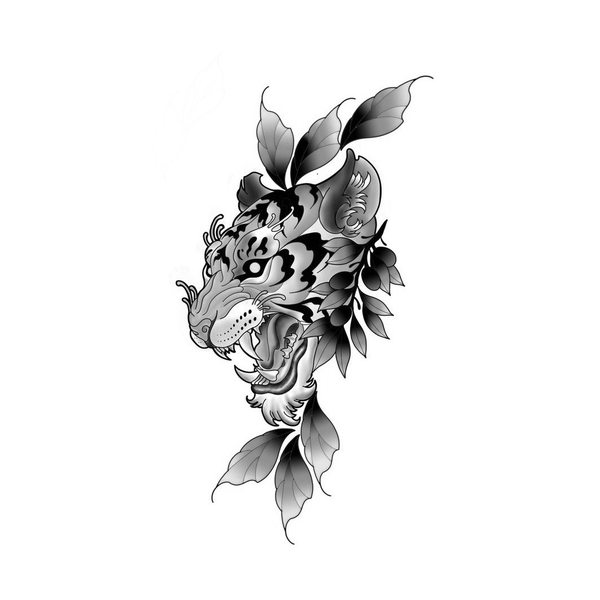
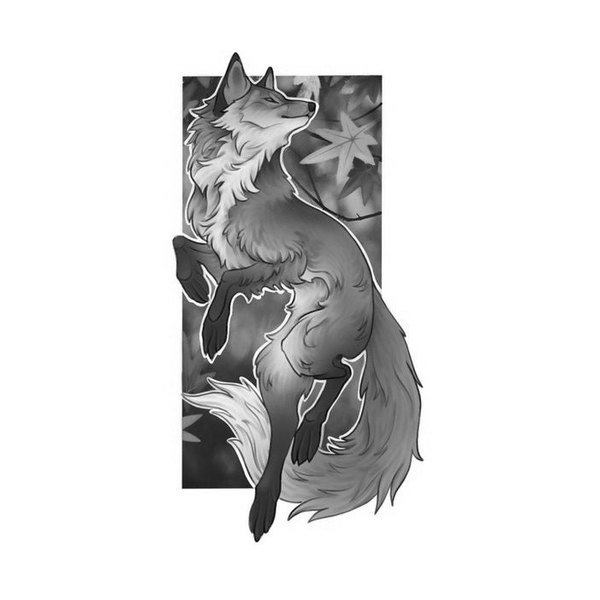
Neo-traditional flash designs
18 hand-drawn designs from our flash collection — book any one as-is, or use it as the starting point for a custom piece. Sizing, placement and linework dialed in at your consultation.


Art Nouveau lineage
The illustrators who shaped the style.
Neo-traditional's other lineage is not a tattoo lineage at all. It's the late-19th-century European illustration tradition the genre openly draws from — and clients who recognize it first often find the style second.
1860–1939
Alphonse Mucha
The Czech Art Nouveau illustrator whose poster work — Sarah Bernhardt theater posters, The Seasons panels, The Arts series — is the single most frequently cited visual influence on neo-traditional composition. Mucha contributes three things: the muted palette (gold, sage, dusty rose, ivory, faded teal), the decorative circular and arched frames neo-traditional artists adapt as background architecture, and the compositional instinct of treating a figure as the center of a larger ornamental system.
1872–1898
Aubrey Beardsley
The English illustrator whose line work — particularly the linework hierarchy in Salome and his Le Morte d'Arthur illustrations — underwrites the neo-traditional instinct to stratify line weight. Beardsley worked almost entirely in black ink with a formal sense of where a line should thicken and where it should thin to a hair. That sensibility maps directly onto neo-traditional line planning.
Late 19th century
Arts & Crafts, Pre-Raphaelites
The botanical illustration and decorative border traditions of William Morris, Walter Crane, and the Pre-Raphaelite circle feed the genre's treatment of leaves, vines, and floral surrounds. Neo-traditional botanicals are usually closer to Arts and Crafts drawing than to botanical realism.
Mid-20th century forward
Modern illustration & animation
A less-cited but real influence: the decisive, dimensional color work of mid-century children's book illustrators and classical Disney animation. The rule is the same — commit to a clear light direction, commit to a limited but dimensional palette, read from a distance — and it governs every well-executed neo-traditional piece.
Genre-defining artists
The artists shaping contemporary neo-traditional.
Neo-traditional does not have a single Sailor Jerry figure. It emerged across multiple scenes in parallel. These are the artists the trade press consistently cites as shaping the working definition.
Jeff Gogue
American
Neo-traditional pioneer on the color-depth and dimensionality side. His work became a reference point for what sculptural shading inside a bold outline could look like at the high end.
Emily Rose Murray
Contemporary figurehead
Art Nouveau-influenced compositions, widely covered in Things&Ink and Inked. Master of the muted, slightly desaturated palette that has become one of the genre's signatures.
Marcus Pacheco
San Francisco
Frequently named in the 1980s-90s origin discussion. Credited with early work that pulled Traditional structure toward a more illustrative and palette-expanded style.
Myke Chambers
American
Sits on the sculptural edge where neo-traditional brushes against color realism. Cited for demonstrating how far interior modeling can push while still preserving the outline contract.
Jesse Smith
Richmond, VA
Expanded the genre's illustrative range into cartoon and character work — widened what counts as neo-traditional subject without breaking the structural rules.
Annie Frenzel
European neo-traditional
Sophisticated palette work and tight compositional discipline. A reference for how European neo-traditional has developed its own accent.
Rewarding subjects
Subjects that reward the sculpting.
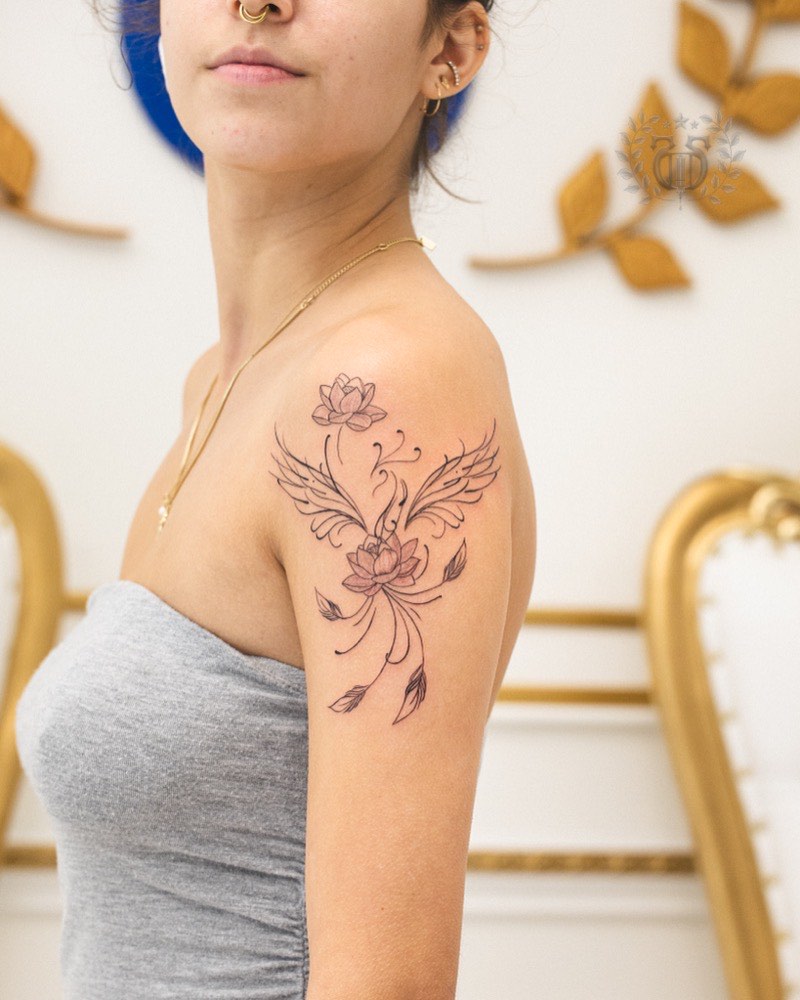
Eight subject categories where neo-traditional's expanded palette and dimensional shading deliver what no other style can.
Art Nouveau figures
The single most identifiable neo-traditional subject. Mucha-style ornamented female figures with flowing hair worked as decorative form, draped fabric, stylized curves, a halo or laurel surround. Clients who gravitate to the style often recognize Mucha's Job or Zodiac lithographs before they can name the tattoo genre itself. Runs 8–12 inches minimum — smaller scales lose the frame that makes the subject legible.
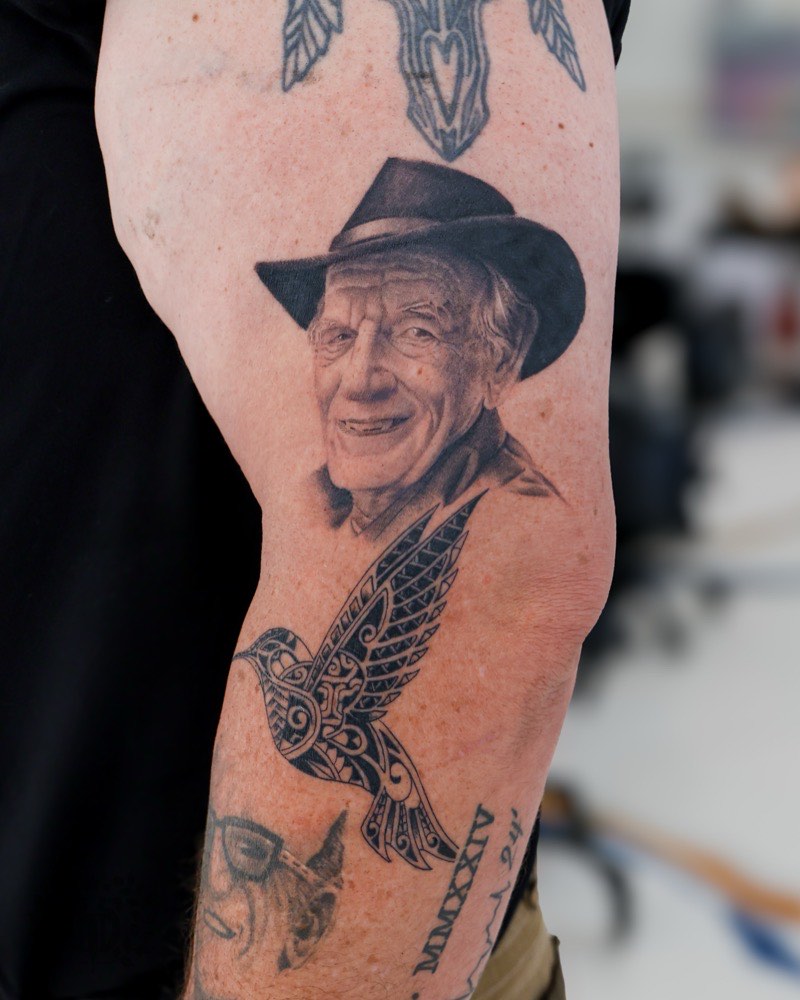
Animal portraits with framing
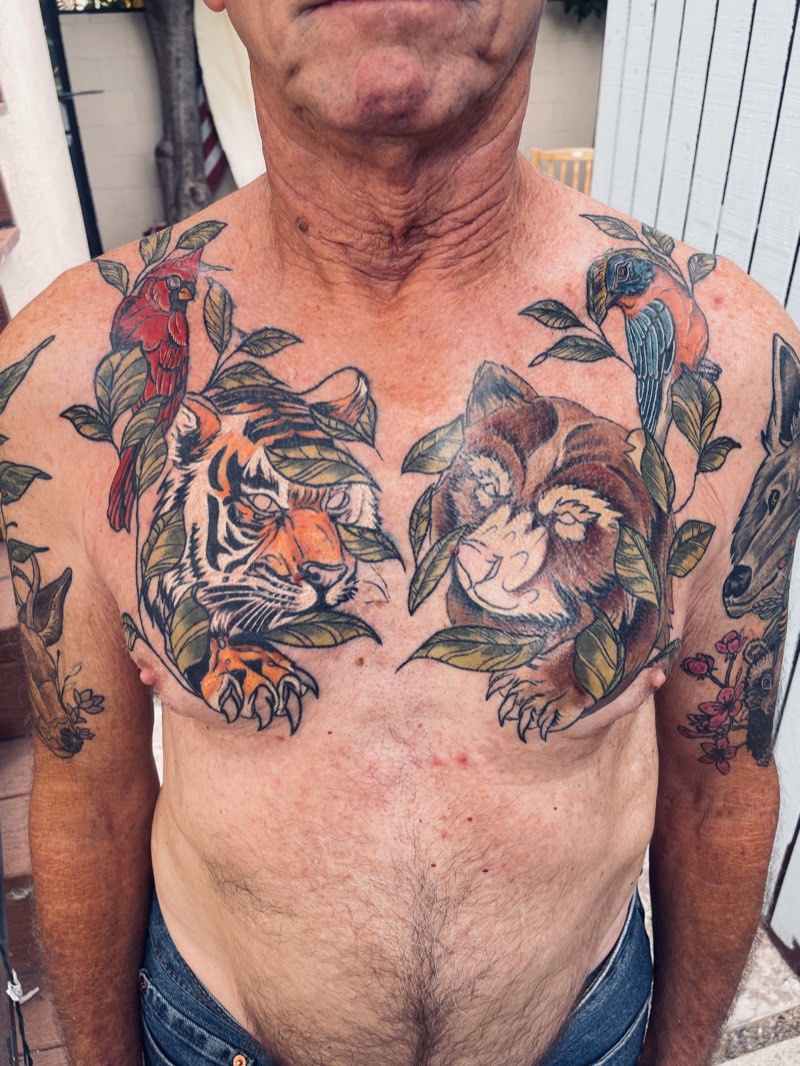
Foxes, owls, stags, ravens, wolves, cats rendered dimensionally, typically shoulder-up, placed against a floral surround, crescent moon, draped banner, or ornamental border. Traditional treats these as iconic flat shapes; neo-traditional treats the same animal as a sculpted subject — form under the line, eyes rendered with depth, fur suggested rather than detailed.
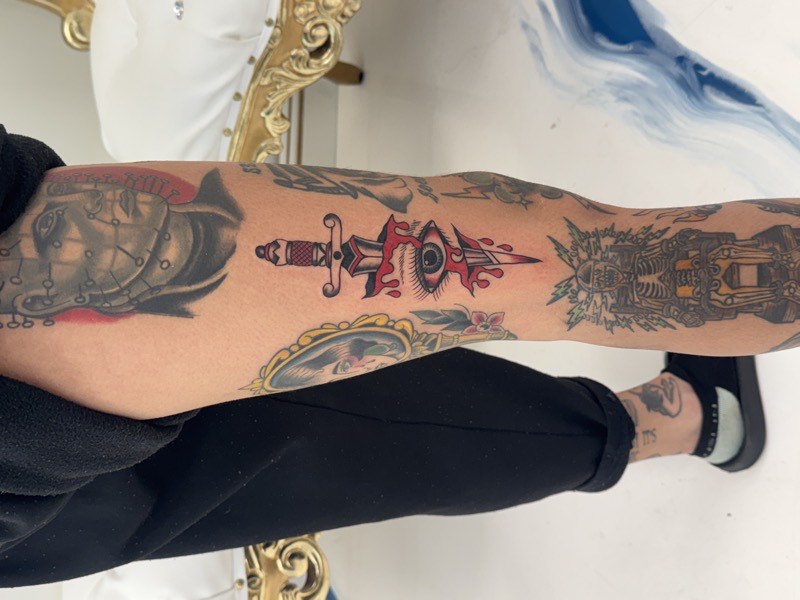
Ornamented florals
Roses, peonies, chrysanthemums, dahlias, lilies, poppies. The distinction from Traditional florals is decisive: Traditional roses use flat color fills with a bold outline. Neo-traditional roses carry sculptural form — petals have dimensional shading that reads like a softened Rembrandt study. The Pinterest rose clients love is almost always neo-traditional.
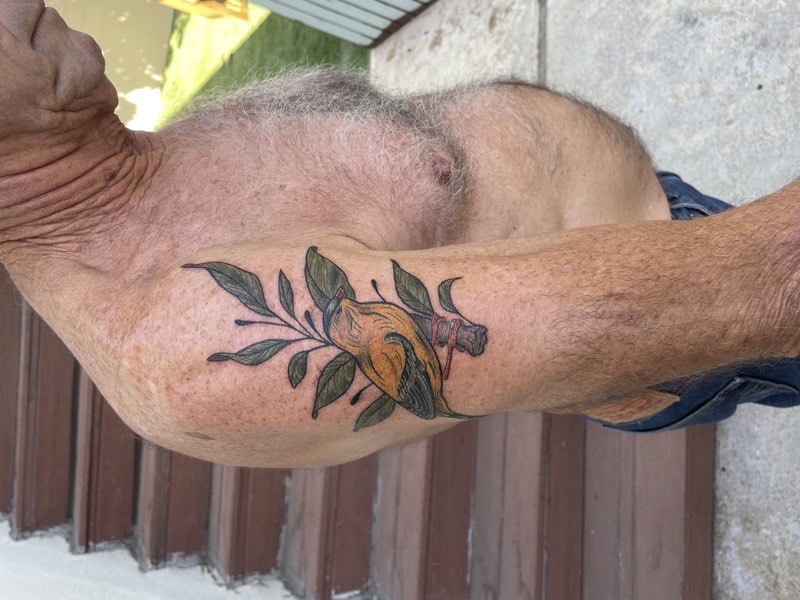
Narrative compositions
Scenes rather than single icons: a fox beneath a harvest moon with a spilled lantern, a figure holding a candle surrounded by moths, a ship framed by kraken tentacles and ornamental rope. Traditional works in isolated icons; neo-traditional builds compositions with foreground, background, and dimensional depth. Usually sleeve-scale or large panel.
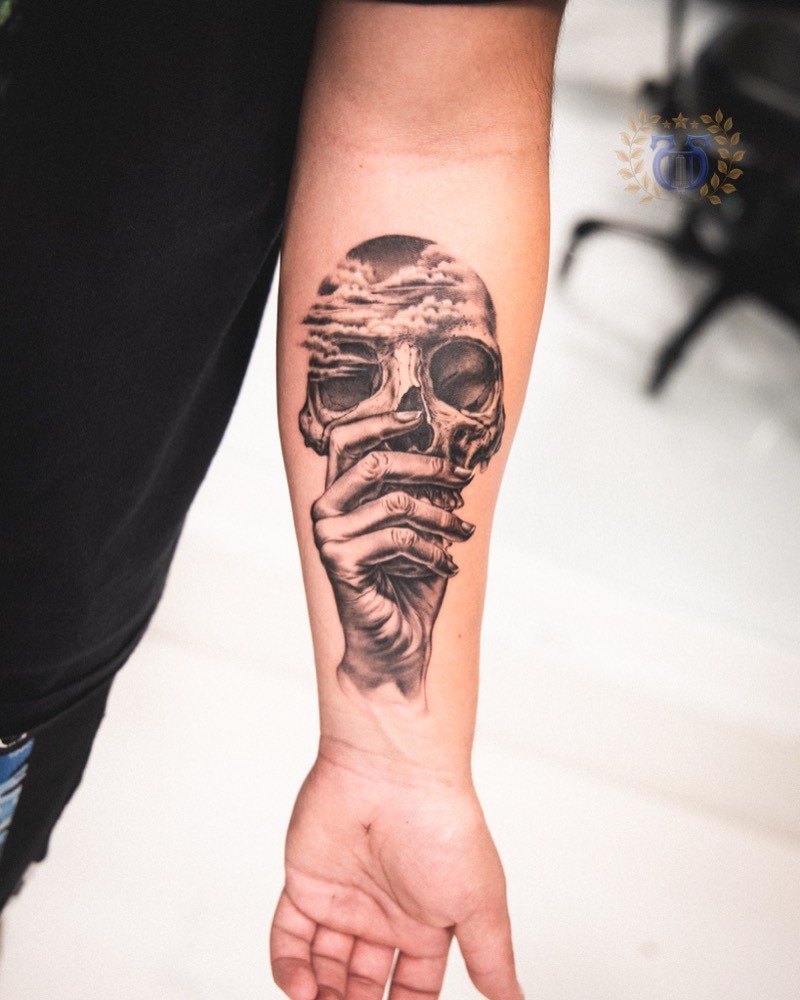
Illustrative portraits
Stylized faces, character portraits, occult figures, historical characters — rendered as illustrations rather than photographs. The seam where neo-traditional touches realism without crossing into it. A neo-traditional portrait reads as a drawing; a realism portrait reads as a photograph. For clients who want emotional weight with graphic legibility.
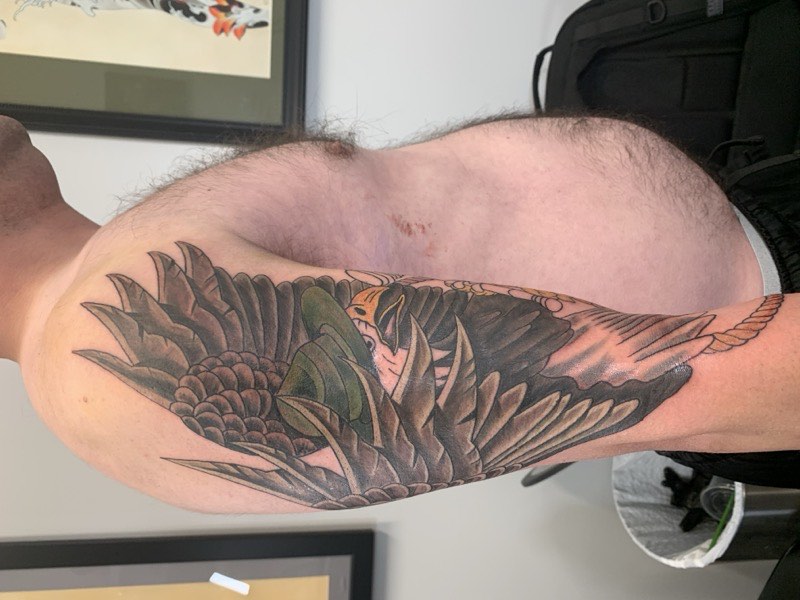
Symbolic narrative
Ships-and-roses-and-banners compositions, daggers through hearts, swallows over script. The iconography is borrowed wholesale from the Traditional canon; the rendering language is neo-traditional. The largest overlap category with Traditional and where client confusion between the two styles tends to live.
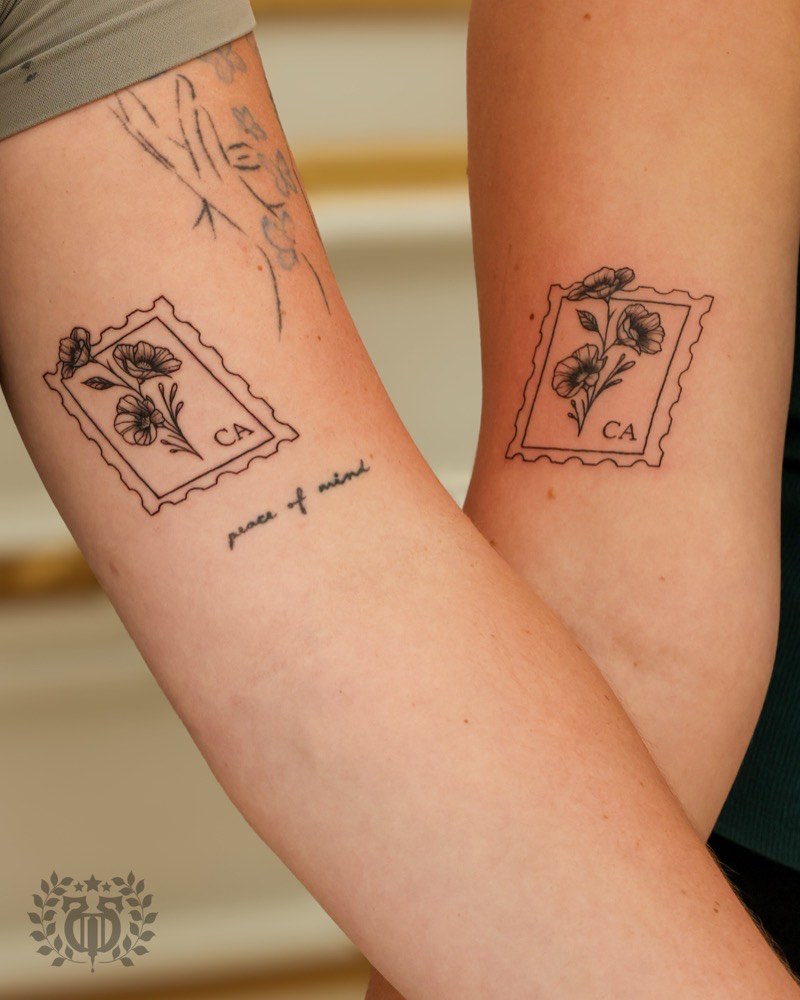
Decorative botanical panels
Ornate flowers, vines, filigree, Art Nouveau borders treated as subject rather than secondary ornamentation. Often worked as large panel work on thigh, back, or sleeve — botanical panels with a central floral focal point and ornamental flourishes filling the field.
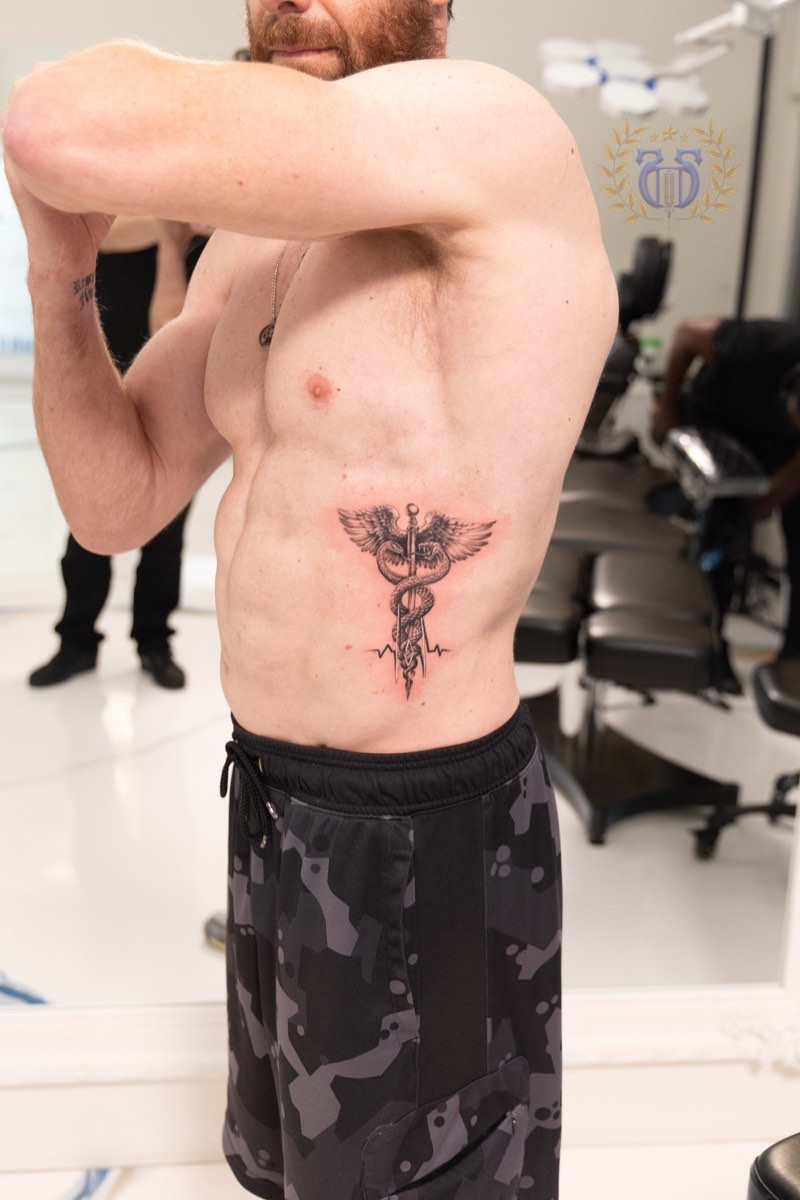
Mythological & fantasy
Gryphons, mermaids, dragons, sphinxes, horned figures, folk monsters. Traditional carries some of these (the dragon is shared with Japanese); neo-traditional renders them as illustrations with ornamental surrounds and a muted palette that distinguishes them from either lineage they borrow from.
Briefs it won't take
Briefs this style will not carry.
Some subjects resist neo-traditional no matter how skilled the artist. These are the requests where style and subject fight each other.
Pure photorealism
Wrong genre. Neo-traditional renders as illustration; realism renders as photograph. Clients who want likeness that could be identified across a room want realism.
Watercolor diffusion
Opposite aesthetic philosophy. Neo-traditional depends on a hard outline; watercolor rejects one. The two styles cannot coexist in the same piece.
Minimalist or fine-line work
Wrong scale and saturation. Neo-traditional's shading language needs room — below ~4 inches the dimensional form flattens and the piece reads as muddy Traditional.
Pure geometric abstraction
Belongs in blackwork or ornamental genres. Neo-traditional is representational illustration; geometry divorced from subject falls outside the vocabulary.
Culturally-owned tribal patterns
Not neo-traditional territory. Those traditions carry living cultural ownership and should go to artists with lineage to carry them — not adapted through neo-traditional's rendering.
Room to sculpt
The shading language needs room.
Neo-traditional's minimum viable size is larger than Traditional's because dimensional shading needs canvas to model form. Below certain thresholds, the style flattens into muddy Traditional.
Room the sculpting needs
Below this, dimensional shading flattens and the piece reads as muddy Traditional rather than distinct neo-traditional. The shading language needs room to model form.
The sweet spot where the subject can be sculpted, the ornamental framing can breathe, and the piece reads as neo-traditional at conversational distance.
Mucha-style figures and narrative scenes need room for the frame, the figure, and the secondary decorative elements. Smaller scales lose the architecture that makes the subject legible.
Sleeve-scale neo-traditional weaves motifs, figures, and decorative borders together. Below this, the compositional density the style asks for starts to crowd rather than flow.
Placements that suit the palette
- Upper arm / bicep. The classic neo-traditional canvas, shared with Traditional. Flat canvas, visible daily, consistent skin.
- Outer forearm. Flat, legible, heals predictably. Great for single-subject compositions with framing.
- Thigh. The largest reliable canvas for Art Nouveau figures and narrative panels. Low friction, holds dimensional work well over decades.
- Outer calf. Carries 8–10 inch compositions cleanly. Flat canvas with moderate sun exposure.
- Chest panel (one-sided). Mirrors Traditional's chest panel logic but with room for decorative density. Good for Art Nouveau figures and mythological subjects.
- Back piece. The canvas for sleeve-scale narrative neo-traditional. Full-back compositions with multiple focal points and connective ornamental framing.
Areas that flatten the sculpting
- Small placements (wrists, behind-ear, inner ankle). Fine-line territory. Neo-traditional's shading language needs scale; at small sizes the dimensional form collapses.
- High-flex inner arm & elbow ditch. Dimensional shading distorts across flexion. Neo-traditional's sculpted form fights constant bending.
- Fingers, palms, side-of-foot. Ink budget too thin for the style's rendering demands. These placements fade the expanded palette fastest.
- Feet (generally). Wear and fade compound with shading complexity. The dimensional modeling that defines neo-traditional is the first casualty.
Aging
How the sculpting holds.
Almost as well as Traditional — but not quite, and the gap is entirely about the palette. Understanding that gap is the difference between a piece that still sings at year 20 and one that reads like a memory of itself.
Settling in
The piece looks its brightest in the first few weeks after healing, then the dermis re-equilibrates. Bold outlines stay sharp. Dimensional color can shift slightly as the body clears excess pigment riding above the final settle depth. Any “hazing” you see at three months usually resolves by month six.
Prime readability
Outlines are crisp. The palette still holds. This is the stretch where neo-traditional looks identical to the portfolio reference photo. Clients photographing work at this stage rarely see any difference from the fresh-work shots.
First palette softening
Brighter fills — especially teals, hot pinks, and light oranges — begin to show a subtle desaturation. Not fading in the “blurry” sense; a gentle pull toward the softer end of each hue. Outlines hold completely. The design still reads exactly as intended.
Expanded palette catches up
The accent colors that distinguish neo-traditional from Traditional — the ones that aren't red, yellow, green, or black — will look a half-step cooler or lighter than they did at year five. A well-built neo-traditional piece at year 15 still reads clearly. Not Traditional-level permanence, but remarkably close — and miles ahead of color realism or watercolor at the same age.
Outlines carry the composition
The bold linework is doing the heavy lifting. Color fills may look desaturated — pinks toward peach, teals toward pale blue-gray — but the drawing is still entirely legible. That structural survivability is the single best argument for choosing neo-traditional over more painterly color styles.
Four structural features give the style its longevity: bold outlines (carbon black at proper depth is effectively permanent), saturation-first color (pigment density is the strongest predictor of how color holds across decades), flat-ish color strategy (fewer fragile transitions than hyperrealism), and composition density without micro-detail (nothing delicate to blur). Where it ages harder than Traditional: expanded palette includes less-stable pigments (teals, pinks, purples, light oranges), gradient shading softens sooner than flat fill, and more complex compositions mean more visible fade surface.
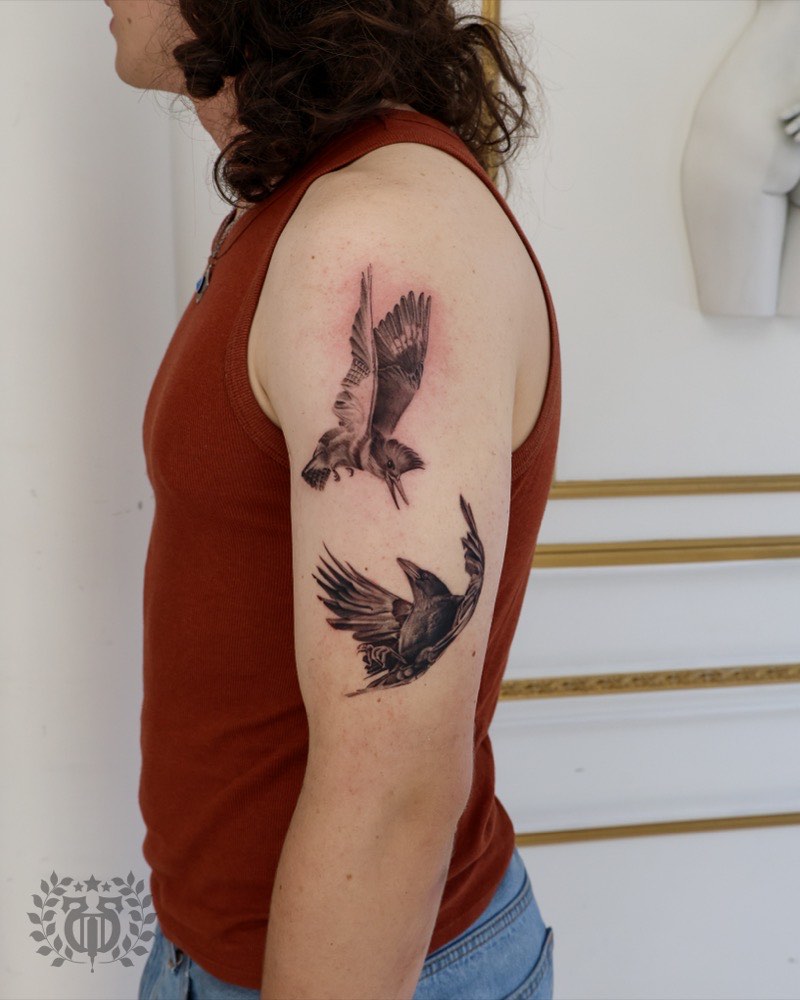
Neo-traditional in the wild
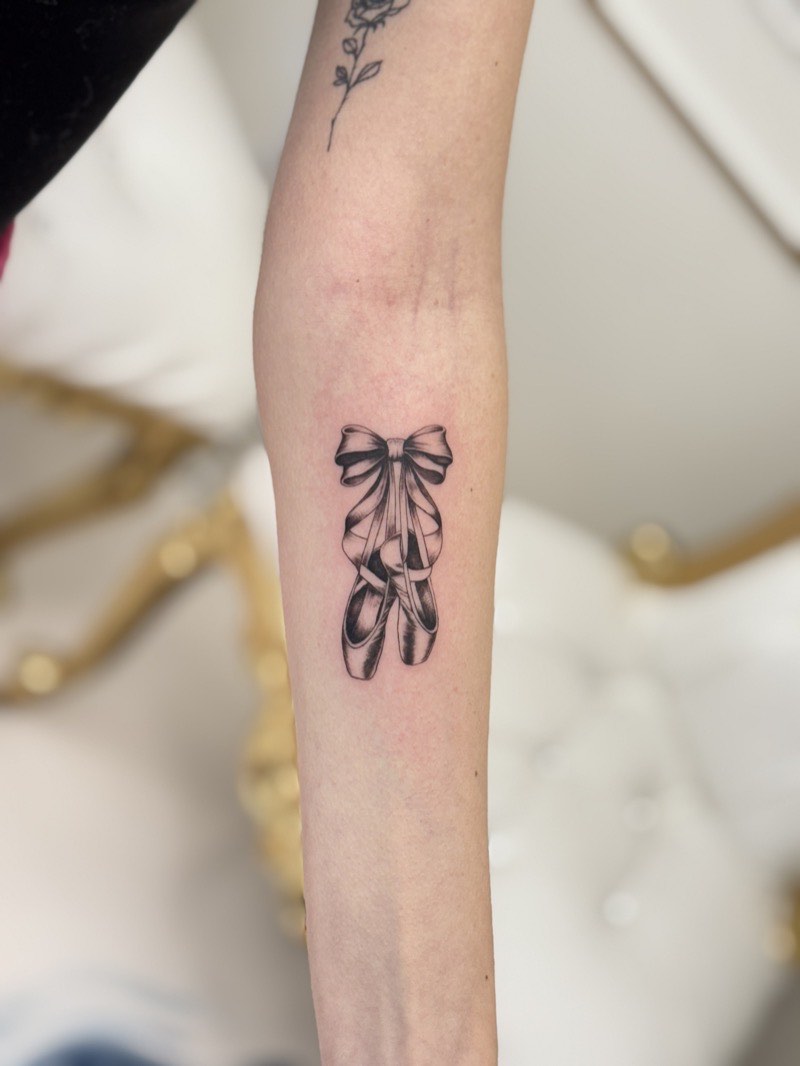
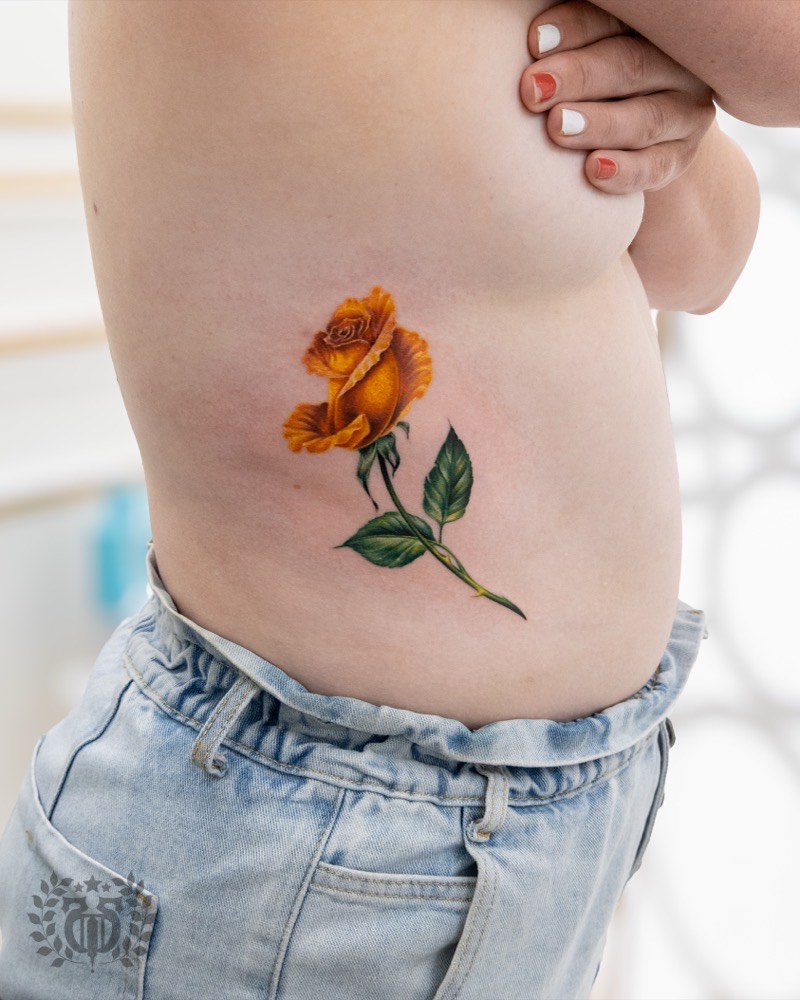
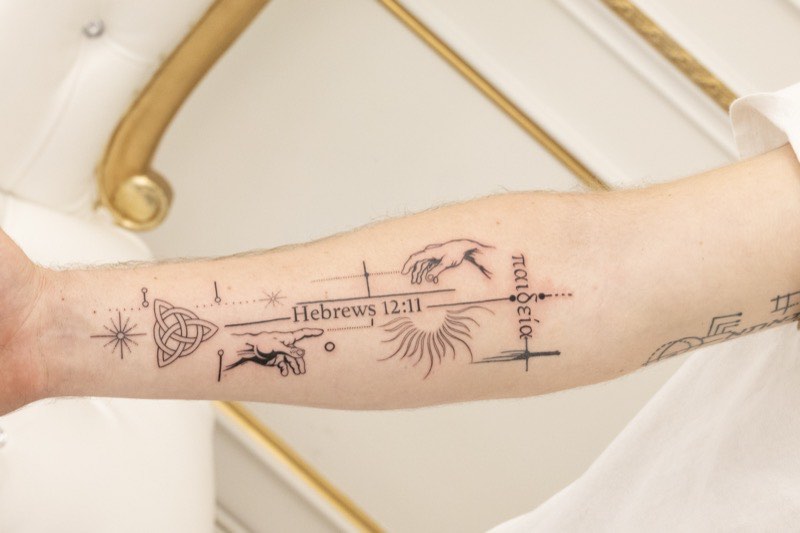
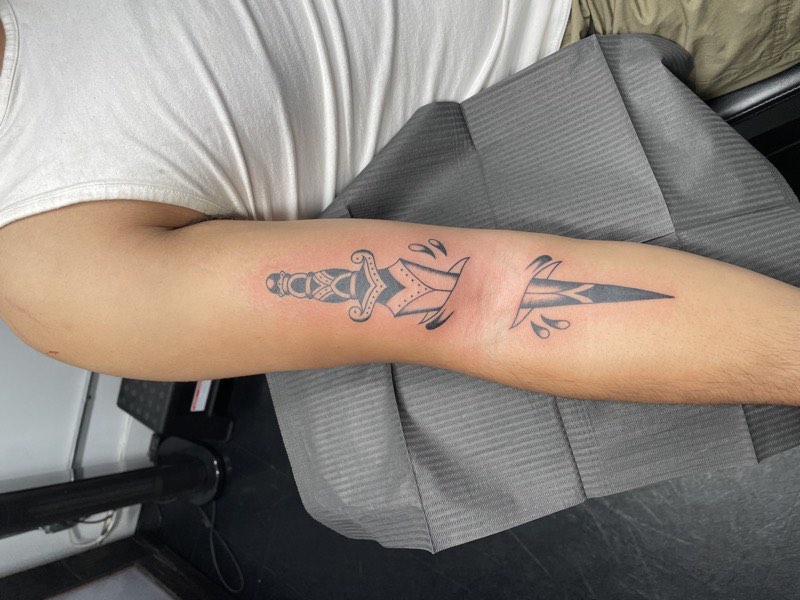
Sculpting you can actually see.
Palette planner
Subject → scale → placement → palette.
What we check before locking a palette. The Palette column is neo-traditional-specific — different subjects call for different color approaches.
Where briefs start
Five plans we tighten first.
Where first-time neo-traditional briefs usually start. For the piece you have not booked yet.
“Neo-traditional is Traditional with more colors.”
The defining difference is dimensional shading, not palette. A Traditional piece in teal-and-pink is still Traditional. A neo-traditional piece in strict primary red-and-black is still neo-traditional. The shading approach is what separates the two.
“I can't decide between Traditional and neo-traditional.”
They are stylistic commitments, not preferences. The artist's hand is trained for one or the other. Picking one is part of the design work — and a specialist will help you see which fits your idea.
“Neo-traditional is always feminine.”
The Art Nouveau lineage is often feminine-coded, but the style spans stags, wolves, occult figures, ships, and skulls. The dimensional rendering language is the constant, not the gender of the subject.
“I want color in my Traditional piece — that makes it neo-traditional.”
Not automatically. The shading approach matters more than the palette. Flat color in an expanded palette is still Traditional-adjacent work; sculptural shading inside the outline is what makes it neo-traditional.
“Neo-traditional ages like Traditional.”
Close, but the dimensional shading and expanded palette introduce fade considerations Traditional's flat fills don't face. Bright pinks and teals soften by year 15; outlines hold for decades. The drawing survives even when the color mellows.
Who can sculpt
Who can actually sculpt in color.
Neo-traditional is the middle-ground style where generalists can look competent at day one and specialists clearly outperform across a decade. The palette decisions are the work.
What the sculpting should look like
- Healed work at 5, 10, 15 years showing color and dimensional shading holding together
- Distinctive, recognizable palette — a signature color mixing sensibility
- Art Nouveau references in the portfolio (Mucha, Klimt, the Wiener Werkstätte)
- Subject range across figures, animals, and florals
- Willingness to discuss color theory and palette rationale in the consultation
- Explicit reasoning about which pigment lines they use for teals and pinks specifically
When to keep shopping
- Outlines that vary unpredictably in weight within a single piece
- Flat color fills where dimensional shading should be — that's Traditional with neo-traditional subject matter, not actual neo-traditional
- Muddy color mixing — the palette should feel intentional, not accidental
- Patchy or uneven gradient shading
- No healed-work documentation
- “Any style” marketing language
Six questions about the shading plan
- Can I see healed neo-traditional at 10+ years old?
- How do you approach palette selection for a subject like mine?
- What's your session count estimate, and how do you structure multi-session pieces?
- Which pigment lines do you use for the expanded palette — specifically for teals and pinks?
- Walk me through how you plan dimensional shading before the needle touches skin.
- Is your approach more Art Nouveau-influenced or contemporary illustrative?
An artist who answers all six confidently — especially the pigment-specific question about teals and pinks — is almost always one you can trust with the expanded palette.
FAQ
Neo-traditional, in plain answers.
Seven questions about the style that sits between Traditional's outline and realism's shading.
What's the difference between Traditional and Neo-Traditional?
One diagnostic question: is there a second color pass or sculptural shading inside the outline? Traditional uses flat color fills + black smoke shading + a disciplined 5–6 pigment palette. Neo-traditional retains the bold outline but adds dimensional shading that models form — highlights, mid-tones, shadows — with an expanded 10+ color palette (teals, pinks, muted earths, warm grays). A Traditional rose reads as a graphic shape; a neo-traditional rose reads as a three-dimensional object. The shading approach is the defining difference, not the colors alone.
How long do neo-traditional tattoos last?
Almost as long as Traditional — but not quite, and the gap is entirely about the expanded palette. Bold outlines hold for 30+ years. The palette softens visibly at 10–15 years: brighter pinks and teals drift toward pale peach and blue-gray; muted earths and olives hold better than brights. A well-built neo-traditional piece at year 15 still reads clearly — not Traditional-level permanence but remarkably close, and miles ahead of color realism or watercolor at the same age. Touch-up windows typically land at 12–18 years.
What colors in neo-traditional fade fastest?
Bright pinks and hot teals are the weakest points in a neo-traditional palette, though modern pigment formulations (Eternal, World Famous, Solid Ink) have dramatically improved their stability over the last decade. Warm oranges and light purples also fade faster than the red-yellow-green-black primaries Traditional relies on. Muted earth tones — olive, salmon, gold, oxblood — are the most stable non-primary colors and a signature of artists who understand longevity. Black outlines are effectively permanent.
Why is Art Nouveau such a big influence on neo-traditional?
Because Alphonse Mucha's commercial lithography from 1895–1905 solved several problems neo-traditional artists were also trying to solve: how to compose a figure inside a decorative frame; how to use a muted-but-distinctive palette (olive, teal, salmon, gold); how to treat hair, drapery, and botanical elements as ornamental architecture rather than background. Bringing Mucha (or Klimt) reference imagery to a consultation is often a stronger starting point than bringing tattoo photos — artists respond to the compositional language directly.
Can I get a neo-traditional piece smaller than 4 inches?
Technically yes, practically no. Below about four inches, neo-traditional's dimensional shading flattens into something that reads as muddy Traditional — you lose the sculpted form that distinguishes the style. If you want a small piece with bold outlines, Traditional is the honest answer. If you want neo-traditional's dimensional rendering and decorative composition, plan for at least 4–6 inches on a forearm or bicep, and 8+ inches for figure-based or narrative pieces.
Is neo-traditional better for a first tattoo than Traditional?
Different tradeoffs. Traditional at 3–4 inches is forgiving, proven, and ages beautifully — arguably the best first-tattoo category. Neo-traditional requires more scale (4+ inches minimum), longer session time per piece, and a specialist artist — which means a higher commitment for a first piece. If you're drawn to the decorative, illustrated aesthetic, a neo-traditional piece at 4–6 inches on a forearm is a strong first choice; if you want something smaller or simpler, Traditional is the better starting point.
How do I tell if an artist is really a neo-traditional specialist?
Look for four things in the portfolio. First, healed work at 10+ years showing color and dimensional shading still holding. Second, a distinctive, recognizable palette — a signature color mixing sensibility rather than muddy approximations. Third, Art Nouveau references in the work (Mucha, Klimt, Arts and Crafts influence) — indicates art-history literacy that translates into better compositional decisions. Fourth, subject range across figures, animals, and florals. At consultation, ask them to walk through how they plan dimensional shading and why they pick particular colors. A specialist has immediate, detailed answers; a generalist deflects.
Ready to bring Mucha to the needle?
Bring the Art Nouveau references, the subject, and openness to dimensional planning.
Neo-traditional is a specialist's craft and a compound skill set. Bring references from outside tattooing — Mucha and Klimt are more useful here than tattoo photos — plus the subject and the placement. Then we plan the sculpting before any color goes down, because the dimensional shading is the style itself and it cannot be added afterwards.