Tattoo Styles
Floral
A flower is a subject, not a technique, so the first real decision is which style you want it drawn in. Botanical-plate accuracy, neo-traditional weight, irezumi peonies, blackwork silhouette: same rose, five completely different tattoos, five different aging curves.
Book a consultationSubject vs style
Why floral is a subject, not a technique.
Floral is a subject category — flowers, leaves, stems, botanicals — that has been absorbed into every major tattoo tradition. The bloom is the same; the grammar that carries it changes completely.
The same peony rendered in fine-line will be a whisper of hairline petals; rendered in neo-traditional, it will be a saturated jewel-tone bloom with decorative filigree; rendered in Japanese tradition, it will sit inside wind-bars and cherry blossoms as part of a larger compositional program. Same flower. Different tattoos.
This means the most important choice a floral client makes is style, not flower. A great artist working in the wrong style for your taste will still produce a great tattoo — it simply won't be the tattoo you wanted. Matching bloom to style is half the consultation conversation.
Floral also crosses scale in a way few subjects do. A sprig of baby's breath at two inches and a full Japanese peony panel at eighteen inches are both within the category. Scale and placement affect style choices too: fine-line florals thrive small; Japanese florals demand room to breathe.
The botanical lineage
Where floral tattooing came from.
Flowers have been on skin as long as tattooing has been practiced. The commercial style we recognize today draws from several deep wells.
18th–19th century
Botanical illustration
Pierre-Joseph Redouté, Ernst Haeckel, and the Kew-plate tradition built a visual grammar for rendering plants with scientific precision. That grammar — clean contour, accurate proportion, tiny hatched shadows — survives intact in contemporary fine-line floral tattooing. The best micro-botanical artists cite these plates directly.
Edo period onward
Japanese irezumi flora
Sakura, botan, and kiku entered the Japanese tattoo vocabulary during the Edo period and have been refined continuously since. Each carries strict compositional rules — sakura drifts between larger subjects, botan anchors, kiku marks autumn. The grammar is complete and still studied.
Mid-20th century
American traditional rose
The rose became the American tattoo flower through traditional flash — Sailor Jerry, Bert Grimm, Owen Jensen. Bold outline, limited palette, instantly readable silhouette. Ages well and was built to. Neo-traditional later expanded the flower vocabulary while keeping the structural discipline.
2010s – present
Fine-line & illustrative revival
Dr. Woo and a generation of fine-line artists revived botanical illustration aesthetics for the Instagram era — delicate single-stems and whisper-thin leaf veins photographed extraordinarily well and became one of the platform's signature tattoo categories. Neo-traditional peonies and blackwork botanicals now share the feed.
Today every serious floral portfolio pulls from several of these wells at once. Knowing which lineage your chosen style descends from sharpens the consultation and the final piece.
Styles
Eight ways florals get tattooed.
Each style is a complete aesthetic tradition, not just a technique. Picking the style is the first and biggest floral decision.
Fine-line floral
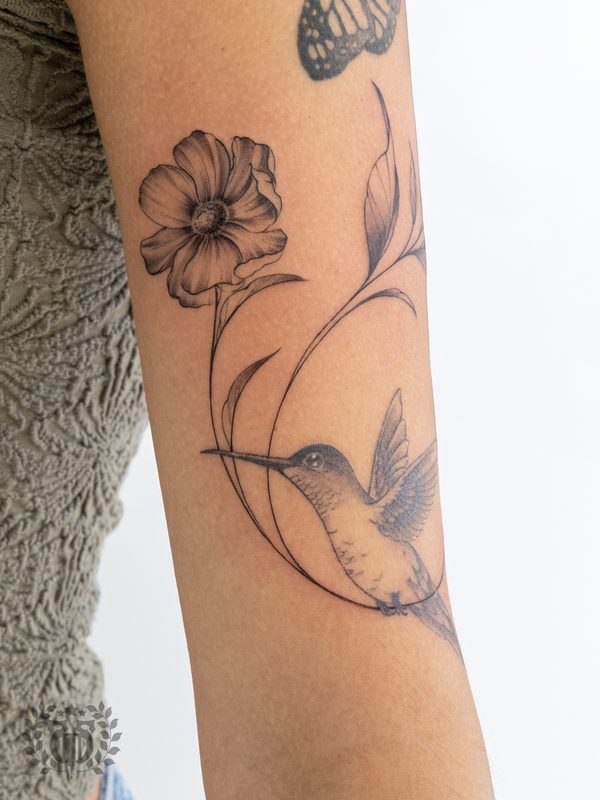
Single-needle or tight three-round groupings render flowers at near-botanical-illustration scale. Delicate stems, whisper-thin leaf veins, intimate placements. Single-stem or small bouquet compositions. Color often omitted or limited to soft blush tones. Longevity depends on placement and aftercare; the line weight that creates the look also ages less forgivingly than bolder styles. Popular subjects: wildflowers, baby's breath, lavender, small roses.
Neo-traditional floral
Heavy outlines, saturated jewel-tone palettes, and decorative framing (banners, ornaments, filigree) give neo-traditional its density. Roses, peonies, and dahlias dominate. Leaves are stylized rather than botanically accurate. Reads well from across a room and ages exceptionally thanks to bold line and pigment load. Often incorporates secondary elements (daggers, moths, hands, skulls) in a decorative program.
Japanese floral
Cherry blossom (sakura), peony (botan), and chrysanthemum (kiku) appear within the compositional grammar of traditional irezumi: wind-bars, water, and negative space that moves the eye across larger placements. Rarely standalone; typically paired with a main subject (dragon, hannya, koi) as seasonal and symbolic context. Color choices and linework follow centuries-old conventions.
Watercolor floral
Soft washes, splashy unbounded color, often no (or minimal) black outline. Visually striking fresh but among the less forgiving styles long-term; pigment migration and color fade require realistic expectations. Best suited to clients who understand they may want touch-ups.
Blackwork floral
Silhouette approach (fern fronds, branches, dark bouquets) or heavy-black botanical with negative-space petals. Draws on woodcut and botanical broadside traditions. Ages exceptionally well. Best for clients who want florals without the softness — a gothic style.
Realism floral
Photographic botanical study in black-and-gray or color. Technically demanding; rewards artists with strong reference-photography workflow and heals best at larger scale where detail is preserved.
Ornamental floral
Florals woven into a decorative mandala, frame, or jewelry program. A single bloom centered inside a geometric halo, or a chain of flowers filling a sternum cartouche. Sits at the intersection of botanical and ornamental style libraries.
Micro-botanical
Single-stem delicate pieces at 2–3 inches — a sprig, a bud, one leaf. Reads quiet and intentional. Longevity requires placement discipline (avoid fingers and insides of wrists) and an artist who will honestly flag when the scale is too ambitious for the desired age.
Ground for botanicals
Where floral work ages best.
Floral compositions reward stable skin and room to breathe. These five zones carry the widest range of styles.
Where botanicals age well
- Forearm (inner or outer). The top request. Lets clients see the piece daily, and short sleeves put it on display. Single stems, small bouquets, and wraparound vines all work.
- Upper arm & shoulder. Hosts larger bouquets with room for depth and shading. Bicep wraps, deltoid caps, and shoulder-to-collarbone compositions are standard.
- Ribs & sternum. Beautiful for symmetrical compositions — matched stems arcing under the collarbone, a central bloom at the heart, or trailing buds down the flank.
- Thigh. Large flat canvas ideal for half-sleeve-scale botanicals and dramatic color work. Heals predictably thanks to stable skin.
- Back & spine. Made for cascading vines. A single trailing stem down the spine is one of the most requested pieces — elegant and architectural.
Bad ground for botanicals
- Fingers — high cell turnover, fine-line florals fade fastest here.
- Palms & soles — friction zones destroy delicate petal detail within months.
- Inside of wrist for fine-line bouquets — thin skin shows line wobble quickly.
- Feet — shoe friction wears floral detail faster than almost any other placement.
Bloom sizes
Four sizes botanicals live at.
Floral work scales from two-inch sprigs to full back panels. Each tier has its own style fits and placement logic.
Fine-line single-stem florals read beautifully — a rosebud on the inner forearm, a sprig behind the ear.
Small clusters and two-flower compositions. Manageable detail, widely available placement options.
Proper bouquets where multiple blooms overlap and leaves interlock. Sweet spot for most floral compositions.
Full sleeves, back panels, cascading spine pieces, thigh-scale Japanese peonies. Multi-session builds.
Cross-style work
Cross-style botanical work.
Florals rarely stand alone on a body over a lifetime. These are the cross-style combinations Apollo artists work in most often.
Floral + portrait
A studio classic. A realistic face framed by botanicals softens the portrait and adds color interest.
Floral + script
The backbone of memorial work. A loved one's name nested inside a bouquet or beneath a single stem.
Floral + geometric framing
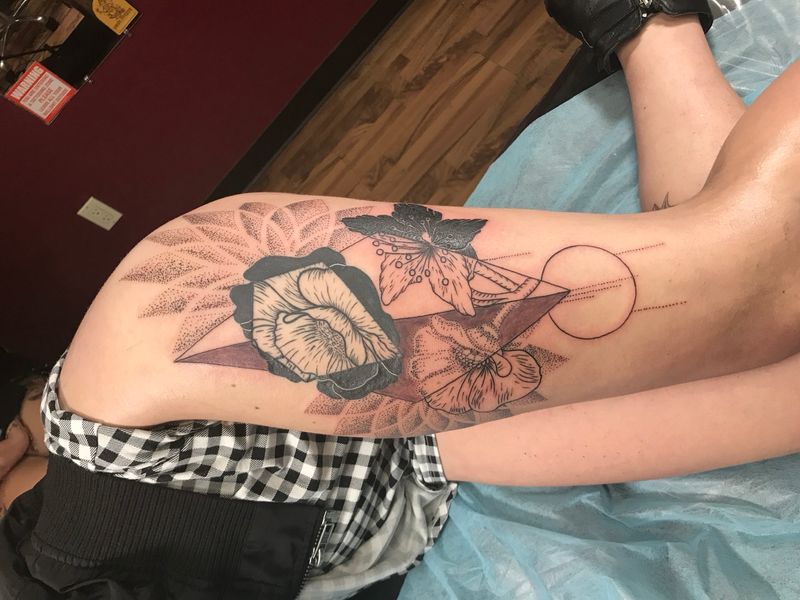
Mandalas and sacred-geometry backdrops turn organic blooms into structured compositions.
Floral + animal
Bees on lavender, hummingbirds at trumpet flowers, butterflies on peonies, snakes winding through roses.
Floral + Japanese
Cherry blossom, peony, and chrysanthemum in irezumi's native compositional grammar.
Flower tattoo idea directory
Every bloom Apollo artists tattoo, cross-referenced to style and meaning.
Bloom questions
Eight things to ask about your bloom.
The questions that move a floral consultation from generic to specific. An artist confident in their style answers all eight without deflection.
- Which specific flower — variety, stage of bloom, color — are we drawing?
- Do you have botanical work in this style that has healed over the past year?
- At this size and placement, what should I expect at year one and year ten?
- Would you recommend color or black-and-gray for this subject and skin?
- What's your approach to leaf and stem composition around the main blooms?
- How do you handle overlap between multiple flowers in a bouquet?
- Have you ever talked a client out of a floral piece? What was the situation?
- What's your touch-up window, and what falls inside vs outside it?
Pricing for floral work is discussed at consultation once style, scale, and placement are locked.
Botanical traps
Seven floral habits we steer around.
The recurring missteps first-time floral clients make, framed at consultation so the final piece doesn't inherit them.
Wrong style for placement
A delicate fine-line bouquet on a foot fades fast. A full-color Japanese peony demands a canvas larger than a wrist. Match style to placement from the start.
Using plastic-flower photos as reference
Silk and plastic blooms have wrong proportions, stiff petals, and no natural light behavior. Real botanical photography or botanical illustration makes a tattoo read authentic.
Getting a generic 'rose' without specificity
'A rose' gives your artist nothing. Is it a bud, half-bloom, or full open? Single stem or cluster? Thorns? What variety — English, wild, tea? Specificity buys you a better design.
Clustering too many flowers
Six bloom varieties crammed into a forearm composition becomes visual noise. Fewer, larger blooms with breathing room always outperform dense clusters.
Skipping the style-first conversation
Picking your 'floral artist' before picking your style is backwards. A fine-line botanical artist and a Japanese peony specialist are not interchangeable.
Under-scaling detailed compositions
Densely detailed floral work needs room. An ambitious bouquet crammed into a two-inch space becomes a blur within five years.
Ignoring leaf and stem design
Leaves and stems are the composition's armature. A bouquet sketched petals-only reads as floating — cohesion lives in the botanical structure between blooms.
First floral guide
From idea to first botanical piece.
The working path Apollo artists walk new floral clients through, from specific-flower choice to settling review.
Variety, stage, color. 'A peony' is not enough. Coral Charm peony in full bloom vs Sarah Bernhardt peony in bud are completely different tattoos.
Fine-line, neo-traditional, Japanese, watercolor, blackwork, realism, ornamental, or micro. Each style has a specialist; generalists rarely carry the nuance.
Look for multi-year portfolios in your chosen style. A fine-line botanical artist and a neo-traditional peony specialist tattoo different tattoos in different hands.
Scale up 10–20% from your first instinct. Floral compositions benefit from negative space — an over-ambitious piece in a cramped footprint loses the air that gives it grace.
Botanical photography and illustration give your artist tonal anchors. They'll redraw the concept for your body and for tattoo permanence. Direct copies raise copyright concerns and rarely translate cleanly.
Full color, muted blush, black-and-gray, watercolor wash. The palette shapes longevity and session length. Decide at consultation, not on the table.
Floral work settles through weeks 4–6. Sun exposure, over-moisturizing, and picking are the three ways to shorten the piece's life. Aftercare isn't optional — it's part of how the tattoo ages.
A six-month check-in lets your artist assess saturation and micro-wobble. Pricing for touch-ups is discussed at consultation based on the piece.
Making it specific
Three ways to make the bloom specific.
Beyond flower choice, these three layers turn a generic floral piece into a specific one.
Birth-month flower stacking
Personalize family tribute pieces by stacking birth-month blooms — one flower per family member, woven into a single bouquet composition.
Regional and native species
California poppy, desert marigold, yucca bloom, coastal sage. Native plants from your home region make more personal pieces than generic florist-shop vocabulary.
Memorial framing & script
Names, dates, or short phrases nested inside a floral composition. Memorial floral work deserves slow design conversations — bring photos, stories, and favorites.
FAQ
Botanical questions from the chair.
The questions that arrive once someone realizes a single rose can be tattooed five entirely different ways.
What flower should I get tattooed?
Start with personal meaning, not popularity. Ask yourself which flower connects to a person, place, memory, or quality you want to carry. Birth-month flowers, garden favorites from a grandparent's yard, native wildflowers from your home region, or blooms tied to a specific date all make stronger pieces than generic picks. Meaning buys longevity. People keep liking a tattoo longer when the bloom means something specific to them.
Do flowers need to be realistic?
Not at all. Florals translate beautifully across every style — fine-line botanical, bold neo-traditional, stylized Japanese peony, ornamental stippled, watercolor washes, blackwork silhouettes. Realism is one option among many, and it demands the strongest technical execution to age well. Stylized interpretations often read cleaner at 10 and 20 years because line weight and shape carry the image, not fragile gradients.
Can I get a birth-month flower tattoo?
Absolutely, and it's a popular framework for family tributes. Each month has a traditional bloom: January carnation, February violet, March daffodil, April daisy, May lily of the valley, June rose, July larkspur, August gladiolus, September aster, October marigold, November chrysanthemum, December narcissus or holly. Stacking family birth flowers into one bouquet piece is a standard request.
How do different floral styles age?
Bold styles age best — traditional, neo-traditional, and Japanese rely on thick outlines and saturated blocks that hold shape for decades. Fine-line botanical is elegant but thins over 20 years if placed poorly. Watercolor without line anchoring softens fastest. Realism ages well only when executed by a true realism specialist with proper contrast. Placement and sun exposure matter as much as style choice.
What's the best placement for a floral tattoo?
Depends on scale and style. Single stems suit forearms, ribs, spines, and ankles. Bouquets and compositions want thighs, upper arms, backs, or chest panels. Fine-line botanicals work anywhere with stable skin — avoid hands, feet, and inner wrists for longevity. Japanese floral compositions demand large canvases: back, sleeve, or thigh. Matching flower to placement is half the design conversation.
Can I combine flowers from different cultures?
Yes, with thoughtfulness. A Japanese peony next to an English rose next to a Mexican marigold can work as a personal story piece, but the styles need unification — either rendered in one consistent technique, or composed so the cultural sources are intentional rather than accidental. Your artist will help harmonize proportions, line weight, and color palette so the piece reads as one composition.
Does every flower have a meaning?
Traditional floriography assigns meaning to nearly every bloom — roses for love, lilies for purity or mourning, forget-me-nots for remembrance, poppies for sleep or remembrance, chrysanthemums for death in some cultures and longevity in others. Meanings shift by region and era. Research the bloom you're drawn to, but your personal association always outweighs Victorian flower dictionaries.
Is a rose too common?
Roses are common because they're perfect — five-petal geometry, recognizable silhouette, endless style flexibility. A well-executed rose by a skilled artist never reads as basic. If you want a rose, get a rose. The variable that matters is execution and personalization: single stem versus bouquet, American traditional versus Japanese versus fine-line, thorns or no thorns, bud or full bloom.
Can I get a funeral flower tattoo?
Yes, and many memorial tattoos center on funeral blooms — lilies, chrysanthemums, carnations, forget-me-nots. These pieces carry weight and deserve slow design conversations. Bring photos, stories, and the person's favorites. Memorial work is handled with care, with placement choices that keep the piece private or visible based on your preference. We quote botanical work in the room.
What about botanical beyond flowers (leaves and branches)?
Botanical tattoos beyond flowers are a growing category — ferns, olive branches, eucalyptus, oak leaves, pine sprigs, monstera, ivy. They read calmer than floral bouquets and often suit minimalist fine-line work beautifully. Pair them with flowers or let them stand alone. Native plants from your region make especially personal pieces.
Picking the style
Name the flower, choose the style, pick the spot. That order matters.
Floral work is style-first. Share the exact bloom — variety and stage — plus a reference and the spot. Then we pin down the style before the bloom, because a peony in irezumi and a peony in fine line are two unrelated commissions. Cost is agreed at consultation.