Meaning · Style · Placement
Dagger Tattoo Ideas
In the flash canon a dagger almost never appears alone. It pierces something, and the thing it pierces carries the meaning: a heart, a rose, a snake, a skull. Twelve directions, what point-up and point-down actually signal, why a straight blade punishes a wobbly line, and the placements a long rigid object chooses for itself.
Book a consultationWhere the blade came from
The dagger arrived in tattooing already piercing something.
Nobody had to invent the tattoo dagger. It came off the flash walls of port-town shops a century ago and it came attached: to a heart, a rose, a snake, a lettered banner. That inheritance explains something clients feel and can’t name: a dagger floating on its own often reads unfinished, because for most of its history it never floated on its own. Understanding the lineage saves you from designing against it by accident.
The flash-wall century
Norman Collins, better known as Sailor Jerry, worked out of Honolulu’s Chinatown. Cap Coleman worked Norfolk, Virginia. Their sheets carried blades by the dozen, and the design rules came from the room they hung in: a shape had to be readable at arm’s length, across a dim shop, by a customer who had maybe twenty minutes. Bold outline. Flat fill. No subtlety in the silhouette. That is why Traditional dagger work still reads at thirty feet and still reads at thirty years.
It almost never stood alone
Look at the canon and the compounds outnumber the solos: blade through a heart, blade through a rose, blade through a skull, snake wound down the blade, two blades crossed behind a name. The dagger supplies the verb. The thing it passes through supplies the subject. Clients who arrive certain they want “just a dagger, nothing else” usually mean they want a clean composition rather than an empty one, and the fix is usually a well-drawn hilt rather than a bare blade.
The banner did the talking
Traditional lettering isn’t an add-on to this motif, it’s original equipment. DEATH BEFORE DISHONOR, a surname, a set of dates, a single word in a ribbon that folds behind the blade. Old flash treated the banner as a structural element. It gave the vertical composition a horizontal to sit against. Modern clients often bolt text on at the end and wonder why the piece feels top-heavy. Draw the ribbon with the blade, not after it.
What crossed into the 2020s
Fine line stripped out the fill and kept the outline. Blackwork threw away the outline and kept the silhouette. Realism kept neither and rebuilt the blade out of value. All three inherited the same proportion, roughly a third handle to two-thirds blade, because that ratio is what makes the shape read as a weapon rather than a letter opener. Styles come and go on this subject. The proportion doesn’t move.
Five readings
Pick the reading before you pick the blade.
The dagger is not a style question. It’s a meaning question first. Clients who skip this step end up with a design that looks sharp in the mirror and goes vague the first time someone asks what it means.
Protection · boundary
What you defend · most common
The most common reading in the chair. What you defend — yourself, your peace, the people you’re responsible for. Often point-down (a blade in reserve, not in use), often paired with a rose (beauty and defense), a snake (guarded wisdom), or a moth (soft thing with a sharp edge). The style for clients whose dagger is about a line they hold, not a wound they carry.
Conflict survived
What you came through
Memorial-adjacent but not identical — a survival reading rather than a grief reading. Often point-up (blade still ready), often with blood droplets, flames, or a banner with a date. Reads as “I made it” rather than “I lost someone.” The style for clients who want the event marked without the event spelled out.
Loyalty · honor · oath
Military · brotherhood · earned
USMC fighting-knife lineage, Army dagger insignia, brotherhood-of-arms composition. Specific and earned. Caveat: non-military clients claiming this reading end up in a different place than they planned. The people who did the thing notice. See the cultural respect section.
Heartbreak · betrayal
Dagger-through-heart · literal and honest
The dagger-through-heart composition, specifically. One of the oldest flash designs in American tattooing, and one of the most honest. A literal image for a literal feeling. Point-down through an anatomical or stylized heart, often with a banner, sometimes with blood, sometimes dry. Reads cleanly when you own the reading.
Occult · ceremonial
Ritual blades from living traditions
Athame (Wiccan), kris (Indonesian/Malay), khanjar (Arabian peninsula). Sacred objects, not aesthetic borrowings. Cultural specificity required — these are living traditions, not shape catalogs. See the cultural respect section for how to approach each.
Flash · ready to ink
Dagger flash designs
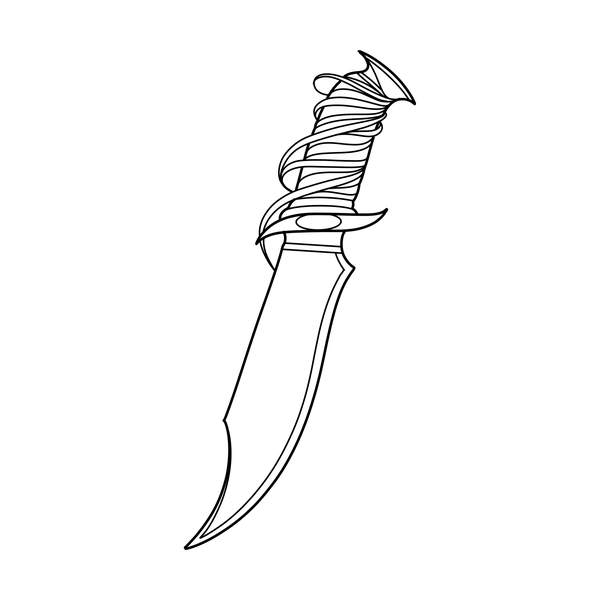
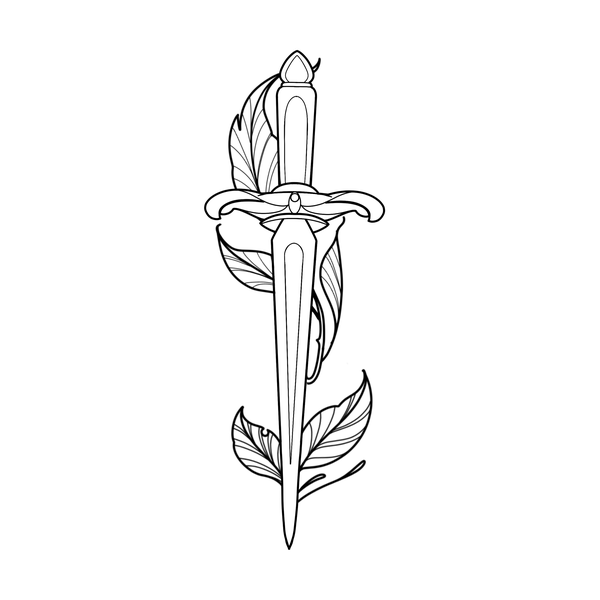
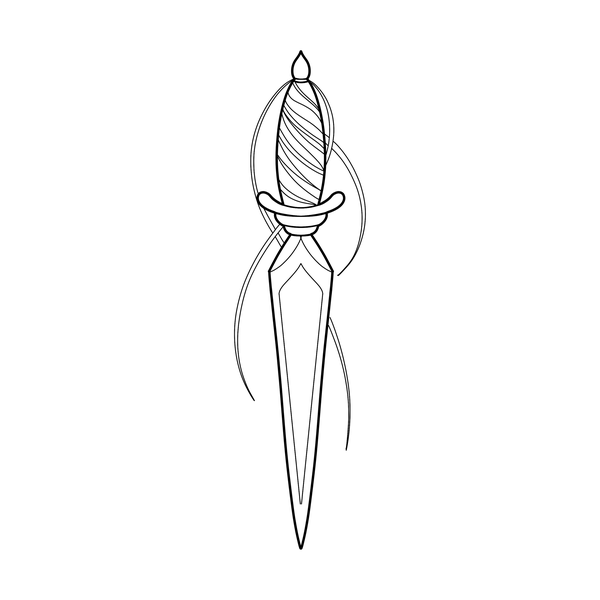
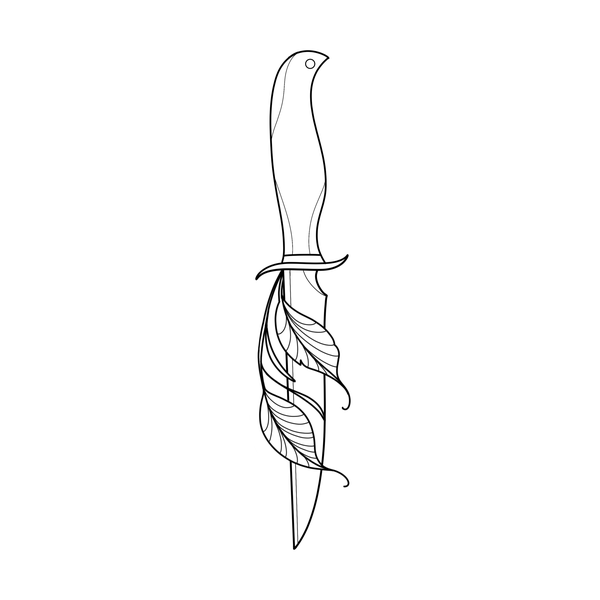
16 hand-drawn designs from our flash collection — book any one as-is, or use it as the starting point for a custom piece. Sizing, placement and linework dialed in at your consultation.
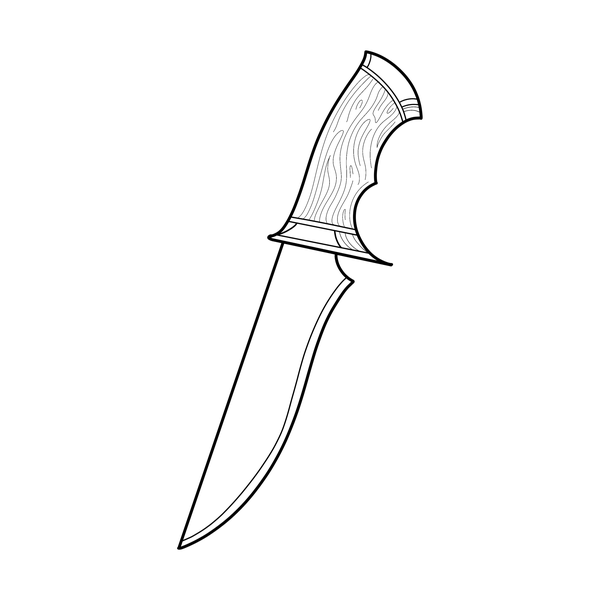
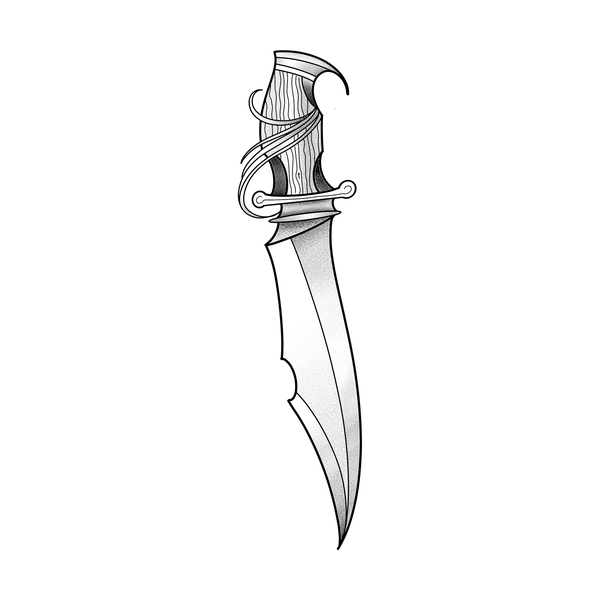
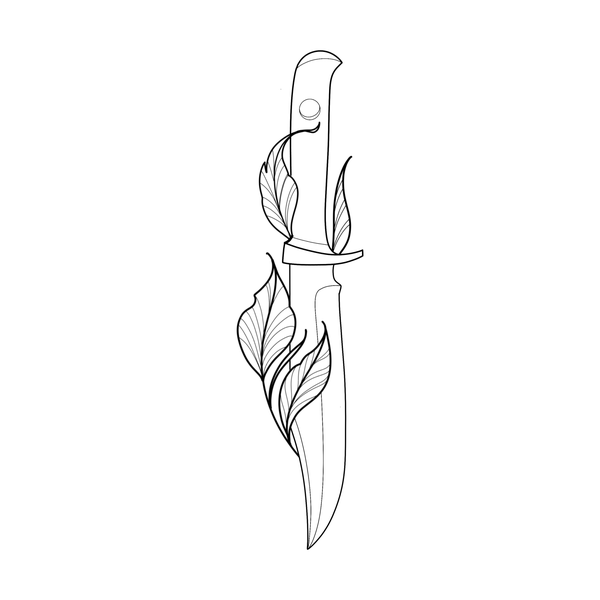
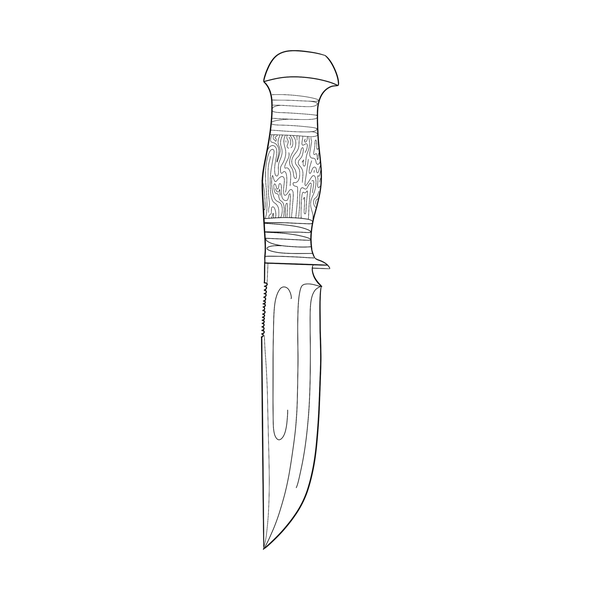
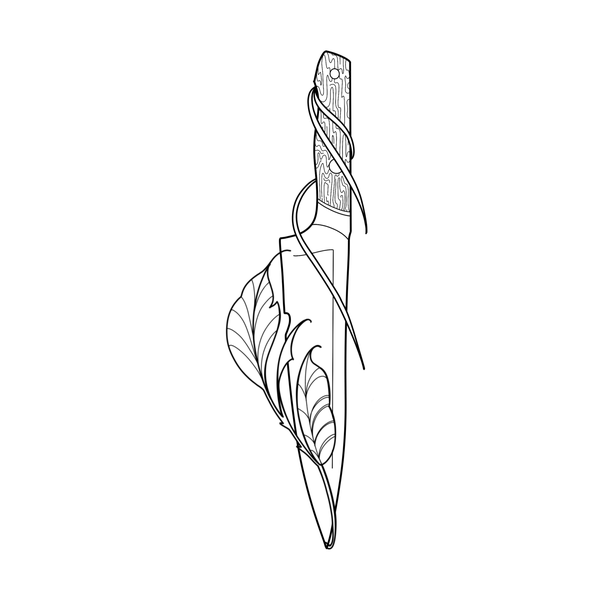
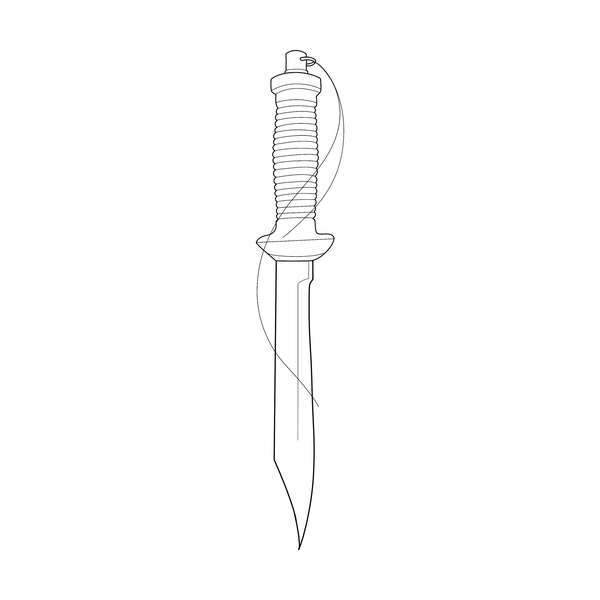
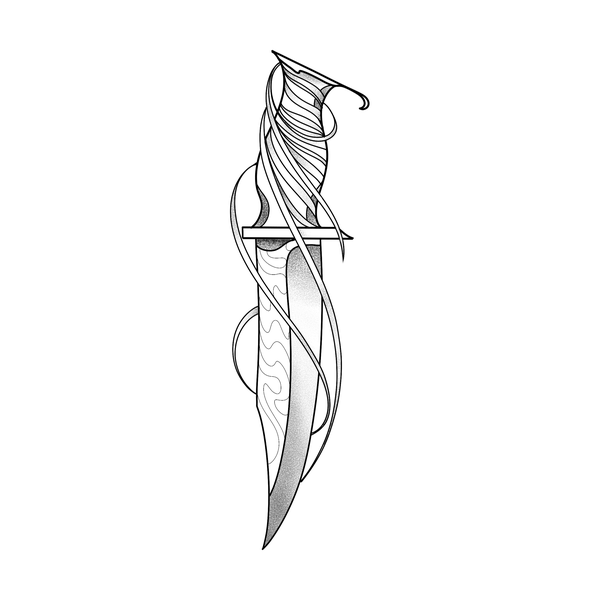
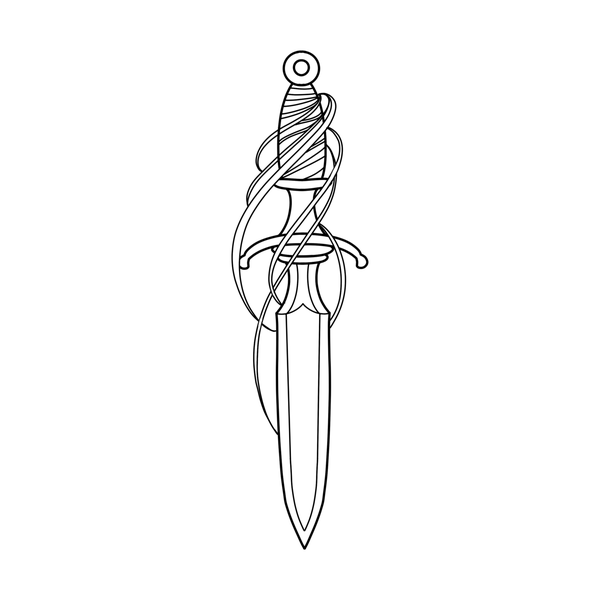
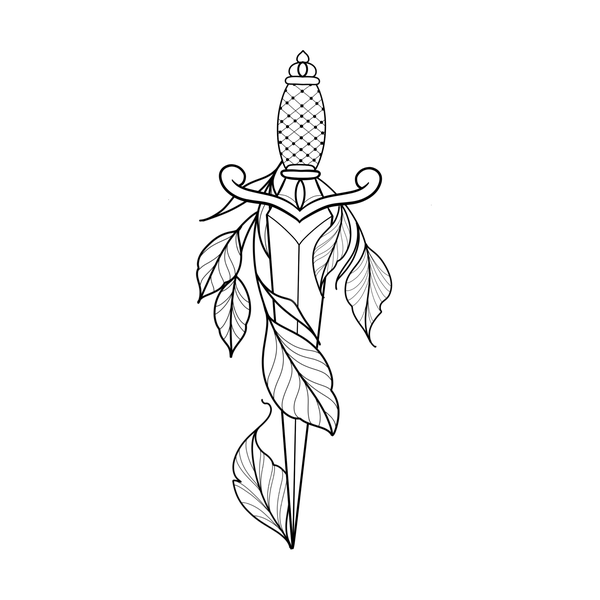
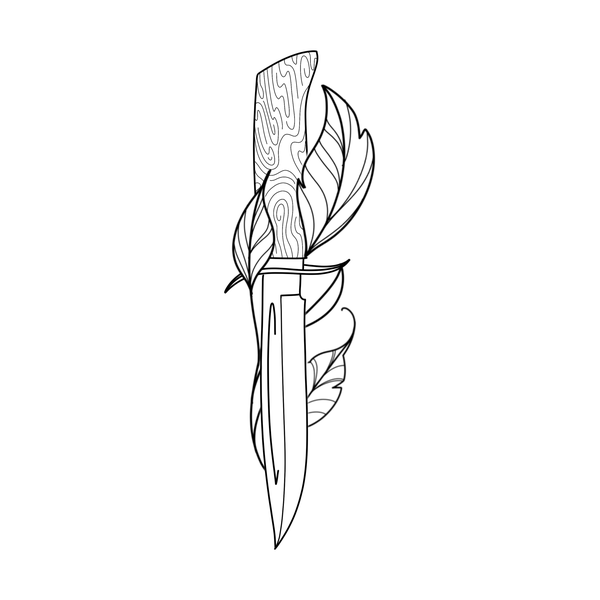
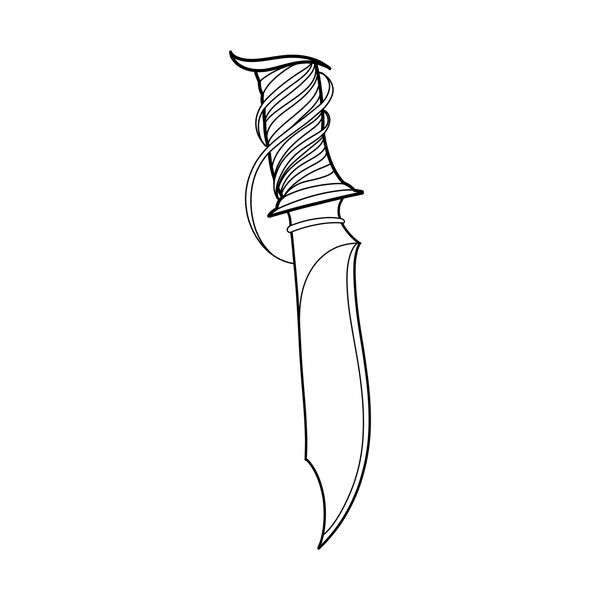
A dagger is a statement, and the statement changes depending on who’s wearing it, where it points, and what’s underneath the blade.
Point-up is ready. Point-down is in reserve. Dagger-through-heart is honest. Direction is not decoration.
Recognizability is not permission. The people who earned it read it instantly.
Blade & hilt
Where good dagger work separates from bad.
Blade and hilt are where dagger tattoos live or die. Roses forgive a wobble — a petal that bends the wrong way just becomes a different petal. A blade edge that bends the wrong way stops being a blade. Everything below is a drawing problem before it is a taste problem, and every one of these details is decided at stencil, not at the machine.
Blade shape
Straight and symmetrical (classical, Traditional). Curved (jambiya, khanjar, fantasy). Leaf-bladed (Greco-Roman). Ornate or serrated (dark-art, fantasy). Commit before the stencil, because the shape is the reading. Worth naming out loud: a dagger with a curved blade has quietly become a knife, a sword or a ceremonial object from somebody else’s tradition. If the straight double edge matters to you, say so, because artists reaching for visual interest tend to reach for curve first.
Fuller (blood groove)
The shallow channel running down the blade. Correctly drawn, it gives the blade three dimensions on a flat plane. Omitted or misdrawn, the blade reads as a paper cutout.
Hilt proportion
Roughly a third of the total length in the hand, two-thirds in the blade. Drift long on the handle and you get a costume prop; drift long on the blade and you get a short sword. This is the single fastest way to sanity-check a stencil taped to your arm in the mirror — cover the hilt with a thumb and see whether what’s left is still about twice as long as what you covered.
Pommel & crossguard
Plain, jeweled, skull-shaped, ornamental — the first thing the eye tracks at the top. Crossguard straight, curved, ornate, or heraldic — the horizontal element that anchors the vertical blade.
Grip material & point direction
Leather wrap, corded wire, gem-set, engraved metal. A detail most artists skip; the eye always notices. Point direction: down is commonly read as ceremonial, memorial, blade-in-reserve. Point-up is commonly read as declarative, ready, aggressive. Neither reading is a rule anyone enforces, but they’re consistent enough across the flash tradition that most tattooers will assume one unless you tell them otherwise.
The straight line itself
Here is the part almost nobody asks about and everybody notices afterwards. A dagger is mostly two long parallel lines, and long parallel lines are the hardest thing in the medium — skin moves, the limb is a cylinder, and a tremor that would vanish inside a rose petal shows up as a visible kink halfway down a blade. It’s also why dagger work is so placement-hungry: the design wants a run of flat, stable skin along a limb’s long axis, which is exactly why the outer forearm, the outer calf and the spine have carried this motif for a hundred years. Ask to see a healed straight line in an artist’s portfolio before you ask to see a dagger.
Twelve blades
Twelve blades clients ask for by name.
The dagger is one of a half-dozen subjects that built American tattooing, so the request list is unusually stable — these twelve have barely changed in forty years. Four of them are compounds where the blade pierces something else, and on those four the pierced element is doing most of the talking.
Single Traditional dagger
Sailor Jerry flash · bedrock
The bedrock. Sailor-Jerry-lineage bold outline, flat palette — silver blade, black line, wood-grain or wrapped-leather handle, a highlight chip on the steel. Runs along the long axis of a limb, which is the whole point: the dagger is directional, built to follow the forearm or calf it sits on. First-dagger clients almost always land here. Forty-year evidence exists.
Dagger through rose
Canonical flash pairing
Second only to rose-and-heart in Traditional lineage. Blade entering from above, rose at the midpoint, petals sometimes falling. The reading is temptation pierced — beauty met with resolve, or beauty met with violence, depending on how the rose is rendered. Traditional palette holds up best: saturated red petals, chrome-green leaves, silver blade, black line.
Dagger through skull
Memento mori sharpened
The blade enters through the cranium or sits crossed behind the skull like a standard. Works in Traditional, blackwork, and realism — each style gives it different weight. Traditional reads as flash-book iconography; blackwork reads medieval; realism reads closer to forensic. Pairs cleanly with a banner across the base — DEATH, MEMENTO, a name.
Dagger through heart
Reading hinges on rendering
A dripping heart with the blade driven through reads as heartbreak — Traditional Valentine’s style inverted. The same composition with heart intact and blade held against it reads as loyalty or oath. Same elements, two different tattoos. Clients who want loyalty should tell the artist out loud at consultation; the artist will draw the heart differently.
Dagger + snake
Traditional flash · heavier symbol load
Snake wrapped around the blade, or coiled at the hilt with the dagger rising out of its body. Reads as protection plus cunning, or as the weapon guarded by the thing it might need to kill. Needs scale to let the snake body carry movement — under 6 inches, the snake compresses into a decorative squiggle.
Dagger + banner
Personal motto piece
Blade vertical or angled, banner wrapped around the mid-blade or floating behind the hilt, text carrying a name, date, Latin phrase, family motto, or a single word — LOYALTY, HONOR, a call sign, a child’s name. Typography ages as much as the image; a serif with weight holds up better than a thin script. Ask the artist to draw the letterforms before the stencil.
Medieval / fantasy dagger
Illustrative · jewel-set pommel
Ornate hilt, jewels set in the pommel, engraved blade, sometimes runes or filigree along the fuller. Pulls from Lord of the Rings, Dungeons and Dragons, Souls-series iconography, and the heavier end of fantasy illustration. Works in Neo-Traditional with jewel-tone gems, full-color illustrative, or heavy blackwork with dot-shading on the ornamentation.
Ceremonial dagger
Kris · khanjar · athame
A specific cultural approach — specificity matters. A kris is the Indonesian and Malaysian wavy-bladed dagger with deep Javanese spiritual weight. A khanjar is the curved Arabian ceremonial dagger that appears on the Omani national emblem. An athame is the ritual blade of modern Wicca. Each carries meaning that is not interchangeable with “cool dagger.” See the cultural respect section.
Fine line dagger
Contemporary · hairline
Hairline single-needle work, no fill, blade rendered as outline only, handle treated as decorative line rather than dimensional shading. Sits comfortably next to fine-line florals, moons, and script. Ages faster than Traditional because the linework is at the limit of what skin holds. Expect visible softening at year 10.
Blackwork dagger
Solid silhouette · architectural
Solid black, architectural, engraved. Blade and hilt rendered with negative-space highlights rather than color — the chip on the steel is white skin, not white ink. Pulls from woodcut and medieval manuscript illumination. Ages exceptionally because there is no color to shift. Demands an artist with genuine blackwork discipline.
Pair of daggers crossed
Military insignia lineage
Two blades crossed at the midpoint like an X, or crossed behind a central element (skull, rose, shield, name banner). Reads as military insignia lineage — crossed sabers, Marine Corps heraldry, the crossed-blade iconography of specific units. Also reads as paired loyalty: two people, one composition. Symmetry demands both blades read as equals.
Memorial dagger
Named · consultation-heavy
The named piece. Dagger with a banner carrying a lost person’s name, service dates, call sign, or a short phrase that meant something to them. Often worn by military clients, families of veterans, or survivors marking a specific loss. Traditional style carries the weight because the lineage is already there — crossed blades and named banners have been tattooed on veterans for a century. Treat this consultation as a long one.
Six styles
Six different tattoos. Same word. Pick the style first.
Clients walk in asking for “a dagger” the way they walk in asking for “a rose” — as if there were one. There isn’t.
American Traditional — the flash-wall blade
Sailor Jerry canon
Bold outline, flat fills, limited palette — red on the wrap or gem, silver-gray on the blade, yellow highlight at the pommel. Often paired with a banner. Ages for decades. The default first dagger and the safest structural bet.
Neo-Traditional — jeweled pommel, patterned steel
Ornamental · expanded palette
Traditional’s bones, an expanded palette, room for ornament — jeweled pommel, filigree on the crossguard, Damascus-pattern blade. Two sessions common above 5 inches. Where much mid-scale modern dagger work lives.
Black & Gray Realism — metal built out of value, no outline
Photorealistic metalwork
Engraved blades, historical reference, reflective highlights rendered through value alone — no outline. Demands a specific reference photo. A realism dagger without a reference is an inventory dagger.
Fine Line — a straight edge at hairline weight
Hairline · 2020s style
Hairline single-needle work, stiletto profiles, minimal shading, often a single thin blade with a simple grip. Dominant 2020s style for intimate placements. Softens at 10 years — expect a touch-up if you want the finest lines crisp.
Illustrative / Dark Art — runes, heraldry, engraved fuller
Fantasy · medieval · knotwork
Ornate fantasy or medieval lineage — knotwork, heraldic crossguards, runes on the blade, occasional botanical or occult framing. Pulls from Dürer, manuscript illumination, and contemporary dark-art tattooers. One of the fastest-growing dagger requests.
Blackwork — the highlight on the steel is bare skin
Solid silhouette · architectural
Solid black, negative-space highlights, no outline, no fill gradient. Ages exceptionally — no color to shift, no fine gray to blur. Handles cover-ups. Demands a disciplined tattooer; patchy saturation ages badly and is hard to correct.
Five placement styles
The dagger is linear. Match it to linear skin.
The blade is already linear; the forearm, calf, and spine are already linear. The shapes agree. That’s why the dagger has lived on these placements for a century.
Vertical limb
Forearm · calf
The dagger’s native home. The blade is already linear; the forearm and calf are already linear. The shapes agree. Outer forearm reads declarative; inner forearm reads personal. Outer calf holds color on stable skin.
Spine (vertical)
Nape-to-mid-back · sacrum-up
Point-down from the nape or point-up from the sacrum. The most anatomically resonant placement for a dagger — the body’s own vertical axis. Demands a tattooer who can straight-line on a curving, moving surface.
Sternum (vertical)
Collarbone-down · breastbone
Between the collarbones and down the breastbone. Intimate, declarative, painful. Pairs with banner text or a pendant-style pommel. Fine line and illustrative styles sit cleanest here.
Read from across the room
Bicep · outer thigh
Where daggers wear at a distance — Traditional territory, visible under short sleeves or shorts. Handles larger compositions with banners, roses, or snakes.
A blade nobody else sees
Inner forearm · ribcage
Private style. Fine line, thin blade, no banner. A dagger for the wearer. Ribcage is the most painful placement on the list and most prone to blowout — book accordingly.
Cultural respect
A kris is not a khanjar is not an athame.
Specificity matters. Three ceremonial-dagger traditions come up in the shop often enough to name, plus one earned style worth handling the same way. Recognizability is not permission.
Kris (Indonesian / Malay)
The kris is not a dagger shape you pick because it looks interesting. It’s a sacred object in Javanese, Balinese, and broader Malay-world traditions — believed to hold spiritual essence, forged through specific rituals, passed down as heirlooms. Tattooing a kris without cultural connection is wearing someone else’s ritual object. If you have heritage or the deep study, work with an artist who knows the tradition. If you don’t, choose a different blade.
Khanjar (Arabian peninsula)
The curved ceremonial dagger of Oman, Yemen, and the broader Gulf. The khanjar is the national symbol of Oman and appears on the flag. It’s a specific cultural object with specific meaning. Same rule: heritage and context first, aesthetic second.
Athame (Wiccan ritual)
A double-edged ritual blade used in Wiccan and broader neopagan practice. If you’re a practitioner, this is yours. If you’re not, it reads as costume. The athame is part of a specific spiritual practice — not a decorative occult motif.
Military daggers
USMC Ka-Bar, fighting knives, regimental insignia. Not ceremonial in the religious sense, but earned in the same way. Honor non-veterans who claim this imagery — the people who did the thing notice, and the reading changes the moment it’s worn without the service behind it.
Scale honesty
Four tiers. Daggers don’t scale down like round subjects.
Detail lives or dies on real estate. A 3-inch rose still reads; a 3-inch ornate dagger compresses into a smudge.
Pricing, honestly
Blade length and what it goes through set the number.
Hourly is $100 with Blue, Hannah or Rick and $350 with Raa or David; a half day is $400 and a full day $600. A solo blade is quick. The same blade through a rose, a skull or a banner is a different appointment, because the secondary element is where the hours go. Final cost depends on artist, size, design and placement, and we quote it off the finished sketch rather than the idea.
Eight compositional pairings
The pairing is often the whole reading.
Eight classical pairings, each landing the dagger in a different category. The pairing shifts the meaning more than the rendering does.
Dagger + rose
The canonical pairing. Blade piercing the bloom or rose wound around the grip. Every style carries it. Forearm, bicep. 5–8 inches.
Dagger + skull
Memento mori. Blade through the cranium, or skull at the pommel. Traditional through Realism. 6–10 inches.
Dagger + heart
Heartbreak or loyalty depending on rendering. The oldest Traditional pairing after rose-and-dagger. Forearm, chest. 4–6 inches.
Dagger + snake
Cunning, venom, wisdom. Snake wound around the blade or coiled through the crossguard. 6–10 inches.
Dagger + banner
Motto piece. DEATH BEFORE DISHONOR, semper fidelis, a family name. Traditional lineage. Forearm, bicep. 5–7 inches.
Dagger + eagle / wings
Military style — USMC raider dagger, paratrooper, commando lineage. Traditional, often with rank or unit numerals. Bicep, chest. 6–8 inches.
Dagger + moon
Modern witchcraft style. Crescent behind the blade, often fine line, often with botanicals. Inner forearm, sternum, spine. 4–6 inches.
Twin crossed daggers
X-formation. Reads as rebellion, brotherhood, or piracy depending on the style. Chest, back, outer thigh. 5–8 inches.
Before the stencil
Six things to settle before anyone draws a straight line.
If you can’t answer the first one, we pause the design conversation and have the reading conversation first.
Which of the five readings?
Protection, conflict survived, loyalty, heartbreak, or ceremonial. If you can’t answer, we pause design and have the reading conversation first.
Point up or point down?
Point-down reads as ceremonial, memorial, defense, in-reserve. Point-up reads as offensive, declarative, aggressive, ready. Same blade, two different tattoos.
Blade style?
Straight European, curved, ornate fantasy, or specific ceremonial (kris, khanjar, athame)? Commit before the stencil.
Solo or composed?
Dagger alone, dagger-through-rose, dagger-through-heart, dagger-through-skull, dagger-and-banner, crossed pair. Composition is the whole reading sometimes.
Scale commitment?
Daggers are linear — they don’t scale down like round subjects. 3 inches, 5 inches, 8 inches, sleeve anchor? Detail lives or dies on scale.
Cultural specificity?
Kris, khanjar, athame, military — or none of the above? Each carries responsibilities. Name it at consultation, not after.
A realism dagger without a specific reference is an inventory dagger, and it shows.
Roses are forgiving. Daggers are not. The fuller, the crossguard, the grip wrap — every detail lives or dies on the linework.
Daggers are linear. The forearm is linear. The spine is linear. The shapes agree — which is why the dagger has survived in the canon for a century.
Common mistakes
Seven patterns to watch for.
Most disappointing dagger tattoos fall into one of these seven categories.
The “just looks cool” default
A dagger with no reading ages into a dagger with no reading. Fix: pick one of the five readings before design starts. Fixable in consultation. Unfixable after the tattoo.
The ornate blade at two and a half inches
Ornate handle, textured blade, banner, and rose compressed into 2.5 inches. Details collide, piece blurs at year 2. Fix: simplify the design or commit to 5+ inches. Detail scales with real estate.
The wrong-direction point
Booking point-up (ready, aggression, conflict survived) when the reading is actually protection or in-reserve. Fix: direction carries meaning. Match it to the reading in consultation, not at stencil.
The cultural-dagger-without-context
Kris, khanjar, athame booked because the shape is interesting. Ends uncomfortably. Fix: if you don’t have heritage or deep study connection, choose a different blade. Recognizability is not permission.
The over-ornamented generic
A dagger loaded with jewels, filigree, and fantasy-novel hilt work that belongs to no tradition and no reading. Looks busy, says nothing. Fix: pick a specific fantasy lineage or a specific historical reference.
The fresh-portfolio artist selection
Daggers look easier to tattoo than they are — the straight line of the blade punishes tremors and unsteady fills. Fix: book an artist whose HEALED dagger photos hold up at 2+ years, not a fresh portfolio.
The rushed military claim
Claiming the loyalty / oath style without the service behind it. Fix: the people who earned it read it instantly. If it’s not your lineage, pick a different reading — protection, survival, heartbreak all work.
Your first dagger
Traditional, 5 inches, forearm, solo, point-down.
The Apollo baseline. Seven decisions the first dagger should make on purpose.
Three personalization layers
Handle · banner · pairing.
The handle is the most personalizable element. The banner anchors the piece to one story. The pairing is often the whole reading.
The handle
The most personalizable element. Wrapped leather, engraved metal, gemstone pommel, wood grain, bone. A generic blade with a specific handle reads as specific.
The banner
A date, name, word, Latin motto, coordinates. Small text that anchors the piece to one person’s story without crowding the composition. Typography ages as much as the image — pick a serif with weight over a thin script.
The pairing
What the dagger is composed with — rose (beauty and defense), snake (guarded wisdom), heart (literal heartbreak), skull (memento mori and the edge), moth (softness with bite). The pairing is often the whole reading.
When to wait
Four signals the tattoo isn’t ready yet.
The dagger is a 20-year image. Treat it that way. If any of these apply, go home, think, come back.
You can’t answer the reading question
Come back when you can. A dagger without a reading ages generic. Spend two weeks, two months — the blade will still be there.
Cultural conversation hasn’t happened
Ceremonial daggers (kris, khanjar, athame) without heritage or deep study are regretted. Book the conversation before the appointment.
Middle of the breakup / conflict / grief
Dagger work done at the peak of the emotion sometimes reads differently 6 months out. If the feeling is less than 90 days old, consider waiting.
The only artist available has a fresh portfolio
Wait for the artist whose healed work holds up. The dagger is a 20-year image. Treat it that way.
FAQ
Nine dagger questions that come up almost every week.
Nine questions covering meaning, direction, style aging, ceremonial daggers, scale, composition, the snake-and-dagger pairing, military style, and first-tattoo guidance.
What does a dagger tattoo mean?
Five primary readings. Protection / boundary — what you defend, point-down in-reserve, the most common reading. Conflict survived — what you came through, point-up still-ready, memorial-adjacent. Loyalty / honor / oath — military lineage, USMC fighting-knife tradition, brotherhood of arms, specific and earned. Heartbreak / betrayal — the dagger-through-heart composition, literal and honest. Ceremonial / occult — kris, khanjar, athame, ritual blades from living traditions requiring cultural specificity. Pick one reading as primary before you pick the design. A dagger without a chosen reading ages generic.
Does the direction of a dagger tattoo matter?
Yes — direction is not decoration. Point-down reads as ceremonial, memorial, defense, blade-in-reserve — the reading for protection and what-you-defend. Point-up reads as offensive, declarative, aggressive, blade-ready — the reading for conflict-survived and what-you-came-through. Same blade, two different tattoos. Decide at consultation, not at stencil. A dagger stenciled sideways because it fits the arm is a shrugged dagger. Commit to orientation with the reading in mind.
What style of dagger tattoo ages best?
American Traditional ages best — bold outline, saturated fills, flash-lineage longevity tested across decades. Blackwork ages exceptionally because there’s no color to shift. Neo-Traditional ages well when the outline is confident. Realism ages well on stable-skin placements but demands careful artist selection. Fine line softens faster — expect visible softening at 10 years and potential touch-up at 15. Illustrative and fantasy styles age as well as their outline discipline allows. For longevity priority, pick Traditional or Blackwork. For contemporary aesthetic with acceptable maintenance, Fine Line or Neo-Traditional.
Can I get a kris, khanjar, or athame tattoo?
Depends on your connection. A kris is a sacred object in Javanese, Balinese, and broader Malay-world traditions — forged through rituals, passed as heirlooms, not interchangeable with “cool dagger.” A khanjar is the national symbol of Oman with specific Arabian-peninsula cultural weight. An athame is the ritual blade of Wiccan and neopagan practice. If you have heritage, practice, or deep study connection to any of these traditions, the design is yours and we’ll work with an artist who knows the tradition. If you don’t, choose a different blade — European classical dagger, Japanese tanto (with heritage), fantasy illustrative, Traditional flash. Recognizability is not permission.
How big should a dagger tattoo be?
Depends on detail load. Under 3 inches: fine line silhouette only — no internal blade detail, no visible fuller, pommel reads as a dot. 3–5 inches: Traditional outline, Fine Line, simple compositions — the universal sweet spot for a first dagger. 5–8 inches: where Neo-Traditional and Realism earn their keep — engraving, Damascus patterning, jeweled hilt, crossguard heraldry start reading. 8+ inches: statement vertical pieces planned from consultation as composition. The honest rule: daggers are linear, they don’t scale down like round subjects. An ornate dagger at 2.5 inches is a smudge on a 5-year timeline.
What’s the difference between dagger-through-heart and dagger-and-rose?
Reading and rendering. Dagger-through-heart: a dripping heart with the blade driven through reads as heartbreak — the Traditional Valentine’s style inverted, literal feeling made visible. The same composition with heart intact and blade held against it reads as loyalty or oath — same elements, two different tattoos. Dagger-and-rose: blade piercing the bloom or rose wound around the grip reads as temptation pierced — beauty met with resolve, or beauty met with violence depending on rose rendering. Both are canonical flash pairings. Pick based on the reading. If you want loyalty, say so out loud — the artist draws the heart differently.
Is it OK for a civilian to get a military-style dagger tattoo?
Depends on what you mean by military-style. A generic Traditional dagger in the Sailor Jerry flash lineage is not claiming specific military service — it’s claiming the flash tradition, which is itself partly military-descended but worn by civilians for a century. USMC Ka-Bar imagery, regimental dagger insignia, crossed unit-specific blades, and named memorial pieces for service members are different — the people who earned those read them instantly, and a civilian wearing them without the service behind them ends up in a different place than they planned. If you want the dagger without the specific military claim, pick Traditional flash, fantasy, or ceremonial style. If you have specific military connection, wear it with the specific insignia that applies.
What’s the best first dagger tattoo?
American Traditional, 5 inches, outer or inner forearm, solo composition, point-down, banner optional. That is 2–3 hours in a single session, so your artist’s hourly is what decides the number — $100/hr with Blue, Hannah or Rick, $350/hr with Raa or David. We quote it off the drawing. Pick an artist whose healed Traditional dagger work holds up at 1–5 years — not fresh-wrap Instagram photos. Daggers are linear and unforgiving; the straight line of the blade punishes tremors and unsteady fills in a way round subjects don’t. Clients who want something more ambitious scale up from here. Don’t scale down from a sleeve plan.
What does a snake and dagger tattoo mean?
A snake wrapped around or pierced by a dagger is one of the oldest Traditional flash pairings, and the reading turns on who wins. A dagger driven through the snake reads as a threat defeated — danger, temptation, or an enemy overcome by will. A snake coiled live around the blade, fangs bared, reads as the opposite: venom and steel as twin warnings, power held in reserve. Because the snake already carries rebirth, medicine, and danger all at once, the composition lets you choose which of those the dagger answers. Decide the outcome — snake defeated, snake ascendant, or an uneasy truce — before the stencil, because the artist draws the coil and the blade angle differently for each. American Traditional and blackwork hold this pairing best at 5 inches or more, where the scales and the fuller both have room to read.
Ready to pick the style?
Bring the reading. Bring the direction. Bring the pairing if you know it.
Tell us what the blade goes through and the rest follows. Protection, conflict survived, loyalty, heartbreak, ceremonial: the pairing carries the meaning and the direction settles it. We pick line weight for an edge that has to stay straight for forty years.