Tattoo Styles
Tribal
One shop word, a dozen unrelated cultures. Polynesian, Marquesan, Maori, Hawaiian and Iban traditions are living systems with their own rules and their own gatekeepers, and lumping them together erases all of it. How we separate them, and where we refer out.
Book a consultationAt the chair
What “tribal” actually names.
The word flattens a family of distinct living cultural traditions into a single commercial label. The first job of an honest guide is to unflatten it.
“Tribal” in the commercial-tattoo vocabulary usually refers to a loose family of bold-black, solid-fill, geometric work descended from — and often diluted out of — a set of distinct living cultural traditions. Samoan pe'a and malu. Maori ta moko. Hawaiian kakau. Iban work from Borneo. Haida formline crest art from the Pacific Northwest Coast. Kalinga batok from the Philippines. Inupiat and First Nations chin-line work. Each carries specific meanings, specific protocols, specific rules about who applies the work and who receives it.
Calling all of this “tribal” as if it were one thing does a disservice to every tradition in the list. A Samoan tufuga ta tatau applying a pe'a carries centuries of lineage and protocol; a Maori ta moko artist works with iwi consultation and elder approval; a Kalinga batok practitioner hand-taps with a thorn and a stick of charcoal ink. These are not styles in the commercial sense. They are cultural practices with gatekeepers.
Apollo's honest position is that authentic cultural work is not ours to offer. When clients want pe'a or ta moko or kakau, we refer them to practitioners from those traditions and, where it helps, write references or introductions. That's the right call, not a lost sale. What we can do is modern blackwork — original, abstract, designed-from-scratch compositions that honor the aesthetic vocabulary of bold shapes, solid black, and negative-space flow without claiming sacred meaning or borrowed identity.
The consultation conversation names this distinction openly. “Is this a cultural piece, or an abstract blackwork piece?” is always the first question. The answer determines everything else — artist fit, pattern choice, design approach, framing. We do not design pieces that reproduce protected cultural patterns, and we do not pretend to. That clarity is part of what makes the work we do sit honestly on a body.
Living traditions
Four lineages, by way of example.
Four of the living cultural tattoo traditions, named specifically. Not a complete list — a reminder that “tribal” contains many distinct practices with specific gatekeepers.
Samoa · ongoing
Pe'a & malu (tufuga ta tatau)
The pe'a is the male body suit from waist to knees; the malu is the women's thigh work. Applied with hand-tapped au tools by tufuga ta tatau — master practitioners in the Sulu'ape family and affiliated lines. The work carries rank, lineage, and earned status. Receiving one partially and stopping is a recognized failure.
Aotearoa New Zealand · ongoing
Ta moko (Te Uhi a Mataora)
Ta moko is identity. Facial moko and moko kauae (women's chin) carry whakapapa — genealogy and tribal identity. Ta moko is for Maori, applied by Maori practitioners working with iwi consultation and elder approval. Non-Maori receiving facial moko is considered culturally harmful regardless of intent.
Hawai'i · revived
Kakau (Keone Nunes lineage)
Traditionally applied with bone combs and mallets (uhi). Geometric bands, triangles, and repeated motifs mark family, rank, and spiritual protection. Revived in recent decades by practitioners including Keone Nunes working in the old tools. Kuleana — responsibility — is carried by the practitioner and respected within community protocol.
Philippines · ongoing
Batok (Kalinga · Whang-od)
Batok is hand-tapped with a thorn and a stick of charcoal ink. Whang-od Oggay and the Butbut community of Buscalan, Kalinga, maintain the practice. Batok markings record honor, beauty, and protection. Clients seeking authentic work travel to Buscalan — it is a pilgrimage, not a booking.
Other traditions — Iban work from Borneo, Haida formline crest art, Marquesan patutiki, Inupiat chin-line tavlugun, Plains and Woodlands First Nations markings — each carry their own practitioners, protocols, and restrictions. For any of these, Apollo's first and best contribution is a referral into the lineage rather than an attempt at imitation. Legitimate cultural practitioners will ask about your lineage before agreeing to specific markings; that conversation is part of the work.
Blackwork variations
Eight directions modern blackwork takes.
What Apollo builds in the tribal-adjacent lane — abstract, original, designed for the client rather than adapted from a cultural template.
Abstract geometric arm wrap
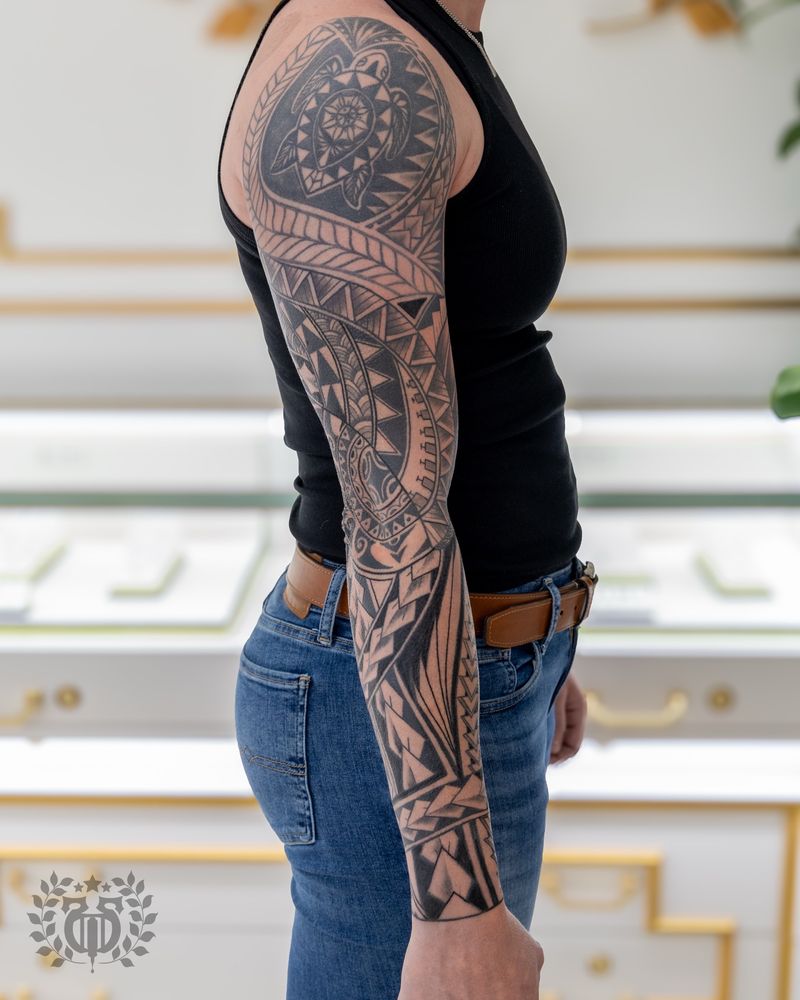
An original geometric composition wrapping the bicep — triangles, curves, and solid black fills designed from scratch. Not derived from any specific tradition; built from abstract blackwork vocabulary. Flows with the bicep contour and reads strong at distance. Framed at consultation as blackwork inspired by visual language, not cultural reproduction.
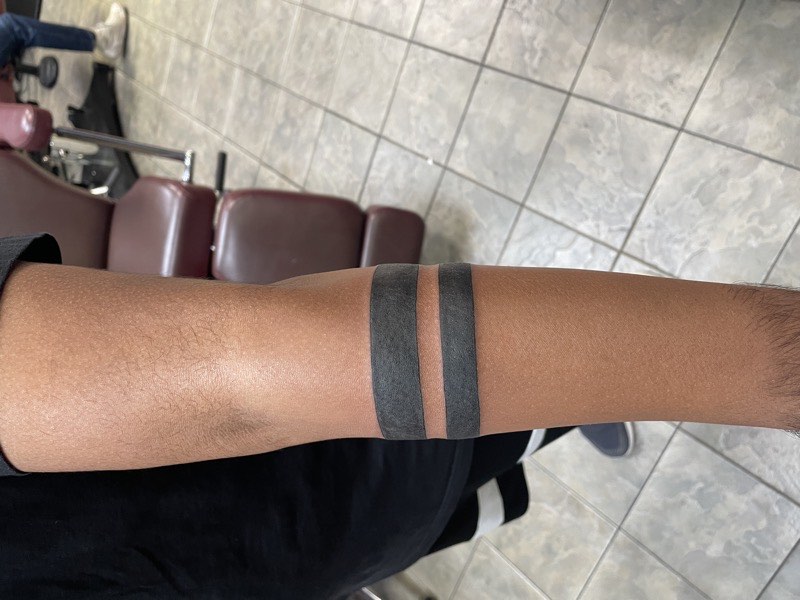
Blackwork armband
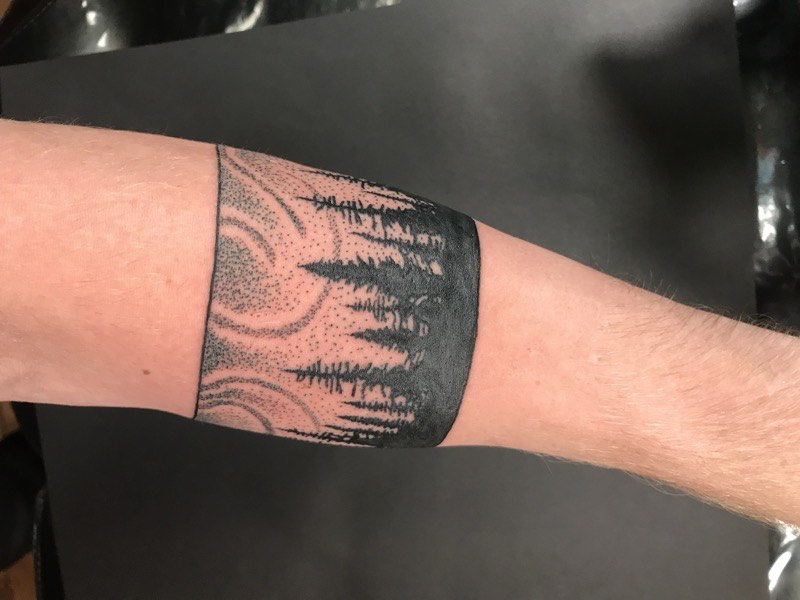
Single or double solid black bands, sometimes with negative-space geometric patterns cut into them. Classic, clean, non-culturally-specific. The modern successor to the '90s tribal armband, designed without borrowing sacred patterns. A strong first blackwork piece.
Neo-tribal organic curves
A contemporary interpretation using organic flowing shapes rather than geometric angles. Influenced by modern blackwork artists globally (Thomas Hooper, Valentin Hirsch, Maxime Plescia-Büchi) rather than by any single cultural tradition. Reads as fine art more than tribal reproduction.
Abstract chest panel
Symmetrical across the sternum with flowing curved shapes spreading toward each shoulder. Uses bold black fields and deliberate negative-space “lines” to create movement. Purely abstract composition; designed for the client's chest rather than adapted from a cultural template.
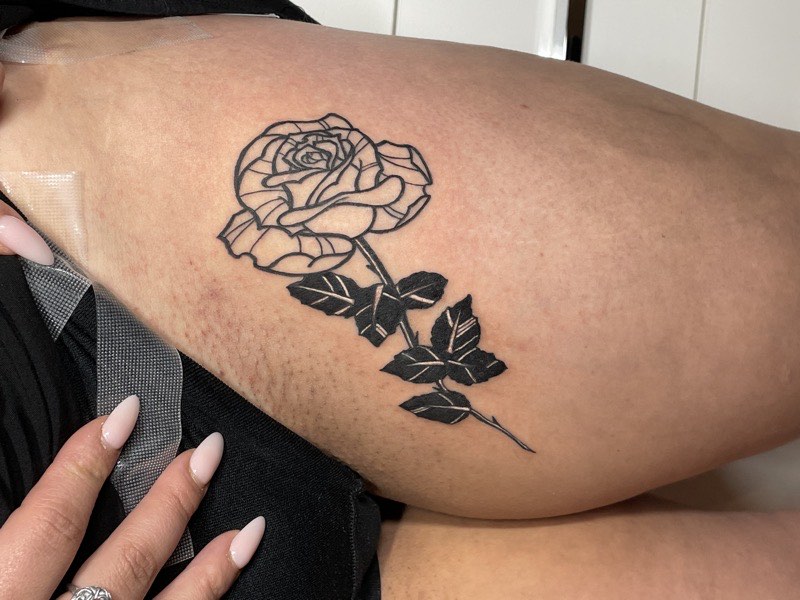
Bold geometric calf piece
Angular shapes and solid fills wrapping the calf muscle, using the leg's curve as part of the composition. Strong negative-space work. Designed as abstract geometry rather than cultural reference. Reads authoritatively at distance.
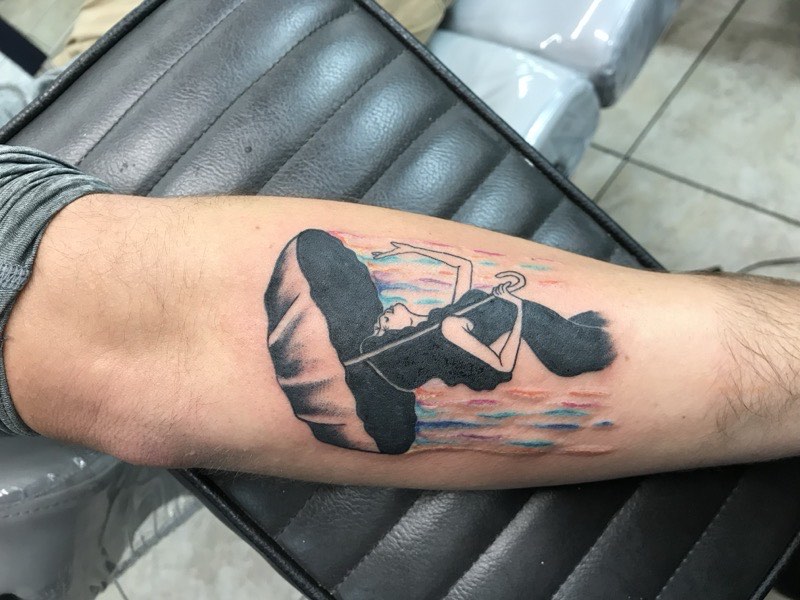
Abstract shoulder cap
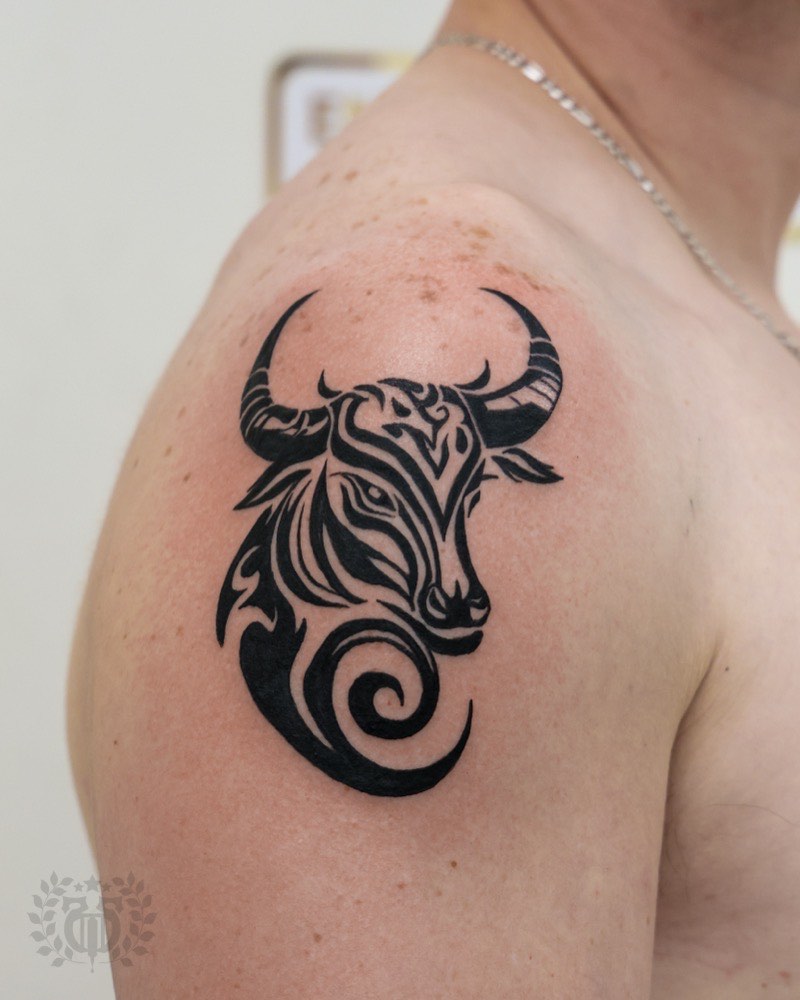
Flowing shapes capping the deltoid, using the shoulder's rounded geometry. Designed as a stand-alone piece or a foundation for later sleeve extension. Original abstract composition — not borrowed iconography.
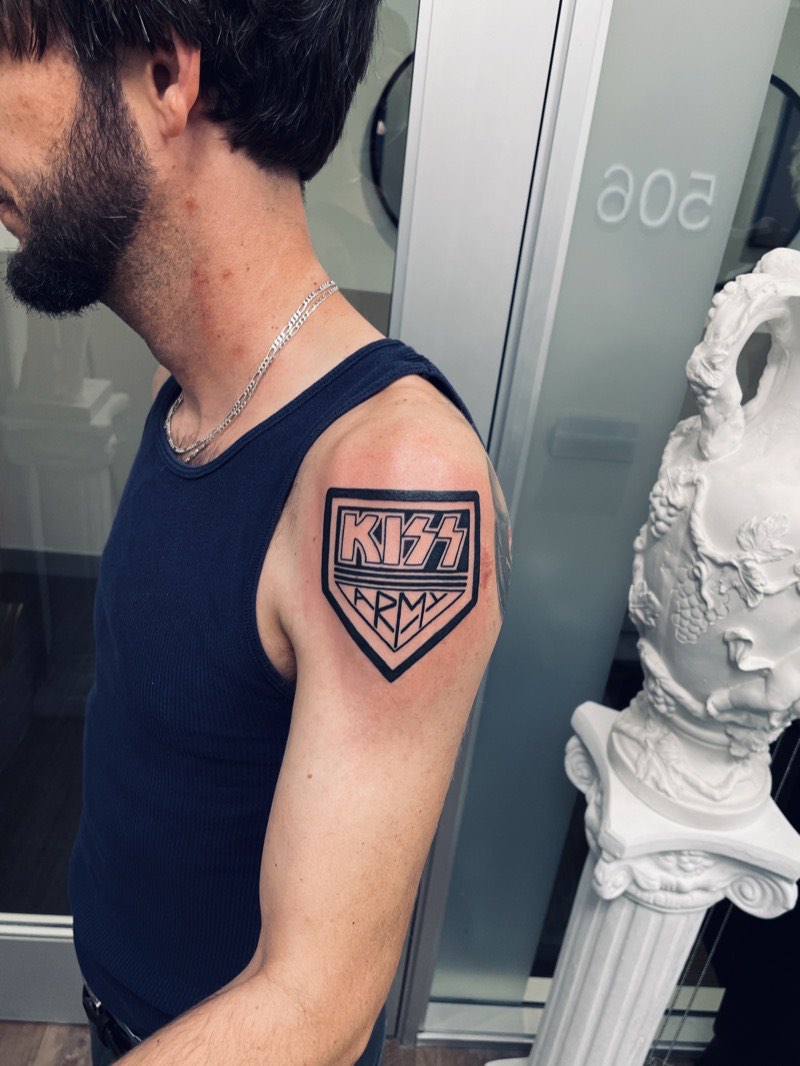
Negative-space figure
Composition where the skin-tone negative shapes carry the design and black is the background. Strong for clients who want tribal-inspired visual impact with a modern twist. All original geometry, no sacred reference.
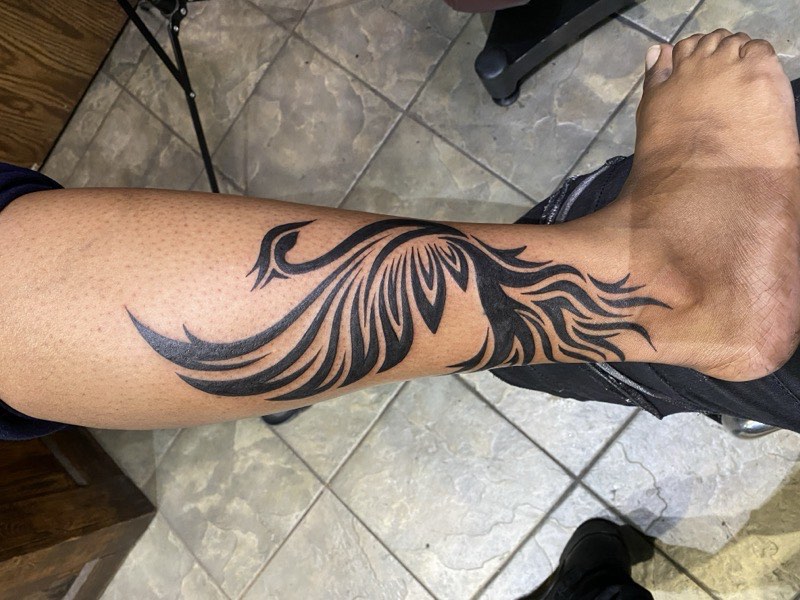
Bold statement sleeve
A full-sleeve blackwork composition built from original geometric and organic vocabulary — not a reproduction of any cultural tradition. Consultation-heavy build, multi-session commitment, designed to wrap the arm as a unified statement piece.
What Apollo does not offer
Honest limits & referrals.
The specific cultural traditions we do not attempt, and the practitioners we point clients toward instead.
Authentic Samoan pe'a / malu
The pe'a (male body suit) and malu (women's thigh work) belong to the Samoan tufuga ta tatau tradition. Applied with hand-tapped au tools, the work carries rank, lineage, and earned status. Receiving one partially and stopping is a recognized failure. Not ours to offer — we refer clients to Sulu'ape-family lineage practitioners.
Maori ta moko
Ta moko is identity. Facial moko and moko kauae carry whakapapa — a person's full genealogical and tribal identity. Ta moko is for Maori, applied by Maori practitioners with iwi consultation. Non-Maori receiving facial moko is considered culturally harmful regardless of intent. We do not do this work.
Hawaiian kakau
Traditionally applied with bone combs and mallets (uhi). Revived in recent decades by practitioners including Keone Nunes. Kuleana — responsibility — is carried by the practitioner and respected within community protocol. Clients seeking authentic kakau are referred to practitioners in that lineage, not handled at Apollo.
Kalinga batok
Hand-tapped with a thorn and a stick of charcoal ink. Whang-od Oggay and the Butbut community in the Philippines maintain the practice. A pilgrimage to Buscalan, not a booking. We refer clients interested in authentic batok to the Butbut community directly.
Iban / Haida / Indigenous First Nations work
Each carries its own lineage, protocol, and often clan-specific restrictions. Haida formline crest art is tied to clan and lineage; Iban bunga terung marks a young man's first journey; Indigenous North American practices are being revitalized by community practitioners. We refer rather than attempt.
Generic '90s “tribal” mash-ups
The flattened, culture-blind armband style of the 1990s usually mixes Polynesian, Bornean, and Indigenous motifs without design logic or cultural awareness. We steer clients toward modern blackwork alternatives — abstract geometry, ornamental bands — that look strong without borrowing sacred patterns.
Composition size
Blackwork as body composition.
Blackwork is built for scale. These rules are where the style carries properly — saturation, negative-space rhythm, body contour.
Composition sizes
Blackwork needs room to breathe. Below half-sleeve, the negative-space rhythm breaks and the piece reads as a patch rather than a composition.
Below this the band reads as a line rather than a structural element of the body.
A full blackwork sleeve is planned as one continuous composition from deltoid cap to wrist, with the design flowing across the bicep, elbow, and forearm.
Patchy black ruins the aesthetic. Expect longer sessions and deliberate re-layering; plan for touch-ups to deepen the black around year 10–15.
Placement styles that carry blackwork
- Bicep / full sleeve (arm wrap). The classic canvas. Design wraps continuously around the bicep, forearm, or both.
- Chest panels (symmetrical). Reads across both pectorals, often connecting into shoulder and upper-arm work.
- Full back. The largest canvas. Ideal for expansive compositions that use the spine as an axis.
- Calves and thighs. Strong vertical canvas for flowing designs; wraps well around the calf muscle.
- Shoulder caps (stand-alone). Deltoid pieces that can later extend into a sleeve.
- Ribs into oblique (connective). Works as a bridge between chest, back, and leg compositions in larger builds.
Ground that breaks a composition
- Fingers / small placements. Blackwork needs scale to breathe; tiny placements don't carry the style.
- Wrists (as solo pieces). Works as the lower edge of a sleeve; not strong as a standalone band without other work.
- Hands (without heavy adjacent work). Hands work when they complete a sleeve; as solo pieces, friction shortens the piece's lifespan.
- Neck (as a first tattoo). Reserved for clients already heavily tattooed.
- High-stretch solo placements (inner elbow, inner bicep). Solid black fills distort asymmetrically across flexion crease.
- Over scar tissue. Ink spreads unevenly through scarring; blackwork's density magnifies the inconsistency.
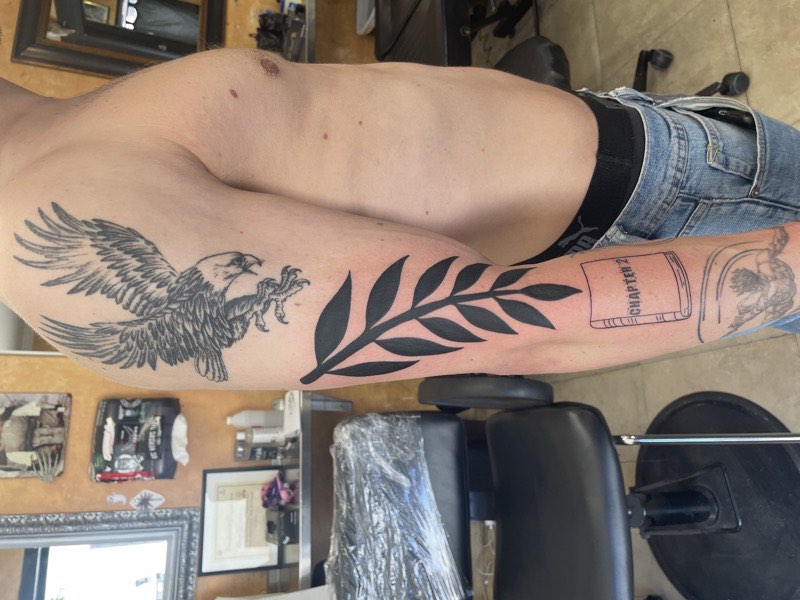
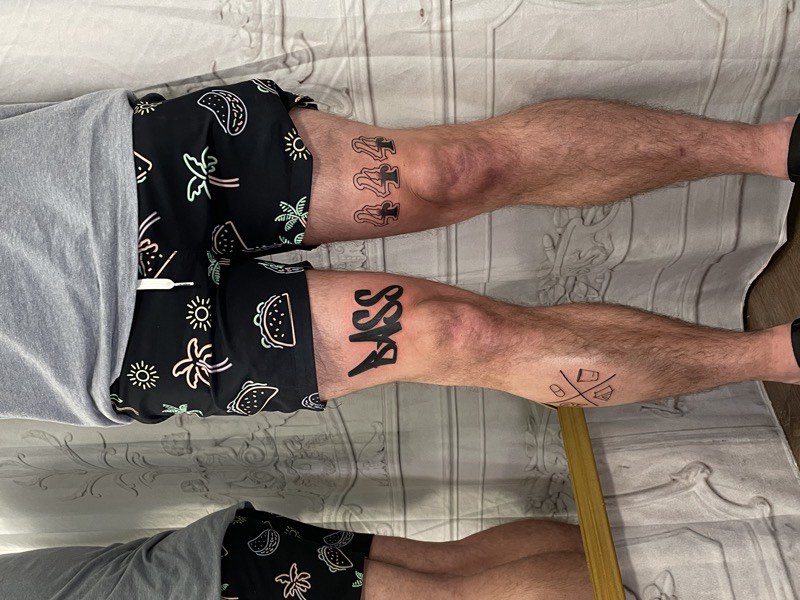
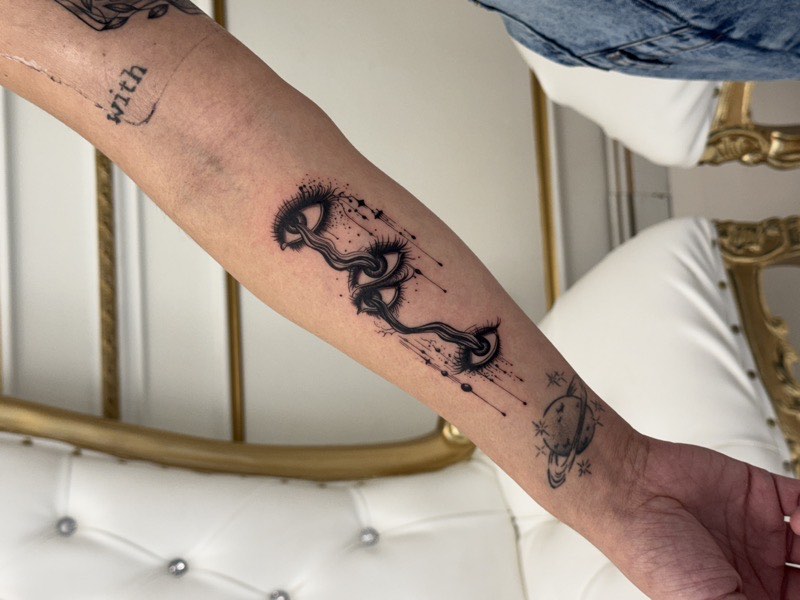
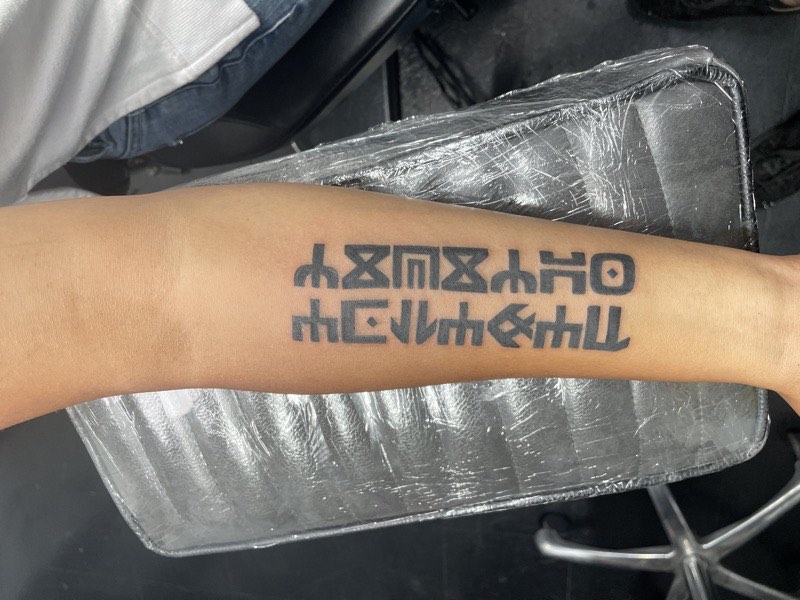
Blackwork in the wild
Composition-first blackwork.
Thirty-year arc
How blackwork ages on real skin.
Solid blackwork is among the longest-lived styles in tattooing. The read across two and three decades.
Settle and deepen
A healed blackwork piece at one year sometimes reads darker than the fresh photo — saturated black fills deepen as the epidermis fully regenerates. Edges soften a hair. This is the medium settling, not aging.
The long plateau
Blackwork ages better than almost any other style. Solid black fields hold through this window with no intervention. Negative-space “lines” stay crisp because the skin around them is fresh rather than worked.
Slow even fade
A well-laid blackwork piece loses a single shade of black density over this span, evenly across the field. Uneven fade signals saturation inconsistency at the original lay-down; even fade is the specialist signature.
Re-saturation window
Most blackwork clients book a single re-saturation pass somewhere in this window — a focused session to deepen the black fields back to their original density. The outlines and negative-space composition rarely need intervention.
The long read
Well-executed blackwork pieces at 30 years still read beautifully — often better than any other style pound-for-pound. The decision to commit to scale and solid saturation from the start is what pays off on the long arc.
Three variables dominate blackwork longevity: saturation completeness (packed black holds better than patchy), UV exposure (covered placements outlast exposed ones), and skin biology. Blackwork is priced by scope, hours and artist, quoted in the room, and drawn for a twenty-to-thirty-year arc.
Composition table
Composition → scale → placement.
The reference table for the blackwork lane.
Lanes and myths
Six conversations we have before drawing.
Repeated patterns from first-time tribal/blackwork clients. Framing for the next conversation.
“I want authentic Samoan / Maori / Hawaiian work.”
We do not offer any of those. Authentic work in living cultural traditions belongs to cultural practitioners — Sulu'ape family tufuga, Te Uhi a Mataora Maori artists, Keone Nunes-lineage kakau practitioners. We will help you find them.
“A '90s tribal armband is fine, it's just a style.”
Most '90s armbands are a loose remix of Polynesian, Bornean, and Indigenous sacred patterns, flattened culturally. Whether a specific piece reads as appropriation depends on the patterns used. Better path: abstract blackwork that looks strong without borrowing sacred motifs.
“I'm partially descended, so I can get the traditional work.”
Possibly — and the right person to answer that is a practitioner from that specific tradition, ideally with community and family consultation. Heritage connection matters, but so does protocol. We refer rather than assess, because that assessment isn't ours to make.
“A talented tattooer can replicate any tribal pattern.”
Authenticity lives in lineage, language, and protocol — not the visual style. A skilled blackwork artist can produce a technically clean piece that reproduces a sacred pattern, but that does not make the piece authentic. The tradition holds, and the pattern carries meaning the wearer may not carry.
“I want the tribal look without the cultural baggage.”
That's exactly the lane Apollo can offer. Modern blackwork — abstract, original, not borrowed iconography — reads as strong and graphic without pretending to be cultural work. Bold shapes, negative space, body-conscious flow.
“Neo-tribal and tribal are the same thing.”
Neo-tribal is a contemporary art movement using tribal-adjacent visual vocabulary for modern design goals. It's original work by named artists (Curly, Mike the Athens, Maxime Plescia-Büchi, et al.), not a cultural tradition. We can do neo-tribal. We do not do sacred cultural work.
A first blackwork piece
Eight steps for a first blackwork piece.
Apollo's path from the first consultation through a first blackwork commission — or, when appropriate, a referral to a cultural practitioner.
Name what you actually want
Is this cultural work or abstract blackwork? The honest answer at consultation determines everything else — artist fit, pattern choice, framing.
If it's cultural, we refer
Apollo will help identify cultural practitioners in the tradition you're drawn to. That's the respectful path, and often the best one.
If it's blackwork, find a saturation specialist
Scroll portfolios for healed full-arm sleeves at 5+ years. Are black fields even? Are negative-space lines crisp? Blackwork specialists have healed work to show.
Plan the scale honestly
Blackwork needs room. Half-sleeve minimum for most compositions; full sleeve for statement pieces; chest panel or back scale for larger work.
Design original, not borrowed
If you're not wearing a cultural piece, the design should be original — abstract geometry, flowing organic shapes, negative-space figures. Not reproduced sacred patterns.
Accept the session count
Solid-black saturation takes layering. A full sleeve typically runs 3–6 sessions across months. Don't rush the lay-down or the black comes in patchy.
Plan re-saturation around year 12
A single re-saturation session deepens the black fields back to original density. Book the relationship with the artist for this, not just the first pass.
Respect the medium's aesthetic rules
Bold shapes, solid saturation, body-conscious flow, negative space as a structural element. The aesthetic works when those rules hold; it breaks when they're ignored.
Your composition
Three layers that make a blackwork piece yours.
Abstract blackwork becomes unmistakable through three layered choices. None of them borrow cultural patterns.
Original abstract composition tied to you
A blackwork piece designed from scratch for your body flow, your placement, your aesthetic — rather than an off-the-shelf template. The design process is where the piece becomes specifically yours, not the visual style.
Negative-space rhythm
The skin-tone gaps inside solid black fields are where individual blackwork pieces distinguish themselves. A signature negative-space pattern — the client's chosen rhythm — makes the composition recognizable.
Scale commitment
Blackwork asks for scale. Clients who commit to a sleeve or full chest panel end up with a piece that reads as a deliberate statement rather than a patch. The scale choice is the personalization.
Conversations first
Eight requests we hear repeatedly.
Repeated failure modes for first-time tribal or blackwork clients.
- —Requesting authentic Samoan, Maori, or Hawaiian work from an artist outside that tradition
- —Assuming a '90s armband is stylistically neutral
- —Picking a generalist without deep blackwork saturation experience
- —Going too small — blackwork needs scale to carry the aesthetic
- —Fragmenting sessions across multiple artists on the same piece
- —Skipping the cultural-framing conversation at consultation
- —Reproducing patterns found online without asking about origin
- —Ignoring the re-saturation cadence for solid black fills
Hard questions
Eight questions we would want asked of us.
Questions that surface the distinction between sacred cultural work and original blackwork — and separate specialists from generalists in the blackwork lane.
- Is this piece being framed as abstract blackwork or as a cultural reference?
- Can you show me three healed full blackwork pieces at five years or more?
- If I want authentic cultural work, can you refer me to a practitioner from that tradition?
- How do you plan solid-black saturation across multiple sessions?
- What's your approach to negative-space composition on this placement?
- Do you have experience with cover-ups of old '90s tribal armbands?
- Can I see your design process — freehand, stencil, digital layout?
- Have you ever declined a tribal-style request? What was the situation?
Any studio that doesn't welcome the cultural-framing conversation is the wrong studio for this work. We put a number on it once we know which lane the piece is in.
FAQ
The uncomfortable questions, answered.
Eight questions, including the ones we would much rather you asked before you booked anything.
Can I get an authentic Samoan, Maori, or Polynesian tattoo at Apollo?
No. Authentic Samoan pe'a, Maori ta moko, Hawaiian kakau, and related Polynesian practices belong to cultural practitioners who carry the lineage, language, and protocol. Apollo does not offer these, and we will not attempt them. What we can do is bold, inspired-by blackwork that borrows the visual language of strong shapes and heavy black without claiming sacred meaning or identity it doesn't have.
Is the '90s tribal armband appropriation?
The generic '90s armband is usually a loose remix of Polynesian, Bornean, and Indigenous motifs, flattened into something stylized. Whether it reads as appropriation depends on the specific patterns used. At Apollo, we steer clients toward modern blackwork armbands — bold geometry, ornamental bands, linework — that look strong without borrowing sacred patterns whose meaning the wearer doesn't carry.
Why is ta moko specifically off-limits for non-Maori?
Ta moko is identity. The patterns carry genealogy, tribal affiliation, and personal history, and they are traditionally given with iwi (tribal) consultation and elder approval. A non-Maori artist applying ta moko — or a non-Maori person wearing it — isn't borrowing a style, it's wearing someone else's family record. That's why the practice is protected and why Apollo will not do it.
What CAN Apollo do that looks “tribal”?
Plenty. Bold blackwork, ornamental patterns, dotwork mandalas, geometric armbands, neo-tribal abstract forms, blackout sleeves, and heavy linework designs — all of which read as strong and graphic without pretending to be cultural work. If you want the visual impact without the appropriation risk, this is the lane we stay in.
Who should I go to for an authentic cultural tattoo?
A cultural practitioner from that specific tradition. For Samoan work, a tufuga ta tatau. For Maori, a Maori ta moko artist working with tribal consultation. For Hawaiian, a kakau practitioner in the lineage of Keone Nunes. These practitioners are findable — through cultural centers, community networks, and Polynesian-run studios. Apollo is happy to point you in the right direction.
Can I cover my old tribal tattoo with something respectful?
Yes. Cover-ups of old generic tribal pieces are common, and blackwork is especially good for the job because the existing ink is usually already solid black. We can turn an old armband into an ornamental band, a blackout sleeve, or a modern geometric piece — something that reflects who you are now. Pricing discussed at consultation based on scope.
Is there a tribal style I CAN get without issue?
Modern neo-tribal and abstract blackwork — original designs that aren't reproductions of any specific cultural tradition — are widely considered fine. These are designed as personal artwork, not as borrowed identity markers. The line is whether the piece claims to be something sacred it isn't.
How do I know if something I'm considering is appropriative?
Ask: Does this pattern belong to a specific living culture? Does it carry sacred or identity meaning there? Am I from that culture? If the first two are yes and the last is no, it's worth pausing. We're happy to talk through the design with you honestly — and redirect you if redirection is what's needed.
The conversation starts with honesty.
Tell us what you want — we'll name the right lane and the right artist.
If it's authentic cultural work, we'll refer you to a practitioner from that tradition. If it's abstract blackwork, bring two or three reference images, the placement you're drawn to, and we'll design original work for your body. Either way you leave with a straight answer about which lane your idea belongs in. You get a number at consultation, not before.