Piercings
Types Of Body Piercings
A working-studio guide to body piercing — anatomy-first thinking across the ear, nose, mouth, and navel, with healing timelines by tissue type and the jewelry standards that keep a fresh piercing clean.
Book a consultationPiercing vs tattoo
A different discipline. A different skill set.
Piercings are not small tattoos. The practice is different, the physics are different, and the stakes of a mistake compound on a different timeline. Knowing what separates the two is the first step in reading a good piercer.
A tattoo is a one-way door
Ink goes into the dermis, the skin closes over it, and barring laser or a cover-up, it stays. A piercing is the opposite — a hole held open by jewelry, kept alive by daily care, and closed (mostly) the moment the jewelry comes out.
Tattooing is visual, piercing is anatomical
Tattooing is primarily a drawing discipline with technical skill carrying the image into skin. Piercing is primarily an anatomical discipline — reading tissue, mapping landmarks, choosing angles — with aesthetics riding on top of the anatomical call.
Mistakes compound faster
A bad tattoo is a cosmetic problem that lives on the surface of the skin. A badly angled cartilage piercing pushes on tissue the body can’t defend — the body rejects, migrates, scars, or abscesses. Mistakes compound in days, not years.
Five body regions
Piercings sort by region, because the region determines what’s possible.
Tattoos sort by style. Piercings sort by anatomy. These five regions cover almost every piercing a working studio sees, each with its own healing timeline, jewelry rules, and consultation checklist.
Ear cartilage & lobe
15+ placements
The densest piercing real estate on the body. Lobe, helix (forward, outer, contour), daith, tragus and anti-tragus, rook, inner and outer conch, snug along the anti-helix, industrial barbells spanning cartilage to cartilage. Different structures, different healing timelines, different jewelry rules. Our ear piercing chart maps all 15 by placement, pain level and healing time.
Facial
6 placements
Nostril, high nostril, septum, bridge, cheek, eyebrow. Each one sits on top of cartilage, bone, or fascia with specific behavior. Septum is cartilage. Bridge is a surface piercing through the fascia between the brows. Cheeks carry risk profiles the others don’t.
Oral
5+ placements
Tongue (center, paired “venom,” frenulum), smiley (upper lip frenulum), lip in all its traditions (labret, Monroe, Madonna, vertical labret), and medusa through the philtrum. Oral piercings heal in a wet environment — faster in some ways, more complicated in others.
Body
Multiple
Navel, nipple, dermal anchors (single-point piercings anywhere flat tissue allows), surface piercings, and microdermals. These placements are the most anatomy-dependent of all — the body either has the structure to hold them or it doesn’t.
Genital
Specialist service
Handled with discretion and respect. The category exists, the work is legitimate, and the anatomical assessment is even more important here than elsewhere. Same principles apply: anatomy first, jewelry second, aesthetic third.
Anatomy drives everything
The four principles every consultation surfaces.
A tattoo consultation is about design intent. A piercing consultation is, first, an anatomical assessment — is the tissue here, in the shape we need, to carry this jewelry for the months it takes to heal. These are the principles working studios quietly use to answer that question.
Anatomy is a constraint, not a preference
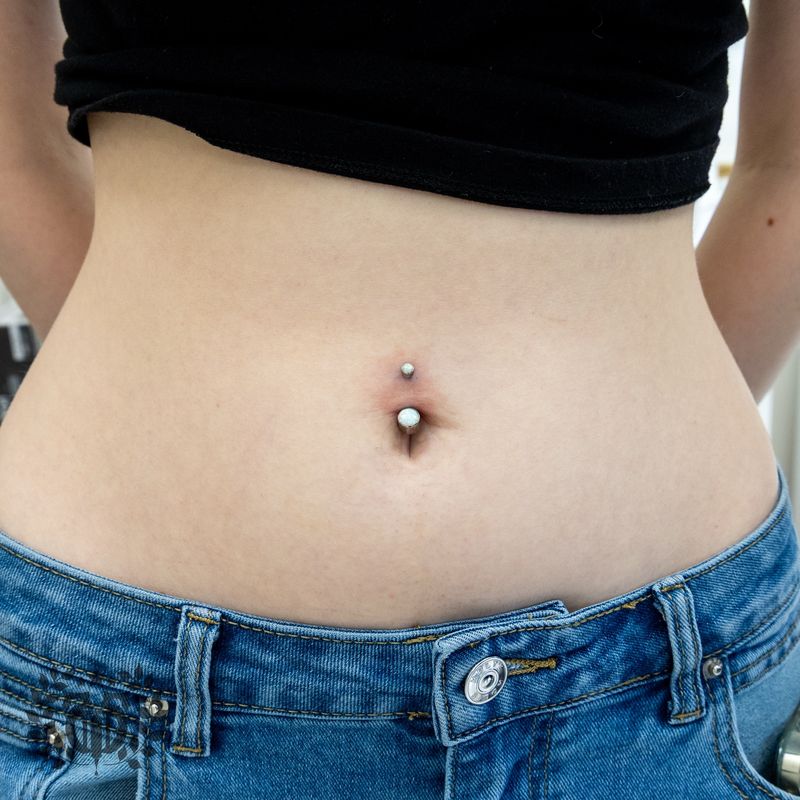
Ear cartilage doesn’t arrive in a standard shape. The fold that makes a snug possible on one person may be absent on another. Rook piercings require a ridge; if the ridge isn’t there, the piercing isn’t there. Tongues carry veins that rule out certain placements outright. Navels depend on a “shelf” of tissue above the navel itself — navels without that shelf reject almost universally, regardless of skill.
Symmetry is a reference, not a rule
Ears are not mirror images. One lobe sits higher, one helix curls tighter, one tragus juts further forward. A piercer matching placements by measurement alone produces work that reads crooked to the eye, because the eye was reading the asymmetry of the underlying anatomy. Good piercers map by landmark, not by ruler.
“Where my friend has it” isn’t a placement brief
It’s a request for a size 9 shoe because someone else wears a 9. Bodies aren’t interchangeable. A photo on the phone is useful as visual reference for what the client likes; it is not useful as a map for where the needle goes on a different person.
“No” is a skill, not a failure
A piercer who tells a client their anatomy won’t support the piercing they asked for is doing the job correctly. A piercer who pierces anyway — because the client wants it, because the shop wants the fee — is producing a rejection, a migration, or a scar on a delay.
A tattoo is a one-way door. A piercing is a relationship — kept alive by daily care, closed the week the jewelry comes out.
Anatomy isn’t a preference. Asking for a piercing your body can’t hold is asking for a rejection you’ll pay twice — once for the jewelry, once for the scar.
A piercing is a wound with a purpose. The jewelry is not the piercing — it is what lets the piercing survive long enough to become jewelry.
Ten priority piercings
The placements Apollo sees most often.
Ten piercings that cover most of what a working studio in LA does — each with a short pitch, healing window, starter jewelry, and the misconception the page exists to correct. Click through for the dedicated deep-dive.
 The catch-all primer
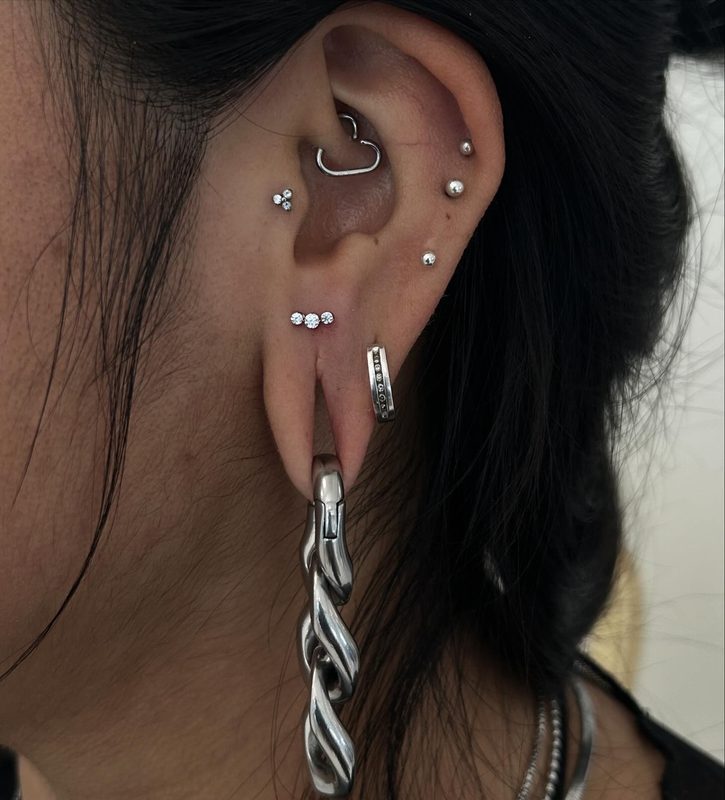
 Everything on the outer ear lives under this umbrella — which is why the term is useful for search and almost useless at the counter.
Read the Ear Piercing page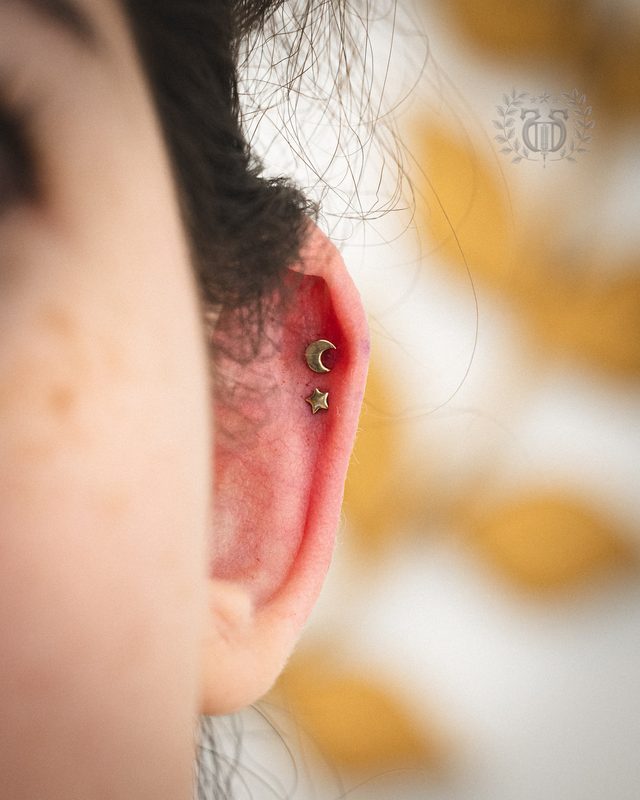 Upper cartilage curl
 The outer upper curl of the ear — the placement most people picture when they picture a “cartilage piercing.”
Read the Helix Piercing page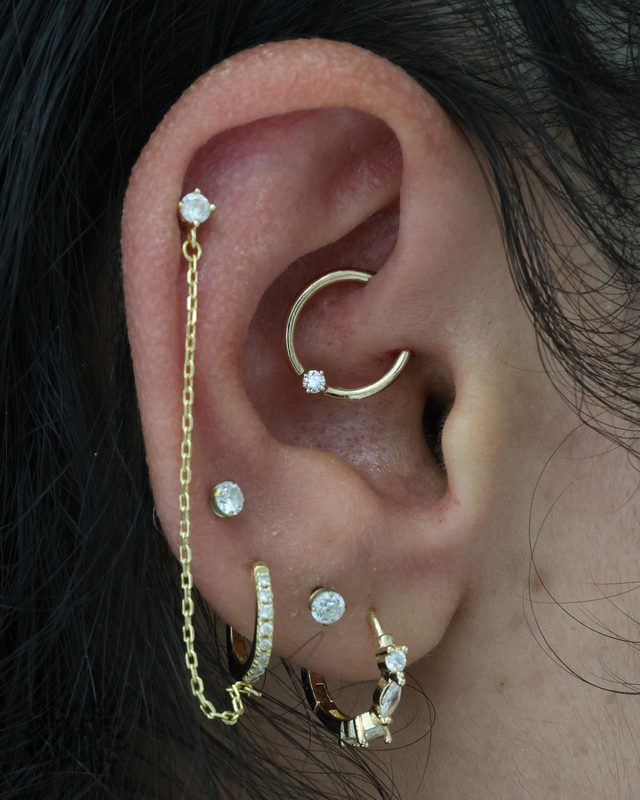 Innermost fold
 Daith Piercing
The piercing that sits inside the innermost fold of the ear, hugging the canal opening without blocking it.
Read the Daith Piercing page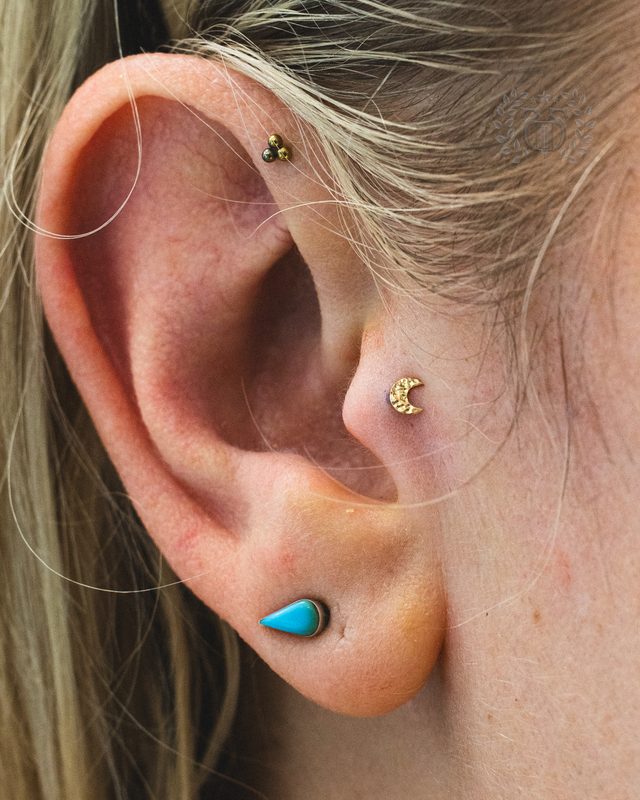 Ear-canal flap
 The small flap of cartilage that covers the ear canal — a compact placement that punches above its weight visually.
Read the Tragus Piercing page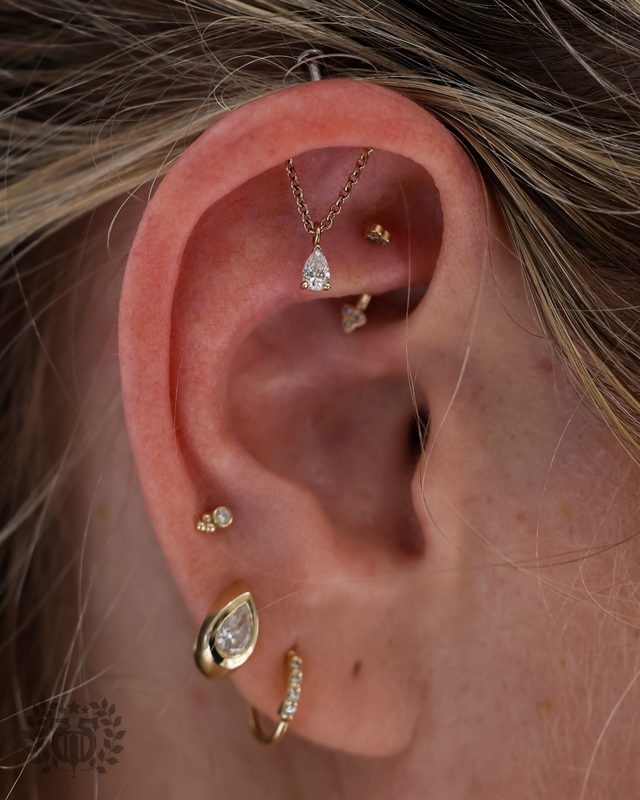 Antihelix ridge
 A vertical piercing through the antihelix fold above the tragus — structural rather than decorative.
Read the Rook Piercing page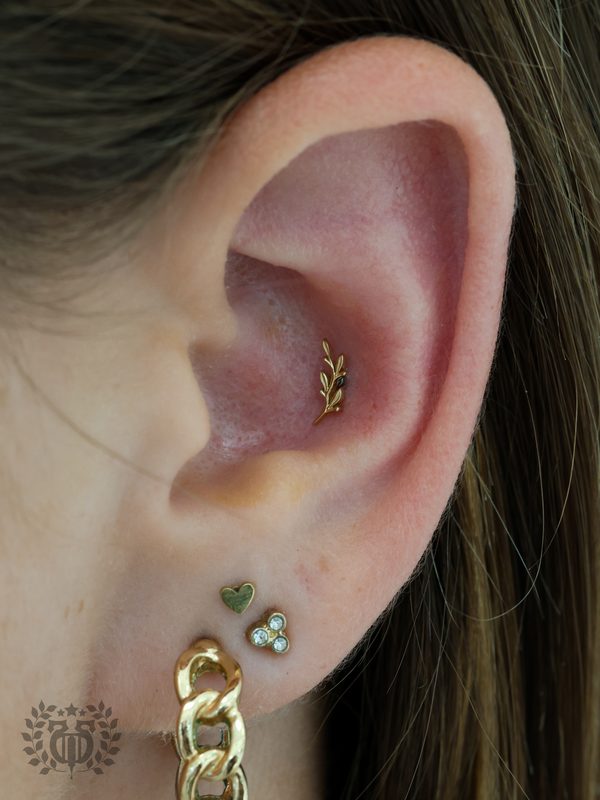 The ear bowl
 The open bowl of the ear — the largest continuous piece of cartilage on the outer ear, and the most flexible placement on the page.
Read the Conch Piercing page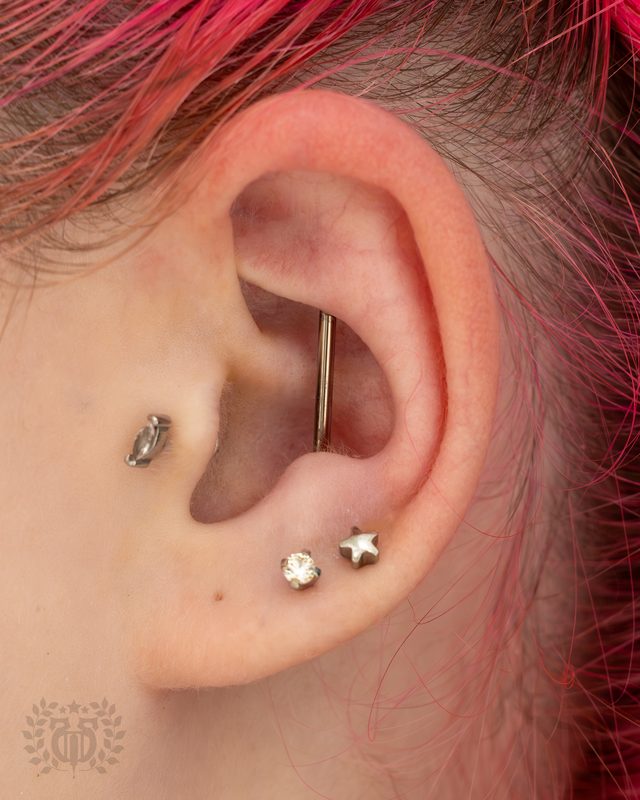 Two piercings, one bar
 Two piercings, one bar — a single piece of jewelry running across the top of the ear through two cartilage points.
Read the Industrial Piercing page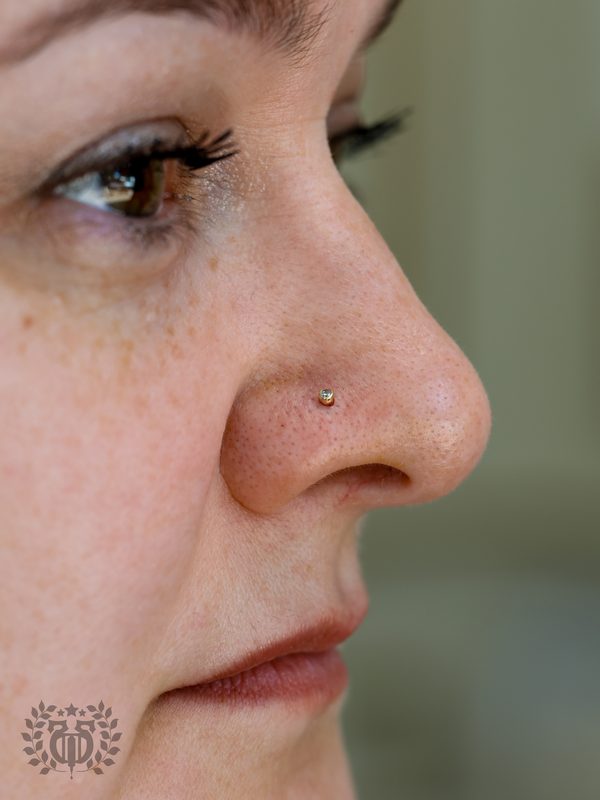 Most-requested outside the ear
 Nose Piercing
The catch-all term for nostril piercings — one of the oldest continuous piercing traditions on Earth, and still the most-requested placement outside the ear.
Read the Nose Piercing page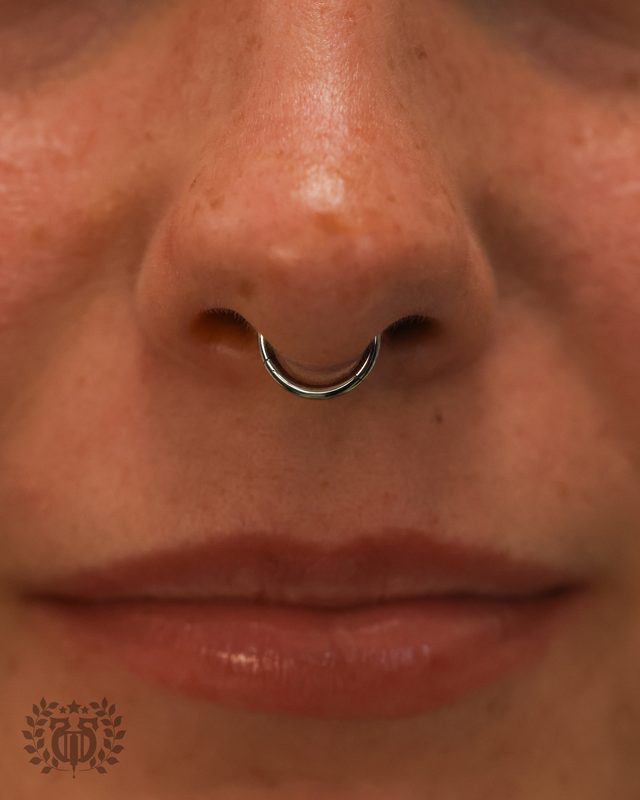 The “sweet spot”
 The piercing that passes through the thin strip of flexible tissue between the nostrils — never through cartilage, despite the common assumption.
Read the Septum Piercing page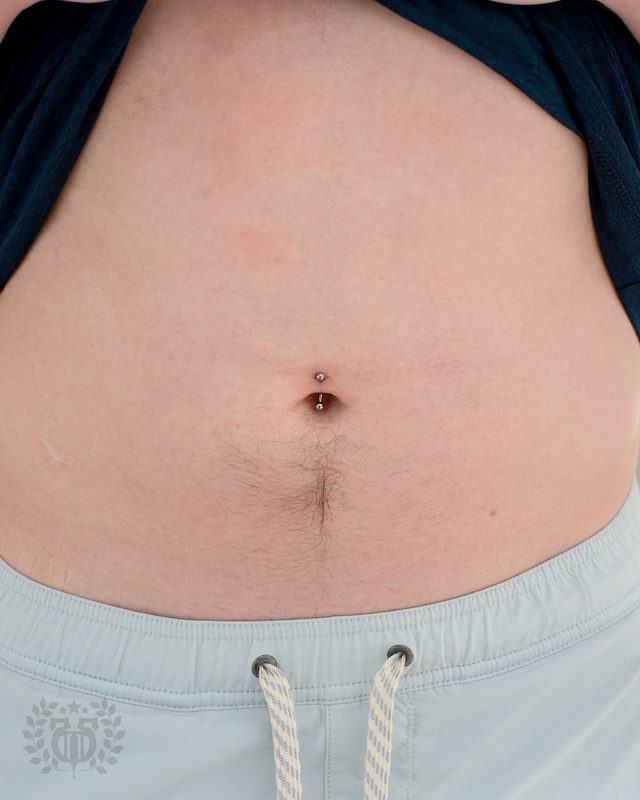 Anatomy-dependent
 A surface piercing through the upper rim of the navel — anatomy-dependent in ways most people do not realize until they consult.
Read the Navel Piercing pageDermals and surface work
How much does a dermal piercing cost?
At Apollo a single dermal is booked at $200 and a double at $400, as priced in our booking system on 27 August 2026. Elsewhere the number varies widely, because a dermal is more procedure than a standard piercing — and because studios differ on what the quote includes.
Three things drive the price anywhere you go. The number of anchors — dermals are usually placed as a set, and each one is a separate placement. The jewelry — the anchor sits under the skin and the visible top screws into it, and tops range from plain titanium discs to gem settings, which is why one studio's quote and another's are not always describing the same thing. Ask specifically whether the jewelry is included; we cannot tell you how another studio prices it, and our own booking record does not encode it either, so the honest answer is to confirm at the appointment. Removal — dermals are designed to be removed by a piercer, and that is a separate visit worth budgeting for from the start. Our piercing prices page carries the current picture, and any quote you should act on is the one given after your anatomy has been looked at.
A dermal is not a surface piercing, and the difference matters. A surface piercing enters and exits the skin at two points, with a bar running under the tissue between them. A dermal — a single-point piercing — has one opening, with an anchor seated in the dermis and a decorative top screwed on above. Both are placed in flat tissue with no natural fold to hold them, which is why both carry a higher rate of rejection and migration than a piercing through a rim of cartilage or a lobe. Neither is permanent in the way an ear piercing is permanent. Anyone selling you either as a lifetime placement is overpromising; the realistic framing is a piercing you enjoy for a period and have professionally removed when it has run its course.
Healing timeline
Tissue type. Blood supply. Patience.
The ranges below are industry-standard, not promises — bodies vary. The most useful mental model: “healed” and “ready to change jewelry” are two different milestones. A piercing can look calm on the outside while the fistula is still fragile on the inside.
Lobe · nostril · navel · eyebrow · septum
Typically feel settled at 6–12 weeks and finish their deeper healing by about 6 months. These sites have generous blood supply and a rich lymphatic network — they close fast and downsize early.
Helix · tragus · rook · conch · daith · industrial · forward helix
6–12 months typical, with industrial bars sometimes taking up to 18. Cartilage has almost no direct blood supply — it heals from the perichondrium at the edges, slowly. Any setback early (sleeping on it, catching a hoodie, swapping jewelry too soon) can restart the clock.
Tongue · lip · labret · Medusa
Surprisingly fast on the surface, often closing in 4–6 weeks, because the mouth is densely vascularized and constantly bathed in saliva. The catch: oral piercings sit in a bacterial environment and live next to teeth and gums — early complications are not rare even when healing looks quick.
Nipple
6–12 months is typical. The tissue heals around a busy everyday area (clothing, activity, moisture) — patience and careful jewelry selection matter more here than in most placements.
VCH · Christina · Prince Albert · frenum
Vary so widely by anatomy and placement that any number quoted outside a consultation is a guess. The most useful mental model: your consultation will include a realistic timeline for your specific piercing.
Industry jewelry standards
Why cheap jewelry wrecks piercings.
Every reputable studio in the country defers to the professional piercing industry on jewelry. The standards aren’t arbitrary — they exist because cheap jewelry in a healing wound causes predictable, preventable problems.
Why material matters
Nickel allergy affects roughly 10–15% of the population. Low-grade jewelry can leach nickel, copper, and other irritants into an open wound. Acceptable baseline: ASTM F-138 surgical steel and niobium. The gold standard: ASTM F-136 implant-grade titanium. Solid 14k or 18k gold (nickel-free alloy, not plated) is acceptable for healed piercings. Plated jewelry and most mall-kiosk stock does not meet the bar.
Why gauge matters
Gauge is the thickness of the post — thinner is not better. 18-gauge is common in retail earrings and is often too thin for a healing lobe; the jewelry can migrate or cheese-wire the channel. Studio standard for most lobes and cartilage is 16-gauge or 14-gauge, depending on placement and anatomy.
Body jewelry vs fashion jewelry
A real material-science distinction, not a marketing trick. Body jewelry is manufactured to tolerances that keep it smooth inside a wound — mirror-polished, internally threaded, documented alloy. Fashion jewelry is made to look good in a display case.
Threaded vs threadless
Externally-threaded jewelry has threads on the post that drag through the piercing every time it’s inserted — a tear risk in a fresh channel. Internally-threaded and threadless jewelry keeps the smooth post in contact with the tissue. Internally threaded is the studio standard.
Starter vs downsize
Day-one jewelry is sized longer to accommodate swelling. Once swelling resolves (4–8 weeks for soft tissue, 3–6 months for cartilage), the piercer downsizes to a shorter post that sits flush and stops catching. DIY jewelry changes inside the healing window are one of the surest ways to injure a piercing that was doing fine.
Aftercare protocol
Sterile saline. Twice a day. That’s it.
Modern piercing aftercare is not complicated, and the single biggest mistake clients make is doing too much. The principle is LITHA — “Leave It The Heck Alone.” Most piercings that go wrong were cleaned too aggressively, not too little.
The protocol, in full
- Sterile saline rinse (0.9% sodium chloride, nothing else) sprayed onto the piercing
- Twice a day — morning and night
- Gentle pat-dry with a clean paper towel
- That’s it. LITHA: “Leave It The Heck Alone”
What not to do
- Don’t rotate the jewelry — rotating doesn’t “keep it from sticking”, it just tears healing tissue
- Don’t use alcohol, peroxide, bactine, tea tree oil, antibiotic ointments, essential oils, or face soap
- Don’t submerge in pools, hot tubs, ocean, lakes, or rivers
- Don’t sleep directly on it, cover with heavy balms, or “remove to let it breathe”
- Don’t change jewelry yourself inside the healing window
Normal vs warning signs
The studio is not a medical provider.
An artist can tell you whether what you’re describing is in the normal band or outside it. An urgent care or dermatologist is who diagnoses and treats the outside-the-band version.
Normal healing signs
- Tenderness at the piercing for the first few days
- Mild swelling that resolves over the first 1–2 weeks
- Thin clear-to-white crust at the jewelry ends
- Itching during the middle healing window
- Occasional tenderness if bumped, even months in
See a doctor — not the studio
- Redness spreading outward beyond the piercing after week 1
- Heat radiating outward; piercing hot to the touch
- Green or yellow discharge, or foul smell
- Fever, chills, body aches
- Any symptom lasting longer than the piercer said it would
Why the piercer matters
California registration is the floor. Industry standards are the ceiling.
State law is the minimum to operate. The professional piercing industry's craftsmanship bar sits above it — and that credential separates a working piercer from a hole-punch.
California floor
State law requires any body art practitioner to register with the local health department, carry a current bloodborne-pathogens certificate, and work in a licensed establishment. That’s the legal minimum — not the ceiling.
Industry credential
Professional-body membership in the piercing industry requires documented apprenticeship hours, demonstrated sterilization practice, sharps and BBP training, and a commitment to implant-grade jewelry and evidence-based aftercare. Member studios are audited on jewelry inventory.
Questions that filter
Ask whether your piercer is professionally-apprenticed. Ask what material the starter jewelry is. Ask to see it in its sealed packaging before it goes into you. A piercer who welcomes those questions is the one you want.
The disaster story
“My friend did it at home with a sewing needle and a regular earring.” Classic for a reason. Sterility, placement angle, jewelry grade, and downsize planning are a package — remove any one and the piercing becomes a longer, more expensive problem to fix than it would have been to do correctly the first time.
When to come back
A piercing isn’t a one-appointment transaction.
Three scheduled moments matter after the initial piercing. Skipping any of them is how a clean piercing turns into a fussy one.
The downsize
Cartilage piercings in particular need a shorter bar once initial swelling resolves. Skipping the downsize is how a clean helix turns into a migrating helix at month five.
Jewelry upgrades
Once the piercer confirms full healing, swapping starter titanium for solid gold, gemstone ends, or curated decorative pieces is a studio job — not a bathroom-mirror job. The piercer has the tools to open internally-threaded ends without nicking the post.
When something feels off
A piercing that starts drifting, a bump forming, a fit that’s suddenly wrong, a piece that catches where it never used to — all studio calls. Bumps in particular are usually mechanical (jewelry fit, sleep position, pressure) rather than infectious, and a five-minute studio visit usually solves them.
Curated ear
One piercer. One plan. Eighteen months.
A curated ear is an intentional, composed set of piercings planned as a single piece. The discipline that makes them work is the same discipline that makes cohesive tattoo sleeves work.
Placements on the ear are interdependent. Where a helix sits dictates whether a forward helix can sit above it. Where a conch sits determines whether a second conch or orbital is viable. A mid-cartilage piercing added without considering the composition can foreclose options the client wanted a year later. The discipline: one piercer tracking the plan, healing-aware sequencing (a fresh helix and fresh conch on the same ear on the same day is a sleep problem, not a curation choice), and a willingness to wait. An ear built over eighteen months, one piercing at a time, heals cleaner and ages better than four forced through in a month.
Cartilage doesn’t have much blood supply. It heals at its own pace, and that pace isn’t negotiable.
The piercings that heal cleanest are the ones clients stop fussing with after week one.
The best curated ears aren’t planned in an afternoon. They’re planned over a year.
FAQ
Questions that come up at the piercing counter.
Eleven questions Apollo piercers answer most often in the consultation chair.
How long does a piercing actually take to heal?
It depends on the tissue. Soft-tissue piercings like lobes, nostrils, and septum feel settled at 6–12 weeks and finish deeper healing around 6 months. Cartilage piercings — helix, tragus, daith, conch, rook, industrial — typically run 6–12 months, sometimes up to 18 for industrials. Oral piercings close surprisingly fast (4–6 weeks) because the mouth is heavily vascularized. The most useful mental model: “healed” and “ready to change jewelry” are two different milestones. A piercing can look calm while the fistula inside is still fragile. Swapping jewelry before the tunnel is fully formed is one of the top reasons piercings go sideways in month three or four.
Does the piercer’s credential actually matter?
Yes. California law requires a Body Art Practitioner registration and a current bloodborne-pathogens certificate — that’s the legal floor. The professional piercing industry is the craftsmanship above it. Member studios meet documented apprenticeship hours, sterilization practice, and jewelry-quality standards. A studio selling externally-threaded jewelry cannot be a professional member. Ask whether your piercer is professionally-apprenticed, what material your starter jewelry is, and to see it in its sealed packaging before it goes into you. A piercer who welcomes those questions is the piercer you want.
Why can’t I use alcohol, peroxide, or tea tree oil on my piercing?
All of them kill healing cells alongside whatever bacteria they target. The modern aftercare protocol, endorsed by the professional piercing industry, is sterile saline rinse twice a day and nothing else. The principle is LITHA — “Leave It The Heck Alone.” Most piercings that go wrong were cleaned too aggressively, touched too often, or rotated by clients who had been told, wrongly, that rotating keeps them from sticking. Leave the piercing alone between rinses and it heals cleaner than any amount of scrubbing produces.
Why does my piercer keep telling me my anatomy won’t support what I want?
Because it’s true, and because saying so is the job. Ear cartilage, nose columellas, navel shelves, and tongue vein placements all vary person to person. Not every ear has a rook. Not every nose has a workable septum sweet spot. Not every navel has the upper shelf that makes a standard navel piercing hold. A piercer who pierces anyway — because the client wants it, because the shop wants the fee — is producing a rejection, a migration, or a scar on a delay. The refusal is expertise, not gatekeeping.
What’s the difference between a regular earring and “body jewelry”?
Material science, not marketing. Body jewelry is manufactured to tolerances that keep it smooth inside a wound — mirror-polished, internally threaded (threads live on the decorative end, not the post), and made from documented alloys (ASTM F-136 implant-grade titanium, ASTM F-138 surgical steel, solid 14k+ gold, niobium). Fashion jewelry is made to look good in a display case — often plated, often nickel-containing, often with externally-threaded posts that drag on healing tissue. An inexpensive implant-grade titanium labret in a healing piercing will treat you better than an expensive fashion-metal stud in the same hole.
When should I actually come back to the studio after a piercing?
Three scheduled moments. First, the downsize — cartilage piercings in particular need a shorter bar once initial swelling resolves, and skipping it is how a clean helix turns into a migrating helix at month five. Second, jewelry upgrades once the piercer confirms full healing, to swap starter titanium for gold or decorative pieces using proper tools. Third, any time something feels off — a piercing drifting, a bump forming, a fit suddenly wrong. Bumps are usually mechanical (fit, sleep, pressure) rather than infectious, and a five-minute studio visit usually solves them.
What is a “curated ear” and is it worth the wait?
A curated ear is an intentional, composed set of piercings across one or both ears — helix, forward helix, conch, tragus, lobe stack, rook, daith — planned as a single piece over months or years rather than added without a map. Placements are interdependent: where a helix sits dictates whether a forward helix can sit above it, where a conch sits determines whether a second conch or orbital is viable. One piercer tracking the plan, healing-aware sequencing (no fresh helix and fresh conch on the same ear the same day), and a willingness to wait. An ear built over 18 months, one piercing at a time, heals cleaner and ages better than four piercings forced through in a month.
Does a belly button piercing hole close up?
Usually it shrinks rather than vanishes. A navel removed early in healing can close within days. One worn for years typically leaves a small permanent mark at each opening, often with a faint indent, even after the channel itself has sealed. The only method that works is taking the jewelry out and leaving it out — no product speeds it up. If the piercing was irritated or migrating when you removed it, have a piercer look before you assume it is finished.
Why is my belly button piercing hole getting bigger?
Almost always mechanics rather than anything wrong with you. A navel sits on tissue that moves constantly, and heavy dangle jewelry pulls downward on it all day. Jewelry that is too thin for the placement and sleeping face-down on a healing piercing both add to it. The fix is usually a shorter, plainer, correctly-gauged bar and less load on the piercing — assessed in person, because the right gauge depends on your anatomy and what is currently in there.
How much does a dermal piercing cost?
At Apollo a single dermal is booked at $200 and a double at $400, as priced in our booking system on 27 August 2026. Prices vary widely between studios because a dermal is more procedure than a standard piercing, because jewelry tops range from plain titanium discs to gem settings, and because studios differ on whether the quote includes the jewelry. Budget for professional removal as a separate visit too — dermals are designed to be taken out by a piercer.
What is the difference between a dermal and a surface piercing?
A surface piercing enters and exits the skin at two points, with a bar running under the tissue between them. A dermal — a single-point piercing — has one opening, with an anchor seated in the dermis and a decorative top screwed on above it. Both sit in flat tissue with no natural fold to hold them, so both reject and migrate more readily than a lobe or a cartilage rim. Neither should be sold to you as permanent.
Ready for the consultation?
Bring your anatomy. Bring your aesthetic. Bring your questions.
Apollo piercings are planned by anatomy first, aesthetic second. A consultation is where the piercer assesses what your body can carry, recommends implant-grade jewelry sized correctly, and explains the healing timeline for your specific placement. Book when you’re ready — and ask whether your piercer is professionally-apprenticed before you walk in anywhere else.