Tattoo Ideas
Dragon
Three claws is Japanese. Five was imperial Chinese. Four legs and bat wings is European heraldry, which is a different animal altogether. Mixing the traditions inside one piece is the commonest avoidable mistake on this motif. Twelve directions, the claw-count conventions, and an honest conversation about the scale a proper ryu needs.
Book a consultationEastern or Western
The first decision is which tradition.
“Dragon” is not one creature. It’s two. The Eastern dragon — Japanese ryu, Chinese long — is serpentine, benevolent, tied to water and wisdom, usually without wings. The Western dragon is winged, fire-breathing, adversarial, hoard-guarding. They share a name in English and nothing else.
Pick the tradition before you pick the pose. A winged European dragon in Japanese irezumi grammar is not a fusion — it’s a mistake. A serpentine ryu in fantasy-illustrative palette isn’t neo-Japanese — it’s a generic dragon shaped like a ryu. Name what you want. Then find the artist who works inside it.
Where the image comes from
A ryu on a back panel is an Edo-period layout decision.
The rules that make a dragon read as Japanese, or Chinese, or Welsh are not aesthetic preferences somebody settled on recently. Each set came out of a different picture-making tradition, and each one still dictates how the piece gets laid out on a body. Worth knowing before you brief an artist.
Kuniyoshi and the tattooed hero
Utagawa Kuniyoshi’s woodblock series illustrating the heroes of the Suikoden, published from the late 1820s, showed those men covered in elaborate work. It is widely credited with driving the appetite for full-body tattooing in Edo. Much of the stock imagery of Japanese tattooing traces back through prints like those — dragons among them. Ask a good irezumi artist where a motif comes from and the answer usually ends up in ukiyo-e.
Why the ryu runs with the body’s length
Irezumi composes to a body, not to a rectangle. Head cresting one shoulder, the coil following the spine, the tail resolving at the opposite hip or thigh. It is designed to be read while the person moves. Crop that onto a five-inch forearm patch and you have removed the exact thing that made it a ryu — which is why we push back on small ones instead of just taking the booking.
Claw count as a rank system
The Chinese convention reads as a hierarchy: five claws imperial, four for nobility, three for common use. Japanese and Korean dragons sit at the lower counts. This is reported consistently enough across sources that we treat it as a live rule at the stencil stage rather than trivia. Say out loud which one you are claiming, because the drawing will say it whether or not you meant to.
The European dragon is a heraldic animal
Four legs, bat wings, a compact body built to sit on a shield or in a church panel — Saint George, Saint Margaret, a hundred coats of arms. It comes out of heraldry and devotional art, not out of a body-covering tradition. That is why it composes as a self-contained figure and lives perfectly well on a forearm, in a place a ryu would suffocate.
“Celtic dragon” is two different drawings
Y Ddraig Goch, the Welsh red dragon, is a flag device with a fixed posture and a fixed palette. Interlaced knotwork dragons belong to the Insular manuscript tradition, where the animal is a line that never terminates. Clients ask for “a Celtic dragon” meaning either one. Bring the picture, not the label.
Five readings
Pick the reading after you’ve picked the tradition.
Power, guardianship, transformation, fantasy allegiance, or heritage. One of these five fits. Let it drive the composition.
Power & wisdom (Eastern)
Ryu · long · benevolent authority
In Japanese and Chinese tradition, the dragon is benevolent. It controls water, brings rain, lives in rivers and seas, carries imperial authority. The Japanese ryu is drawn serpentine and wingless, paired with clouds, waves, or a flaming pearl. The Chinese long is heavier, more architectural, with specific claw-count conventions. This reading belongs to clients who want authority without aggression — the dragon as guardian and sage, not conqueror.
Guardian & hoard (Western)
Winged · fire-breathing · protective
Smaug, Fáfnir, the Beowulf dragon. Winged, fire-breathing, treasure-guarding. The reading is protective and possessive at once — what the dragon guards matters as much as the dragon. Clients coming to this reading often carry something they’ve accumulated the hard way: sobriety, a family, a business, a chapter they protect.
Transformation (Dragon Gate)
Longmen legend · perseverance rewarded
The koi swims upstream, leaps the Dragon Gate waterfall, and becomes a dragon. Perseverance rewarded. The full composition pairs koi at the base with dragon emerging above — mid-transformation, half-scaled, half-horned. The most narratively loaded dragon piece in the catalog and a deep pairing with the koi ideas page.
Fantasy allegiance
D&D · Game of Thrones · specific story world
Fandom-as-identity, and it’s legitimate — but the design brief changes completely. A Drogon piece is not a Smaug piece is not a Targaryen sigil. Name the specific story world at consultation so the artist renders the correct creature, not a generic fantasy dragon.
Celtic · Norse · Welsh heritage
Knotwork · runic · national
Heritage pieces, not fantasy. Knotwork dragons (Celtic) interlock into closed knots. Norse Jörmungandr and Fáfnir carry Viking lineage. The Welsh Y Ddraig Goch — the red dragon — is a national symbol with specific posture (passant, forefoot raised) and palette. Clients with Welsh heritage wear it as lineage, not style.
Eastern or Western isn’t a style decision — it’s the first decision. These are different creatures, not two flavors of the same one.
Five claws is imperial Chinese. Four is Japanese or Korean. Three is common. Claw count is not a detail — it’s the sentence the tattoo is saying.
A Game-of-Thrones dragon rendered in irezumi grammar reads as neither. Pick fandom or tradition; they don’t fuse.
The dragon catalog
Twelve dragons we actually build, sorted by tradition first.
Dragons are the largest single subject in Western tattooing. Twelve directions cover what clients request — from full irezumi commitments to contemporary fine-line companions to heritage knotwork.
Japanese ryu (irezumi)
The native Eastern style
Serpentine body, four-clawed feet, mane and whiskers, no wings in the canonical rendering. Paired with a pearl (wisdom), a tiger (the ryu-ko composition), or water spray and wind bars. Lives on a sleeve, back panel, thigh panel, or chest panel — anything smaller and the tradition collapses. Only tattoos cleanly in the hands of a Japanese-tradition specialist. Heavy outline, indigo water, saturated red and gold. A one-to-two-year build.
Chinese long (tradition)
Imperial · five-clawed
Five clawed feet (three or four on provincial or lesser dragons, five reserved historically for the emperor), longer and more serpentine than the Japanese ryu, chasing a flaming pearl through rolling clouds rather than water. Palette gold, vermilion, jade. A heritage piece — most-requested by clients with Chinese family. Bring reference: a specific dynasty, temple dragon, or family artifact.
European dragon (classical)
Winged · fire-breathing · adversarial
The Western style. Winged, four-legged, reptilian, fire-breathing, compositionally adversarial — the dragon Saint George slays, the dragon the knight faces. Reads in neo-traditional, black-and-gray realism, or fantasy-illustrative depending on artist. The symbolism flips from the Eastern reading: guardian of treasure rather than rain, wild force rather than benevolent wisdom.
Celtic / Norse dragon
Knotwork · rune-adjacent
The Celtic dragon interlocks into a closed knot — head biting tail, body weaving through itself, the ouroboros cousin. The Norse dragon is Fáfnir or Jörmungandr, heavier and rune-adjacent, often inside a shield-shape or Viking-knot panel. Specific heritage piece. Blackwork or heavy line in a traditional palette. Ask to see knotwork the artist drew — not traced — before booking.
Fantasy dragon (illustrative)
Game of Thrones · D&D · Smaug
Cinematic, painterly, high-detail. Wings spread or folded, anatomically muscular, rendered in black-and-gray realism or illustrative color. Clients here are usually marking a book, a game, a world they grew up inside. Bring specific reference: a named dragon, a scene, a particular illustrator. Generic fantasy dragons read as generic. Named ones read as portraits.
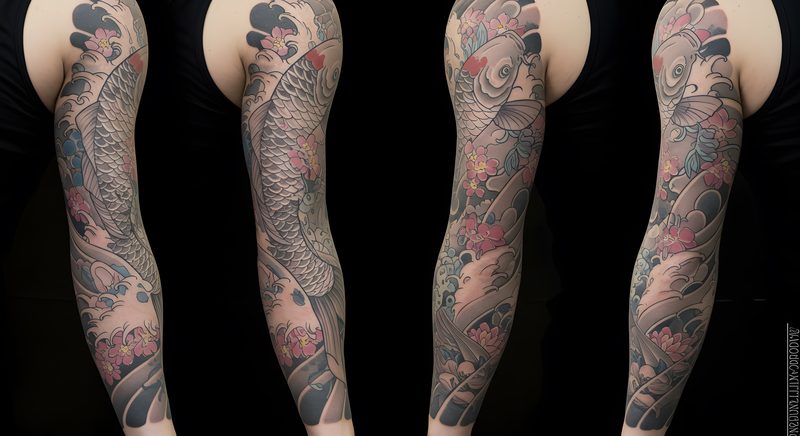
Dragon + koi (Dragon Gate)
Ryu-koi mid-transformation
The Longmen legend. A koi swimming upstream, leaping the Dragon Gate, becoming the dragon above. The most narratively loaded composition in Japanese tattooing. Head-and-claws of the dragon emerging from the koi’s tail is the canonical frame. Sleeve, back piece, or thigh panel. Plan 3–6 sessions with a Japanese-tradition specialist.
Baby dragon / cute dragon
Contemporary fine line · companion
Small, sitting, curled around a pearl or perched on a shoulder, eyes oversized, proportions softened. Reads as personal symbol rather than declaration — the dragon as companion rather than guardian or adversary. Often illustrative or single-needle black-and-gray with one color accent. Fine-line dragons lose mythological weight on purpose. That’s the trade.
Dragon skull
Memento mori · relic
A dragon skull rather than the live creature — horned, toothed, rendered in black-and-gray realism or heavy blackwork. Fantasy-adjacent but carries a different reading: what’s left after the dragon is gone, the creature reduced to relic. Pairs with flowers (skull-and-bloom convention), swords, or a banner. The Eastern dragon lives forever; the Western one leaves bones.
Dragon + sword
Slayer · guardian · heraldic
A sword through the dragon (Saint George style), a sword held by the dragon (guardian style), or sword and dragon entwined in heraldic parallel. Purely Western in symbolic logic — the sword-and-dragon conversation doesn’t live inside Eastern tradition. Name which role the dragon plays before the design starts.
Blackwork silhouette dragon
Solid · architectural · shape-first
Solid black, architectural, negative-space detail. The dragon reduced to shape and contour, rendered in one weight from head to tail. Reads across a room rather than at arm’s length. Works for either tradition if the silhouette carries the lineage. Requires even saturation — patchy blackout ages poorly.
Watercolor dragon
Splash · painterly · contemporary
Saturated washes trailing the body, pigment scatter behind the wings or coils, deliberate drips. Reads painterly and contemporary rather than traditional, Eastern or Western. Caveat: watercolor ages faster than line-based work because the wash carries the piece without outline scaffolding. Plan a touch-up at year 7. Not a style that should pretend to be irezumi.
Memorial dragon
Named · consultation-heavy
A dragon carrying a person, a chapter, a loss. Scale and style follow the style the client is already inside — a memorial ryu stays irezumi, a memorial Western dragon stays Western, a memorial fantasy dragon quotes the named creature. Name integrated into water, wind bar, or banner, not captioned below. Wait 12 months minimum after the loss.
Six styles
The style picks the artist. Specialist work only.
Dragons are advanced work. Match the style to the tradition. Irezumi specialists for ryu. Chinese-tradition specialists for long. The rest are legitimate if named honestly.
Japanese / Irezumi
Native style for the ryu
Heavy black outline, saturated scale work, wind bars, finger-wave water, clouds as structural negative space. The ryu is serpentine, four-clawed, horned rather than antlered, wingless. Only specialists. A back-panel ryu is a 30–80 hour commitment across a year or more.
Chinese traditional
Imperial long · five-clawed
The long sits next to but not inside Japanese irezumi. Five-clawed in imperial style, longer and more horse-headed than the ryu, carries the flaming pearl, integrates with cloud. Finding a tattooer who renders this category faithfully is a search. Honor the distinction at consultation.
Neo-Japanese / American Japanese
Japanese structure · contemporary palette
Japanese structure, contemporary palette, cleaner negative space. The most common honest landing place for clients who want the irezumi reading without a full back panel. Two to four sessions typical.
Western Illustrative / Realism
Winged · cinematic · fantasy-adjacent
Winged, four-legged, castle-and-mountain dragon. Smaug. European heraldry. Rendered best in black-and-gray or limited-palette color with deep rendering. The painterly style for Western tradition and high-fantasy fandom.
Fine Line
Loses the tradition
Hairline single-needle work. Loses the scales. Loses the claws. Loses the mythological weight. A gesture of a dragon rather than a dragon. Legitimate for certain clients — we will say so at consultation — but not the style that carries the subject.
Blackwork
Silhouette · solid fills
Silhouette work, heavy solid fills, Eastern European and contemporary blackwork reference. The dragon as shape rather than character. Ages exceptionally when saturation is even. Handles cover-ups. Demands a disciplined tattooer.
Cultural respect
Claw count. Wings. Element. Tradition markers, not preferences.
Dragon conventions are specific, not decorative. Get them wrong and the piece tells on itself. Four traditions come up often enough to name.
Japanese ryu — irezumi
Lives inside a defined grammar — wind bars, finger-wave water, flaming pearl (tama), cloud scrollwork — and belongs to artists trained inside the tradition. A “Japanese-style dragon” from a generalist is neo-Japanese fusion work, legitimate when named honestly and a decorative misrepresentation when it isn’t.
Chinese long — claw count
Imperial symbolism with specific conventions. Five claws = imperial Chinese, historically reserved for the emperor. Four claws = Japanese or Korean. Three claws = common Chinese and standard Japanese. Getting the count wrong changes the piece from specific tradition to generic fusion. Ask your artist to name the count before they stencil.
Welsh Y Ddraig Goch
National symbol with particular posture (passant, forefoot raised) and palette (red on white and green). Clients with Welsh heritage wear it as lineage, not style. Non-Welsh clients adopting the flag dragon should know they’re wearing someone else’s national emblem.
Fantasy clients — name the world
“A Game of Thrones dragon” is a genre. “Drogon at the Battle of the Goldroad” is a rendering brief. The specificity is what gets the tattoo right. Bring the book, the scene, the illustrator. Generic fantasy reads as generic fantasy.
Five placement styles
Dragons want big canvas.
Nothing else in tattooing uses a back panel the way a ryu does. Five placement styles cover almost every dragon choice.
Full back panel
Shoulder-to-hip · full back
Irezumi home. The body of the dragon snakes shoulder-to-hip, head often cresting over one shoulder, tail wrapping the opposite thigh. Nothing else in tattooing uses a back panel the way a ryu does.
Sleeve / half-sleeve
Full arm · shoulder-to-wrist
Wraps the dragon around the arm so it reads in the round — head at the shoulder or elbow, body spiraling, tail at the wrist. Japanese and Western both live here.
Full thigh
Hip-to-knee · outer or inner thigh
The second irezumi home. Outer-thigh-to-hip panel gives the dragon the length it needs without committing to a full back. Heals well, wears well under clothing, photographs well.
Chest panel
Single pec · full chest · across collarbone
Single-pec or full-chest dragon, often paired across the collarbone or emerging from the shoulder. Asymmetrical by nature — the dragon is not a chest piece that balances the way a rose or an eagle does.
Forearm (smaller solo)
Inner or outer forearm
The only honest small-dragon placement. 6–10 inches maximum, simplified Western style, single creature without heavy background. Everything above this scale wants a bigger canvas.
Anatomy details
Where good dragon work separates from bad.
Claw count, horns vs. antlers, wings, element, scale pattern. Each is small. Together they decide whether your dragon reads as specific tradition or generic fusion.
Claw count
Chinese imperial = five. Japanese ryu = three (standard) or four (specific conventions). Korean = four. Welsh dragon = four. Western fantasy = four, typically. Tradition-specific and visible at scale. A Japanese-style dragon with five claws is a tell.
Horn · antler · frilled
Japanese: paired horns swept back, sometimes with small antler points. Chinese: antlered, deer-like, with whiskers. Western: horned, sometimes frilled, sometimes crested. Not interchangeable. Get this wrong and the piece reads as nothing particular.
Wings or wingless
Eastern dragons do NOT have wings — they fly through cloud and water by movement alone. Adding wings to a ryu is a tradition mistake. Western dragons ALWAYS have wings; wingless European dragons are wyrms or serpents, different creatures with their own lore.
Pearl · flame · element
Eastern dragons carry the flaming pearl (hōju / 寶珠) — wisdom, authority, the thing pursued. Western dragons breathe fire — weapon, frame, the negative space the body carves through. A dragon without an element is incomplete. Pick the element the tradition demands.
Scale pattern & tail resolution
Overlapping fish-scale (uroko), tesselated diamond, or individually rendered plates. Consistent across the body. Scales that degrade near the tail are rendering shortcuts, not style choices. Tail resolution: Japanese tapers to fine curl, Western ends in tuft or barb. Different creatures.
Scale honesty
Dragons are the largest subject in tattooing.
We say that first because clients ask for 3-inch dragons every week and it’s the conversation we have to have.
Twenty years out
Scale texture closes first. Outline is what’s still legible at thirty.
A dragon is more repeated fine mark than almost anything else in the catalog. Knowing which of those marks survives, and which ones merge, is most of the argument for the size we keep pushing you toward.
Uroko — the densest mark on the animal
Overlapping fish-scale is the finest repeated line anywhere on a dragon, and it covers the largest area. Ink spreads slightly under the skin for as long as you own it. Neighbouring scale lines creep toward each other and, past a point, stop being scales and become a grey field with a dragon-shaped edge. The gap between those lines is set by how big you drew the animal on day one. That is the real reason we argue about inches.
Heavy outline is a survival mechanism
The bold unbroken contour in Japanese work is not a stylistic tic. It is the part that holds the shape after the interior softens. Old Japanese pieces still read across a room because the outline is carrying them. Western illustrative dragons that skip the contour in favour of pure rendering look extraordinary in the healed photo at six weeks and vague at fifteen years.
Wing membrane is gradient with nothing underneath it
A Western dragon carries two large thin panels of skin usually rendered as smooth tonal gradient. Nothing structural sits under that. As pigment softens the gradient flattens toward a single mid-tone and the wings go papery. Wings drawn with visible finger bones, membrane ribs and a defined trailing edge keep their architecture. Ask for the bones.
Background is structure, and packed background stops working
Wind bars, cloud scrollwork and finger-wave water aren’t filler. They set the negative space that lets the body of the dragon separate from the arm. Pack them edge to edge and in fifteen years the whole panel reads as one dark mass. A specialist leaves the skin gaps deliberately wide, and it looks empty at first. It isn’t.
Sun is the one variable you control
Ultraviolet is the main thing that dulls colour, and a dragon is often a colour piece. Back, outer thigh and the inner half of an upper arm see very little of it. Outer forearms and hands see the most, and a red-and-gold ryu on an outer forearm in Southern California is on a shorter clock than the same drawing on a back. Touch-ups are $100 with us. Budget for one somewhere around the ten-year mark and you will be fine.
Pricing, honestly
A dragon is booked as a project, not an appointment.
Hourly rate varies by artist — $100/hr with Blue, Hannah or Rick, $350/hr with Raa or David, half day $400, full day $600. A back panel is booked as a project across many of those days, not as a single sitting. Final cost depends on artist, size, design and placement, and we quote it from the sketch.
Eight compositional pairings
The pairing extends the tradition.
Dragon alone is one sentence. Dragon with koi, pearl, sword, castle, or twin is a compound sentence — and each pairing lives inside a specific tradition.
Dragon + koi (Dragon Gate)
The Longmen legend mid-transformation. Canonical Japanese pairing. Reads as perseverance rewarded. Wants 14+ inches minimum.
Dragon + pearl
Eastern style. The flaming pearl (hōju) clasped in the claws or pursued through cloud. The pearl is wisdom, the pursuit is the story.
Dragon + cherry blossom
Irezumi pairing. Ferocity against impermanence — the dragon that will outlast, the blossoms that will not. Seasonally loaded composition.
Dragon + tiger (ryu-ko)
Japanese pairing. The dragon of water and wind opposite the tiger of earth and wind. Balance composition across a full back or chest. 16+ inches.
Dragon + sword
Slayer or guardian reading, depending on how the figures relate. Sword driven through, sword held alongside, sword as companion rather than weapon.
Dragon + skull
Hoard-and-mortality. Heavier Western reading. Works in blackwork and neo-traditional styles.
Dragon + castle / mountain
Pure Western. Smaug and Erebor. Setting the creature in terrain demands room — thigh or back panel minimum.
Twin dragons / flame
Balance — paired ascending-and-descending, or mirrored head-to-head across the spine or chest. Or dragon + flame as the Western-native pairing, fire as breath and frame.
Consultation
Six questions before we sketch.
The first question is non-negotiable. Nothing else is designable until it’s answered.
Eastern or Western?
The non-negotiable first question. Nothing else is designable until this is answered. These are different creatures, not two flavors of the same one.
Which specific tradition?
Japanese ryu, Chinese long, Western medieval, Celtic knotwork, Norse, Welsh, fantasy. Each carries different visual rules.
Scale you can commit?
Dragons are large. Under 6 inches they lose the tradition. Under 10 inches they lose the detail. Full irezumi wants 18+.
Solo or composed?
Dragon alone, or with koi, pearl, sword, hoard, clouds, waves? Composition drives placement and session count.
Claw count correct?
Five = imperial Chinese. Three or four = Japanese. Four = Welsh and most Western fantasy. Verify before stencil.
Fire, water, or neither?
Western dragons breathe fire. Eastern dragons command water. A dragon with no element is an incomplete creature.
A dragon is the largest subject in tattooing. Under five inches it stops being a dragon and becomes a suggestion of one.
The hybrid — Eastern head, Western wings — is the tattoo equivalent of a sentence in two languages. Fluent in neither.
A dragon is a decade decision. The ryu you wear at 30 you will still be wearing at 60.
Common mistakes
Seven patterns to watch for.
The hybrid-tradition mistake leads this list because it’s the single most common dragon error.
The hybrid-tradition mistake
Eastern serpentine body, Western wings, generic flames. Reads as nothing coherent. The single most common dragon-tattoo mistake. Fix: pick one tradition and stay inside it.
The scale-too-small mistake
Dragons need body length to read as dragons. Under 6 inches, a ryu is a snake and a Western dragon is a gecko. Fix: 10 inches minimum for solo dragons, more for composed pieces.
The wrong claw count
Five claws on a Japanese piece, three on a piece claimed as imperial Chinese, four on a Welsh dragon. Fix: verify the count against the tradition before the stencil lands.
“Game of Thrones but make it Japanese”
Fandom pieces dressed in irezumi grammar read as neither. Fix: pick fantasy or tradition. Fandom belongs in illustrative or neo-traditional styles, not irezumi.
The fresh-portfolio artist selection
Dragons are advanced work. A tattooer on their first ryu is doing a dragon-shaped reference inside a tradition they haven’t trained in. Fix: portfolio-match on three healed dragons at 1–5 years in the exact tradition you want.
The “just looks cool” default
A dragon without a named reading reads as decoration. Fix: pick one of the five readings and let it drive the composition.
The memorial without design rigor
A grief dragon booked at month 3 usually gets added to or covered within 2 years. Fix: wait 12 months minimum, and design the dragon to the tradition, not the grief.
Your first dragon
Neo-Japanese or Western illustrative. 10–12 inches. Forearm or thigh.
The Apollo baseline. Irezumi is not a first dragon. Save that for session 3 or 4 once you know you’re in.
Three personalization layers
Tradition · element · private meaning.
Dragons are decade decisions. The layer-three meaning keeps them yours across that decade.
The bones — tradition, claws, element
Tradition, pose, scale, style, claw count, element, placement. The bones. This is the layer where most personalization should live — a specific tradition rendered correctly is already specific.
What the claws are holding
The reading made visible. A pearl held in the claws for a named child. Koi at the base for a completed climb. A specific sword for a Norse ancestor. A flame shaped around a date.
What the dragon is guarding, unsaid
What the dragon marks for you. Authority earned, a chapter protected, a lineage carried, a transformation finished. Nobody else needs to know. The dragon is a decade decision — this layer keeps the piece yours across that decade.
When to wait
Four signals the dragon isn’t ready.
The dragon will still be there. The ryu you wear at 60 is worth waiting for the artist and the scale it needs.
You haven’t picked Eastern or Western
Not designable. Wait until the tradition clarifies. Two weeks, two months, a year. The dragon isn’t going anywhere.
You want irezumi but can’t commit to sleeve or back
Book neo-Japanese instead. A 4-inch “irezumi-style” dragon is not irezumi. Wait until the panel commitment is possible.
Inside the grief window for a memorial dragon
Wait 12 months minimum. A grief dragon booked in month 3 usually gets added to or covered inside 2 years.
You can’t name the specific tradition
“A cool dragon” is still research. Come back when you can name the tradition, the pose, and the element.
FAQ
Eight answers before you commit a year of Saturdays.
Eastern versus Western, claw counts, minimum scale, the wings question, Dragon Gate, what a panel costs, where to start, and how to brief a fandom dragon.
What’s the difference between an Eastern and Western dragon tattoo?
They’re different creatures, not two flavors of one. The Eastern dragon (Japanese ryu, Chinese long) is serpentine, wingless, benevolent, tied to water and rain and imperial authority. It moves through cloud and water, carries a flaming pearl, and is drawn with specific claw-count conventions. The Western dragon is winged, four-legged, fire-breathing, adversarial — Smaug, Saint George’s dragon, Beowulf’s dragon. It guards treasure, breathes fire, lives in mountains and caves. They share a name in English and nothing else. Pick the tradition before you pick the pose. A winged European dragon in Japanese irezumi grammar is not fusion — it’s a mistake.
What do claw counts on dragon tattoos mean?
Five claws = imperial Chinese, historically reserved for the emperor. Four claws = Japanese or Korean standard, or provincial Chinese. Three claws = common Chinese and some Japanese renderings. Getting the count wrong changes the piece from a specific tradition to a generic fusion. A Japanese-style dragon with five claws is a tell — it reads as someone who meant Japanese but drew Chinese. Welsh dragons are four-clawed. Most Western fantasy dragons are four-clawed. Verify the count against the tradition you’re claiming before the stencil lands.
How big does a dragon tattoo need to be?
Dragons are the largest single subject in Western tattooing. They don’t exist honestly at 3 inches. Under 5 inches, the tradition collapses — scales blur, claws read as dots, the eye doesn’t hold detail. 6–10 inches is the honest small dragon (simplified Western, curled compact, no background). 10–18 inches is where neo-Japanese and full Western style earn their keep — scales read, claws count, background contributes. 18+ inches is irezumi scale — back panel, full thigh, full sleeve with chest extension. If you want a small dragon, commit to fine-line style and accept the loss of tradition.
Do Japanese dragons have wings?
No — not in the canonical rendering. The Japanese ryu is serpentine and wingless, flying through cloud and water by movement alone. Some Edo-period source illustrations show winged ryu, but these are specific quotations, not the default. Adding wings to a Japanese dragon is a tradition mistake — it produces a hybrid creature that reads as neither Eastern nor Western. If you want wings, you want a Western dragon, a Welsh dragon, or a specific fantasy creature. Chinese long may occasionally show wing-like features but more often are rendered wingless, with flight implied through serpentine movement.
What’s the Dragon Gate koi tattoo?
The Longmen legend — a koi swims upstream against the Yellow River current, leaps the Dragon Gate waterfall, and becomes a dragon. Perseverance rewarded. The tattoo composition renders the transformation mid-leap: koi at the base, dragon emerging from the koi’s tail above. The most narratively loaded dragon composition in Japanese tattooing and a deep pairing with the koi tradition. Needs 14 inches minimum because both creatures have to read as characters. Sleeve, back piece, or thigh panel. Plan 3–6 sessions with a Japanese-tradition specialist. For clients marking a long climb completed — sobriety, recovery, a terminal degree, immigration story.
How much does a dragon tattoo cost?
Session count is the number that matters, because a dragon is quoted by chair time rather than by the piece. A forearm or small-placement Western or neo-Japanese dragon at 6–10 inches runs 1–2 sessions. A sleeve or half-sleeve at 10–16 inches runs 3–6. A full thigh or chest panel at 14–20 inches runs 4–8. A full back panel irezumi at 20–30+ inches runs 6–15 or more across a year. Fine-line dragons sit below all of that and get quoted separately, because they’re a different commitment. Rates run $100/hr with Blue, Hannah or Rick and $350/hr with Raa or David; a half day is $400 and a full day $600, which is how most panel work actually gets booked. The number that matters is the one we give you against the finished sketch, because artist, size, design and placement all move it.
What’s the best first dragon tattoo?
Neo-Japanese or Western illustrative at 10–12 inches on outer forearm or outer thigh, solo composition without heavy background. Plan for 3–4 sessions totalling 6–12 hours and price it off your artist’s hourly rather than off a per-piece figure. Full irezumi is the wrong first venue — save that for your third or fourth major piece once you know you’re in. Fine-line dragons are legitimate but lose the mythological weight entirely. Portfolio-match the artist on three healed dragons at 1–5 years in the exact tradition you want. Name the tradition out loud: “I want neo-Japanese” and “I want Western illustrative” are different assignments.
Can I get a dragon tattoo based on a book or movie?
Yes — fantasy allegiance is one of the five legitimate readings. D&D, Game of Thrones, Eragon, Skyrim, Tolkien dragons all work as tattoo subjects. Key rule: name the specific story world at consultation so the artist renders the correct creature, not a generic fantasy dragon. A Drogon piece is not a Smaug piece is not a Targaryen sigil. Bring reference: a named dragon, a specific scene, a particular illustrator (Alan Lee for Tolkien, the HBO team for Thrones, Wayne Reynolds for D&D). Generic fantasy reads as generic fantasy. Named ones read as portraits. Pick illustrative or neo-traditional styles — don’t ask for fandom dressed in irezumi grammar.
Ready to pick the tradition?
Answer Eastern or Western first. The claw count, the element and the panel size all follow from it.
Pick the tradition first. Ryu, long, Western, Celtic, Norse, Welsh or a named fantasy dragon are different animals, and mixing them is the one thing we can't quietly fix later. Claw count and scale get settled in the same sitting.