Tattoo Ideas
Lily
Six species, six different tattoos. A calla is Art Nouveau and funerary. A stargazer is a modern hybrid covered in freckling you either draw or deliberately drop. A water lily is not a lotus, whatever the internet says. Species by species, plus the trumpet-throat foreshortening that separates good lily work from bad.
Book a consultationStart with the species
The species decides the meaning, so the species gets decided first.
A lily is the one flower where naming the species settles most of the argument. A calla means something different from an Easter lily, which means something different again from a tiger lily, and the silhouettes are so far apart that no artist can start drawing until you pick. Species first. Style second. Everything else after that, in the order below.
Which lily, specifically?
A calla, a stargazer, a tiger lily, a water lily, a lily of the valley — these are genuinely different flowers and genuinely different tattoos. They carry different meanings, different silhouettes, different scale requirements. “A lily” is a family, not a design. The first decision is always the variety.
Purity, grief, pride, or a birth month?
Purity (Madonna, Easter), memorial (white calla, white lily), passion or pride (stargazer), birth month (lily is May), heritage (fleur-de-lis for French ancestry, calla for Mexican Dia de Muertos connection), or plain aesthetic. Pick one primary reading and the variety will narrow itself.
Single bloom or cluster?
A single calla is one design problem. A three-stem stargazer cluster is another. A Victorian lily-of-the-valley spray is a third. A cluster forces a vertical run, a stem count and a minimum of five inches before you have chosen anything else. Lilies pair most cleanly with their own species; a single stem and a three-flower spray are separate pieces, not the same piece at two sizes.
Botanical accuracy or stylized?
A Redouté-style botanical calla with full stem and leaves, and a Neo-Traditional stylized stargazer, are different design languages. Botanical rewards scale and stable-skin placement. Stylized rewards bold outline and ages more predictably at smaller sizes. Pick the style on purpose.
How many inches do you actually have?
Scale determines which varieties work. Under 2 inches eliminates the trumpet shape of the Easter lily and the layered petals of the stargazer. Under 3 inches eliminates most botanical accuracy. A single lily of the valley composes at 2 inches; a single stargazer almost never does.
“A lily” is a family. A calla is a design. The variety carries the meaning before the style does.
The stargazer wants scale. The lily of the valley wants restraint. Know which one you’re asking for.
A white calla is the most-chosen memorial flower in American tattooing. It got there on merit.
Flash · ready to ink
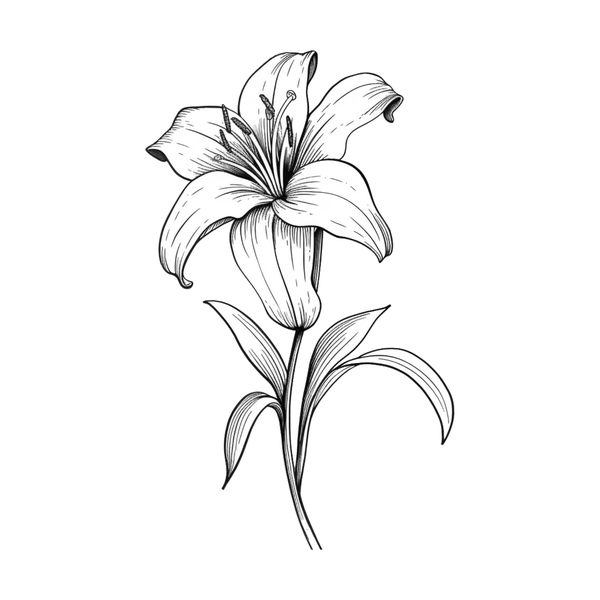
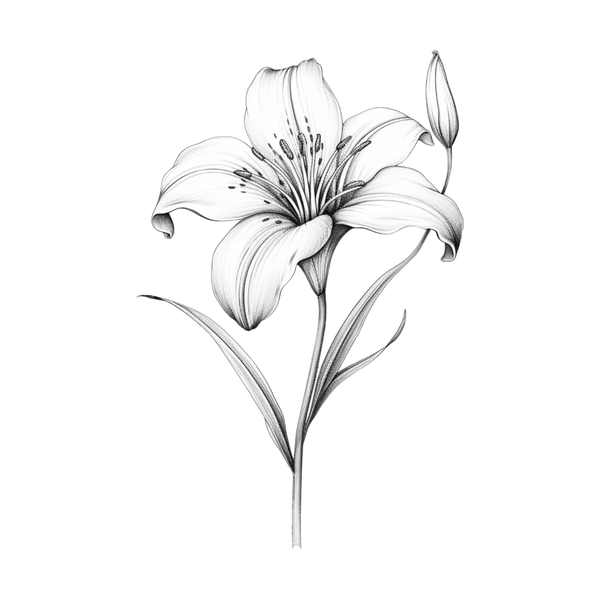
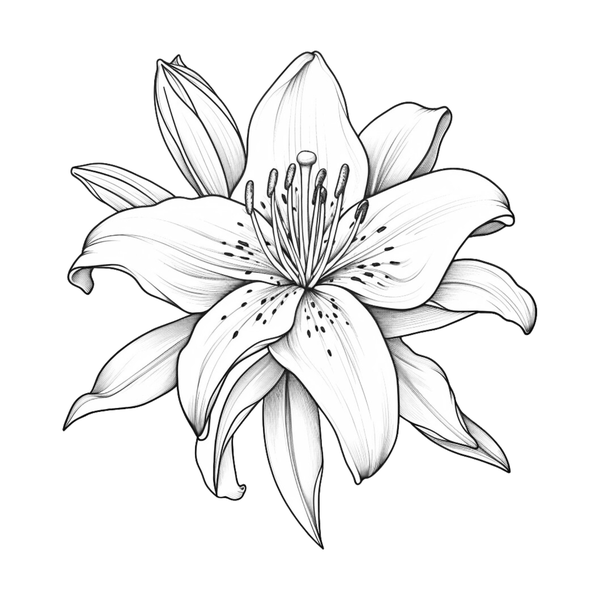
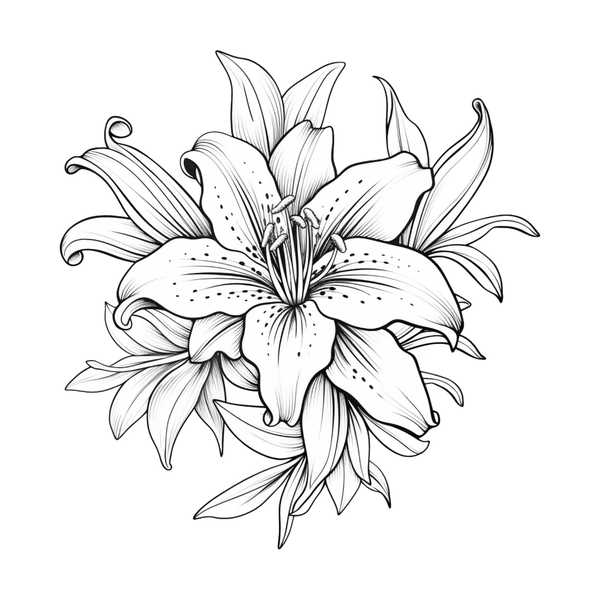
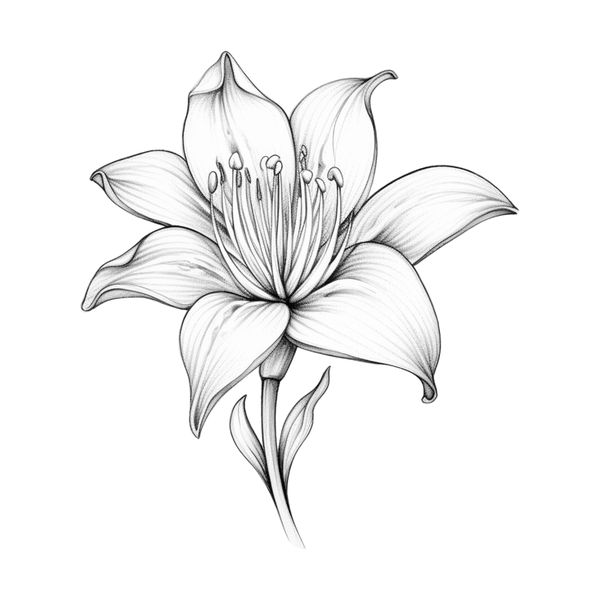
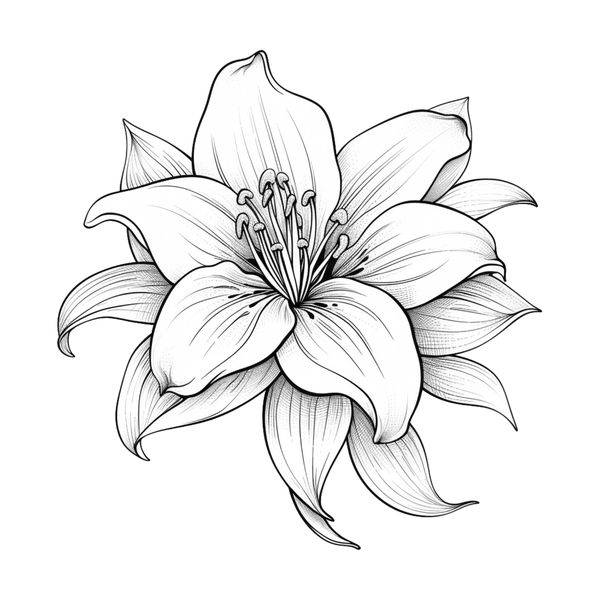
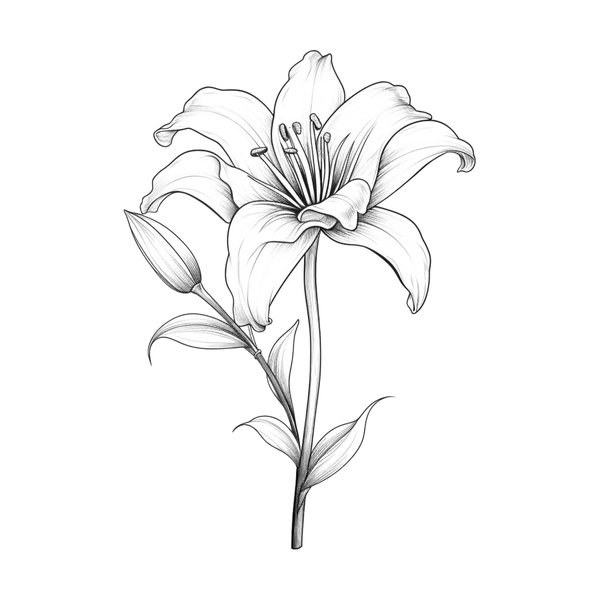
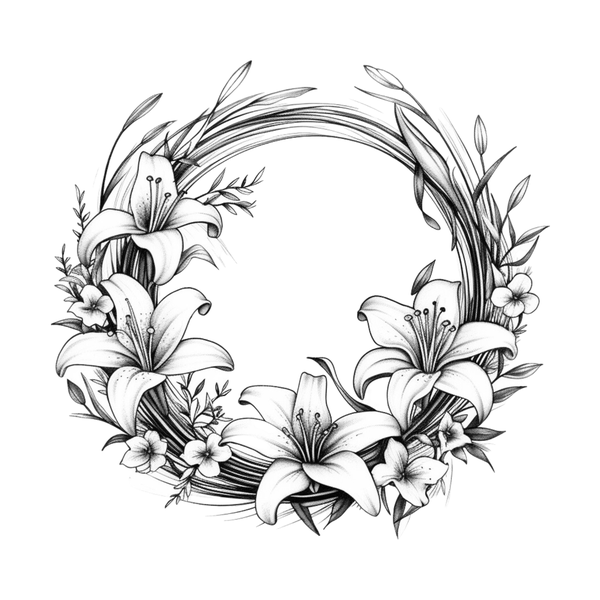
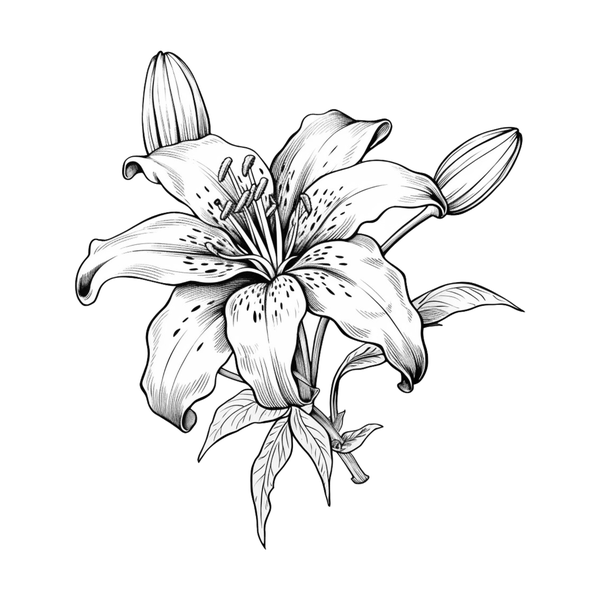
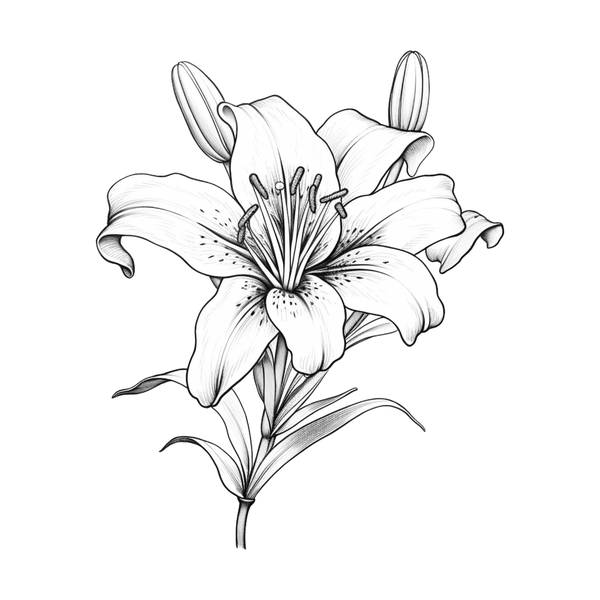
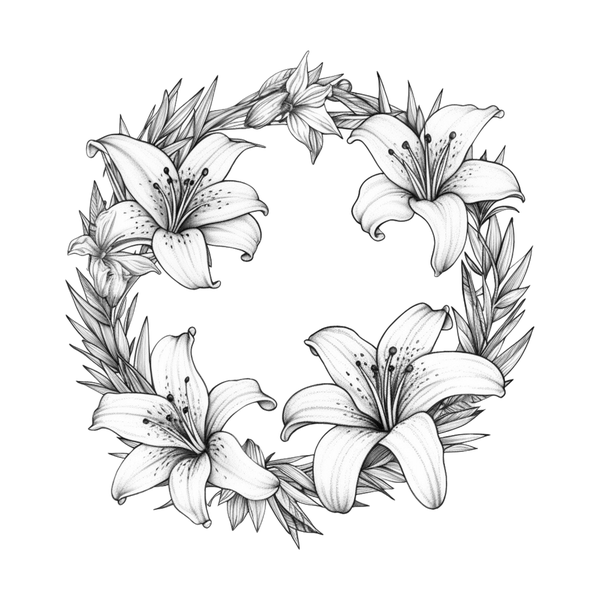
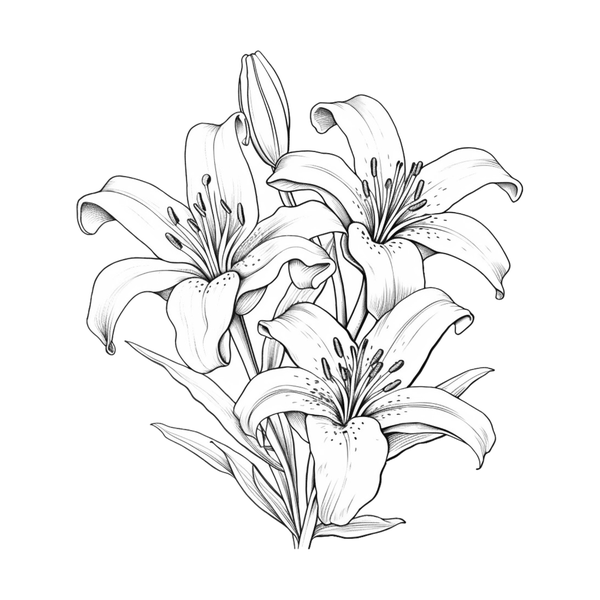
Lily flash designs
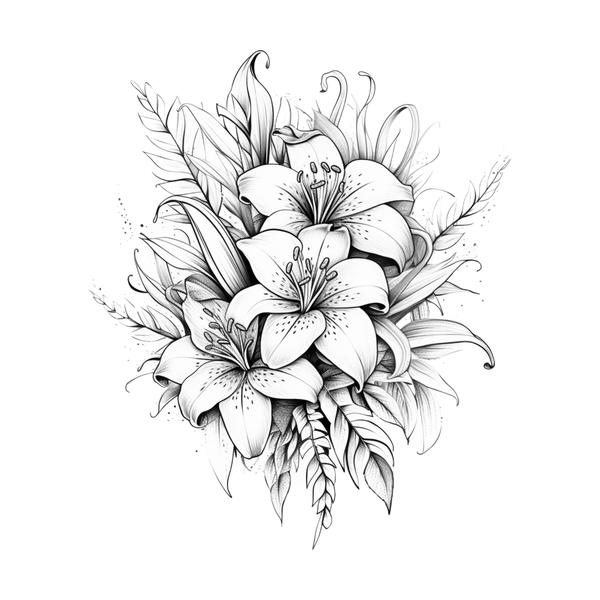
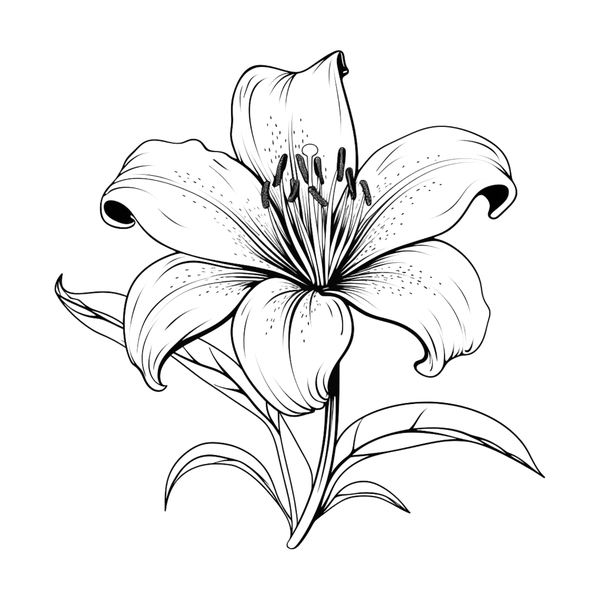
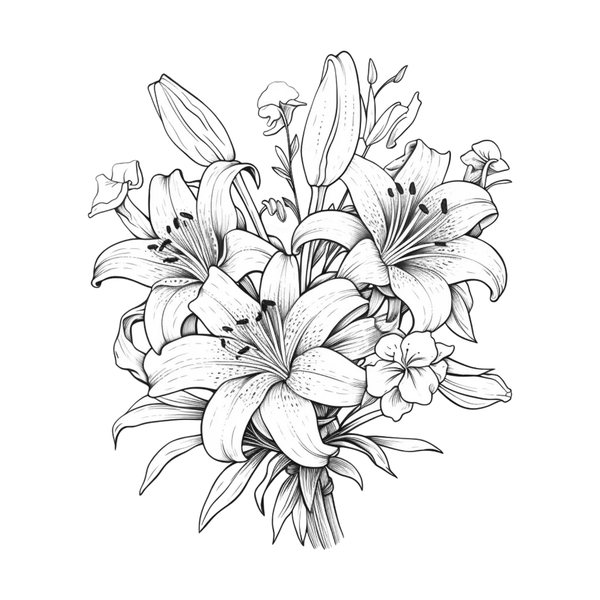
15 hand-drawn designs from our flash collection — book any one as-is, or use it as the starting point for a custom piece. Sizing, placement and linework dialed in at your consultation.
Twelve so-called lilies
Twelve lilies, and only five of them are actually Lilium.
Calla, water lily, day lily, lily of the valley, Peruvian lily, canna, fleur-de-lis — none of these are true lilies. They are separate plants, and in two cases a separate kingdom of meaning, that English decided to file under one word. Botanically that is untidy. For a tattoo it matters, because the silhouette, the palette and the reading all follow the actual plant rather than the shared name. All twelve below.
The calla lily
Architectural spathe, single spadix
The lily with a single curved petal (spathe) wrapped around an upright yellow spadix — technically one of the least traditionally lily-shaped lilies. Reads as elegance, Art Deco, memorial (especially in white). Fine line, neo-traditional, or illustrative style. 3–6 inches. Inner forearm, spine, ribcage. Often chosen in white or black-and-gray for memorial compositions.
The Easter lily
Large white trumpet, six petals
The ceremonial lily of Western Christianity — trumpet-shaped bloom with six flared petals, rendered pure white with bright yellow stamens. Carries purity, resurrection, and Easter-season readings. Neo-Traditional or illustrative style. 4–7 inches. Outer thigh, upper arm, ribcage. Often chosen for clients marking a spiritual milestone or Easter-season loss.
The stargazer lily
Pink and white with dark spots, upward-facing
The showpiece lily — hot pink edges fading to white at the center, deep burgundy spots, heavy yellow-orange stamens pointing up. One of the most-requested lilies for its saturated color style. Neo-Traditional or watercolor carries it cleanly. 5–8 inches because the color work needs room. Outer thigh, upper arm, shoulder.
The tiger lily
Orange with black spots, recurved petals
Saturated orange petals curved backward (recurved), heavy black spots, prominent stamens. The Pacific-Northwest native lily and a staple of American flower gardens. Traditional, Neo-Traditional, or watercolor. 4–6 inches. Outer calf, shoulder, upper arm. Reads as boldness and as the lily that refuses to be domesticated.
The water lily
Flat-floating bloom on still water
Technically a Nymphaea, not a Lilium — but every shop calls it a water lily. Often rendered floating on the water with pads and a reflection. Watercolor or fine-line style. Reads as meditation, Buddhist symbolism (not to be confused with lotus), or Monet-adjacent aesthetic. 4–8 inches. Outer thigh, back panel, ribcage.
The day lily
Trumpet-shaped, short-lived bloom
The most-planted garden lily in America — bright orange or yellow trumpet that opens for a single day. Carries the reading of brief beauty, the transience of a single good day. Traditional or Neo-Traditional. 3–5 inches. Outer forearm, bicep, calf. Common memorial choice for grandmothers who grew them.
Lily of the valley
Small bells on a single stem
Tiny bell-shaped white blooms hanging from a single vertical stem. May’s birth flower in the Victorian style, and the traditional flower of a royal wedding bouquet. Fine line or illustrative. 2–4 inches vertical. Inner forearm, ribcage, spine. One of the smallest lilies that still reads as a specific species.
The Peruvian lily (alstroemeria)
Six petals with streaks, clustered
Technically not a Lilium but universally called a Peruvian lily — pink, yellow, orange, or white petals with dark streaks in the throat, growing in clusters of three to five blooms. Neo-Traditional or illustrative. 4–7 inches. Outer thigh, upper arm, ribcage. The lily that looks like a composition without needing to be composed.
The Madonna lily
Pure white trumpet, Marian iconography
The Lilium candidum — the white lily of Christian Marian iconography, carried by the Archangel Gabriel in Annunciation paintings. Similar shape to the Easter lily but with a deeper devotional style. Illustrative or Neo-Traditional. 4–7 inches. Chest, upper arm, outer thigh. For clients marking Catholic or broader Christian faith.
The canna lily
Red or orange, tropical style
Technically not a Lilium but called canna lily in every American garden catalog — broad-leafed tropical plant with saturated red, orange, or yellow blooms. Reads as heat, as the American South, as late-summer gardens. Neo-Traditional or watercolor. 5–8 inches. Outer thigh, upper arm, back panel.
The Asiatic hybrid
Upward-facing, solid color
The broad family of modern hybrid lilies — upward-facing trumpet shape, saturated single-color petals (red, orange, yellow, pink, white), sometimes spotted. The most-planted cut-flower lily. Neo-Traditional or illustrative. 4–6 inches. Outer thigh, upper arm, ribcage. The lily for clients who know they want a lily without knowing which species.
The fleur-de-lis
Stylized heraldic lily
Not a botanical lily but a stylized one — the three-petal heraldic device that represents the iris (or the lily, depending on which European tradition you follow) in French royal symbolism and in Louisiana regional identity. Traditional, blackwork, or illustrative style. 2–5 inches. Outer forearm, chest, upper arm. Cross-link: ornamental style.
The drawing problem
A lily is a trumpet, and almost every reference photo flattens it into a star.
This is the thing that separates good lily work from bad, and it has nothing to do with style. A true lily opens as a funnel: six tepals recurving backward from a throat, six stamens on long filaments leaning out of it, one longer style with a three-lobed stigma at the tip. Shot straight on, which is how nearly every photograph of a lily is taken, that funnel collapses into a flat six-pointed shape. Draw what the photo shows and you get a star. Draw the throat receding and you get a lily.
Foreshorten the throat or it isn’t a lily
The near tepals have to overlap and shorten; the far ones sit higher and read smaller; the mouth of the funnel becomes an ellipse rather than a circle. That single decision does more for a lily than any amount of shading. It is also why we ask for a reference shot from three-quarters above rather than head-on, and why the best lily references are old botanical plates. Those illustrators drew from specimens in the hand and understood they were drawing a tube, not a rosette.
The stamens should not be a symmetrical fan
Six filaments radiating at equal angles is a diagram. In life the anthers are heavy enough to pull their filaments into uneven curves, and they sit at different depths inside the throat, which is exactly what gives the flower dimension. Six identical lines out of a flat center is the single most common tell in a weak lily tattoo, and it survives every style: it looks wrong in fine line and it looks wrong in realism.
The anthers set the floor size
They are the only part of a lily with real mass on a thin support, and they are the first element to close up. Below about three inches on a true lily the anthers merge with their filaments into six small blobs, and once that happens the flower stops reading as a lily and starts reading as a generic bloom. If you want it smaller than that, pick a species that doesn’t depend on them.
Stargazer freckling is a rendering problem, not a detail
Stargazers are Oriental hybrids and they carry heavy dark spotting across the tepal faces, usually with a paler band running up the center of each. Those spots are the reason people want the flower and the reason it heals badly at small scale: dots packed at a couple of millimetres migrate into one another and the whole face settles into a dirty gray wash within a few years. Fewer, larger, deliberately uneven spots hold. A photocopy of the photograph does not.
The calla isn’t a lily, and that’s why it’s the beginner’s lily
Botanically a calla is a Zantedeschia, an arum, and the thing everyone reads as a petal is a single furled spathe wrapped around a yellow spadix. One curve. No tepal count, no stamens, no freckling, nothing to close up. That is why it survives at two inches where a stargazer does not, why Art Nouveau and Art Deco designers used it constantly, and why it dominates funeral imagery. The shape is already finished, so nothing needs to be added to it.
A water lily is not a lotus, and the difference is visible
A water lily floats: the flower sits on the surface and the pads are round with a notch cut from the edge to the center, lying flat on the water. A lotus stands: both leaf and flower are held clear of the water on stalks, and the leaf is an unbroken disc with no notch. If your reference has a flower resting on the water beside a split-edged pad, you want a water lily, which carries European and Egyptian readings rather than Buddhist ones. Clients get this wrong constantly, and the tattoo ends up saying something they didn’t choose.
The fleur-de-lis is heraldry, not botany
It is almost certainly a stylized iris rather than any lily, and it has been drawn to a fixed heraldic formula for centuries: three lobes, a horizontal band, a specific taper. Nothing about observing a plant helps you here. What matters is proportion — the height of the band against the outer lobes, and the sharpness of the central point. Drawn loose it reads as a scout badge. Drawn to the heraldic proportion it reads as what it is.
Variety-specific meanings
Four notes on what each lily carries.
The meaning is built into the species. Pick the variety whose reading matches your brief and the tattoo carries the reading without a banner to explain it.
Purity and devotion
The Madonna lily (Lilium candidum) and the Easter lily carry the oldest Christian symbolism — purity, the Virgin Mary, resurrection, the Annunciation. A white lily rendered cleanly carries those readings without further annotation. For Catholic clients or broader Christian faith, these are the varieties that lean into tradition.
Memorial and mourning
The white calla lily is one of the most-chosen memorial flowers in American florist catalogs and in tattoo practice — the architectural silhouette and the white palette match the style of grief cleanly. The Mexican Dia de Muertos tradition carries callas as well, alongside marigolds. Lily of the valley also carries memorial weight, especially for lost mothers, because of its May-birth association.
Passion, pride, ambition
The stargazer lily is the showpiece flower of the modern garden — saturated pink edges, deep throat spots, upward-facing. It carries readings of passion, ambition, and pride. Clients marking a career milestone, a survival, or an arrival often choose stargazer for the color weight alone. The Asiatic hybrids read similarly in their saturated single-color styles.
Birth month and heritage
Lily of the valley is May’s birth flower in the Victorian language. The fleur-de-lis carries French heritage (royalist or regional) and Louisiana identity (New Orleans, Cajun Country, the fleur-de-lis on the state flag). The calla carries Mexican memorial tradition alongside its Christian reading. Pick the variety whose heritage matches yours — don’t wear a heritage you don’t carry.
Six styles
Six styles, and which species each one can actually carry.
Each variety has styles that serve it and styles that fight it. Fine-line tiger lily loses its saturation. Traditional stargazer flattens. Match style to variety, on purpose.
Fine line — calla and lily of the valley live here
The dominant 2020s style
Hairline work, minimal interior shading, often black-only. The default modern lily style — carries calla, lily of the valley, and small Asiatic hybrids cleanly. Softens faster than bold lines — plan for a touch-up at seven to ten years. Struggles with saturated stargazer or tiger lily work because the style lacks the color scaffold.
Neo-Traditional — where the stargazer holds together
Expanded palette, dimensional bones
Where most mid-scale lily work lives in 2026. The style that carries stargazer, tiger lily, Easter lily, and Peruvian lily cleanly — bold outline scaffolds the saturated color. Two sessions is common for anything over five inches.
American Traditional — the tiger lily’s style, and few others
Sailor Jerry flash lineage
Bold outline, flat color fill. Less common for lilies than for roses or poppies because the Traditional flash canon didn’t codify the lily as heavily. When it works, it works — best for tiger lily and day lily where the saturated orange matches the Traditional palette.
Botanical plate — six tepals, drawn like a field guide
Victorian plate illustration
Detailed stem, labeled-looking leaves, etching-style line weight. Holds its structure for decades because every value in it is carried by a line. Best for calla, Madonna, Peruvian, and lily-of-the-valley — the varieties that reward careful botanical rendering.
Watercolor — the stargazer’s freckles as wash
Splash, wash, bleed
Line-drawn bloom with saturated color wash behind. Best for stargazer and water lily — the varieties where color is the design. Honest caveat: watercolor ages faster than line work because the splashes lack outline scaffold. Touch-up at year seven to ten is standard.
Black-and-gray realism — the throat rendered in value
Photographic rendering
Full tonal shading, photographic petal detail. Best for memorial callas and detailed Easter or Madonna lily portraits. Doesn’t scale down — 5 inches is the floor. Bring a specific reference bloom if you have one.
What the stamens need
How small before the stamens turn into a smudge?
Six long filaments carrying heavy anthers, sitting inside a throat: that is the part of a lily that decides its floor size. A calla has none of it and lives at two inches. A stargazer has all of it plus freckling and wants five.
Five placement styles
Lilies are vertical. Most of the body isn’t.
Most lilies are naturally vertical (calla, lily-of-the-valley, stargazer clusters). The vertical styles of the body — forearm, spine, ribcage, outer thigh — carry them cleanly.
Shoulder blade and hip — the bloom laid against a curve
Shoulder blade · upper back · hip · outer thigh · inner bicep
The lily reads as ornament against a curve. Calla and Madonna lilies in particular sit here cleanly — the architectural silhouette wants a curved placement. No era shorthand.
Outer forearm and calf — the tiger lily placement
Bicep · outer forearm · calf · chest
The traditional placement and the Traditional style. Tiger lily and day lily live here naturally — the saturated orange matches the Traditional palette and the public-facing style.
Inner forearm and sternum — the vertical calla’s home
Inner forearm · ribcage · sternum · spine · inside wrist
These placements read as “lily tattoo” without locking in a style era. Fine line calla and lily-of-the-valley are the two most-requested modern lily placements. The vertical format of lily-of-the-valley fits the spine and ribcage cleanly.
Ribs and inner bicep — a stem nobody asks about
Sternum · underboob · inner thigh · behind ear · nape of neck
Private style. Often paired with fine-line because the style matches. A sternum calla is one of the most-requested LA fine-line lily placements of the past three years.
Spine and thigh — where a full stargazer spray fits
Full back · full thigh · chest panel · rib-to-hip composition
Not placements — compositional commitments. Stargazer clusters, Easter lily memorial panels, water-lily-and-koi compositions. Planned from day one across three or more sessions.
A stargazer at day one is a photograph. Ask what the freckling looks like at year six.
The water lily is not the lotus. Don’t confuse them in the consult — the meanings are different.
If this is your first lily, start with calla or lily of the valley. Both forgive the learning curve.
Eight companions
Eight companions, and what each does to the species you picked.
Some of these are botanical and some are iconographic, and the two behave differently. A koi belongs beside a water lily because they share a pond. A cross belongs beside an Easter lily because they share a feast. Pair across those categories and the tattoo reads as two ideas that met by accident.
Lily + koi (water lily)
The traditional Japanese pond composition. Water lilies floating on a still water surface with one or two koi beneath. Japanese modern or illustrative. 8–14 inches. Cross-link: koi fish ideas.
Lily + rose
Dual-flower Victorian composition — lily (purity, memorial) paired with rose (love, loss). Neo-Traditional or illustrative. 5–8 inches. Thigh, upper arm, ribcage. Cross-link: rose ideas.
Lily + cross (Easter)
Christian devotional composition. Easter lily with a small Latin or Celtic cross, often with a banner. Neo-Traditional or illustrative. 5–8 inches. Chest, upper arm, ribcage. Most common at Easter-season memorials.
Lily + name banner
Memorial style. White calla or Madonna lily with a small banner carrying a name or date. Neo-Traditional or illustrative. 4–7 inches. Forearm, ribcage, upper arm. Wait at least a year after loss.
Lily + butterfly
Transformation composition. Fine line or Neo-Traditional. 4–6 inches. Upper arm, shoulder blade, outer thigh. Cross-link: butterfly ideas.
Lily + skull (memorial)
Dia de Muertos style — calla lilies are one of the traditional Mexican memorial flowers, and calla-and-skull compositions honor that lineage. Traditional, Neo-Traditional, or illustrative. 5–8 inches. Upper arm, outer thigh, chest. Cross-link: skull ideas.
Lily + name (script)
A lily carrying a single name in script, integrated into the stem or petals. Fine-line or illustrative. 3–6 inches. Inner forearm, ribcage. Build so the flower reads as a solo piece if the name ever needs to come off.
Stargazer cluster
Three to five stargazer blooms on a shared stem, each rendered in the full pink-and-white palette. Neo-Traditional or watercolor. 7–12 inches. Outer thigh, upper arm, ribcage. One of the largest single-composition lily pieces in the catalog.
Before the consult
Six answers, starting with the species name.
The first one does most of the work. Name the species and the style, scale and placement shortlist collapse to two or three options each.
Which variety, specifically?
Calla, Easter, stargazer, tiger, water, day, lily-of-the-valley, Peruvian, Madonna, canna, Asiatic hybrid, or fleur-de-lis. Twelve specific flowers, twelve specific tattoos. Pick the species first.
Which meaning cluster?
Purity (Madonna, Easter), memorial (white calla, lily-of-the-valley, white lily generally), birth month (lily is May), heritage (fleur-de-lis, calla for Mexican tradition), passion or pride (stargazer), or aesthetic. Pick one primary.
One stem, or a spray?
A single stem, a three-flower cluster, a stargazer spray, a water-lily-and-koi composition, or a lily paired with skull, rose, cross, butterfly, or name. Each of those sets a different floor size before anything else is decided.
Which style suits that species?
Fine line for calla and lily of the valley. Neo-Traditional for stargazer, Easter, tiger, and Madonna. Traditional for tiger, day, and fleur-de-lis. Illustrative for botanical accuracy. Watercolor for stargazer color-saturation. Realism for memorial portrait work. Match style to variety.
Vertical run, or a curve?
Classical (shoulder blade, hip, inner bicep), bold (forearm, bicep, calf), modern (inner forearm, ribcage, sternum), intimate (sternum, inner thigh), or statement (full panel). The vertical format of lily-of-the-valley and many callas fits vertical placements naturally.
How many hours, honestly?
A 3-inch fine-line calla is one to two hours. A 6-inch stargazer is three to five. A water-lily-and-koi back panel is four to eight sessions minimum. Know your ceiling before you fall in love with a variety that asks for more than you can give.
Where lily work fails
Eight ways a lily gets drawn wrong.
Three of these are botany, three are scale, and two are the artist. Every one of them is cheaper to catch at the reference stage than at the stencil.
The generic-lily trap
Picking “a lily” without picking which lily. Result: a bloom that reads as decoration. Fix: name the variety at the consultation. If you don’t know which lily you want, you don’t know what you want yet.
Stargazer freckling at two inches
Wanting a photorealistic stargazer with full petal detail at 2 inches. The color-and-spot detail doesn’t fit — blurs within five years. Fix: if you want the stargazer, commit to five inches minimum. If you only have two inches, pick a calla or lily-of-the-valley.
The style-variety mismatch
Fine-line tiger lily (loses the color style). Traditional stargazer (flattens the gradient). Watercolor lily-of-the-valley (the style needs more surface area than the flower provides). Fix: fine line for simple silhouettes, Neo-Traditional for saturated blooms, Traditional for solid-color lilies, illustrative for botanical detail.
Six lilies collaged into one
Thirty saved images, bits picked from each, artist asked to combine. Result: a lily that belongs to no specific designer. Fix: bring three references, not thirty. Name the single element in each you actually want.
The lily-lotus confusion
Asking for a water lily while meaning a lotus, or vice versa. They’re different flowers with different meanings — water lily is Monet and Buddhist pond iconography; lotus is Hindu and Buddhist spiritual practice with a different symbolism. Fix: name which flower you actually want, and bring species-specific reference.
A partner’s name down the stem
A lily wrapping a partner’s name, booked at month three. Fix: build the lily so it works as a solo piece if the name ever needs to go. Same design hygiene as any partner-name composition.
The memorial lily inside six months
Booking a memorial lily within six months of the loss. Grief keeps moving. Fix: wait at least a year. The piece you need at month four is rarely the piece you need at year two.
Choosing from the day-one photo
Choosing an artist from shiny-wrap Instagram. A wet lily photographs beautifully; the spotting is still crisp and the white is still bright. Fix: ask that artist for a healed lily at one year and at five. That’s the flower you’re buying.
The first-lily guide
If this is your first one, start with calla or lily of the valley.
Both varieties carry at smaller scales, both work in simpler styles, both forgive the learning curve. Eight decisions the first lily should make on purpose.
Personalization
Species, stem count, and the thing you don’t explain.
A lily becomes yours in three layers, and they carry very different weight. The species is the layer everyone arrives having chosen. The third is the layer almost nobody has thought about, and it is the one that keeps a well-drawn flower from reading as wallpaper a decade later.
Bones: species, style, scale, placement
Variety, style, size, placement, palette. These are the bones. They determine whether the piece reads as calla, stargazer, Easter, or fleur-de-lis, and whether it reads as bold, classical, modern, or intimate.
Stem count, color, and the second bloom
A specific cultivar (particular stargazer variety, specific heirloom calla from a family garden). A color tied to a story. A companion bloom paired for a sibling. A specific date tied to an Easter or a May memorial. This is where the piece starts separating from the category.
The part you keep
A mother. A May birthday. The bank where the things actually grew. Nobody else is owed the reason. The private layer is what keeps the piece from ever reading as generic.
FAQ
Eight questions people ask before choosing a species.
Eight questions covering meaning, variety popularity, lily-versus-lotus confusion, memorial use, scale, aging, mother-name customization, and pricing.
What does a lily tattoo mean?
The reading depends on the variety. Madonna and Easter lilies carry purity, resurrection, and Christian devotional readings — the Virgin Mary, the Annunciation, Easter-season faith. White callas carry memorial and mourning; they’re one of the most-chosen sympathy flowers in American florist catalogs and carry into Mexican Dia de Muertos tradition as well. Stargazers carry passion, ambition, and pride — the showpiece saturated palette matches those readings. Tiger lilies read as boldness and the refusal to be domesticated. Lily of the valley is May’s birth flower in the Victorian language and the traditional flower of the royal wedding bouquet. The fleur-de-lis carries French heritage and Louisiana identity. Pick the variety whose reading matches your brief — the meaning is built into the species.
Which lily is most popular for tattoos?
Three are most-requested at Apollo. The calla lily — the architectural single-petal bloom — is the most-requested fine-line lily, usually rendered in black or black-and-gray as a memorial or an elegance piece. The stargazer is the most-requested saturated color lily, carrying the passion and pride style in Neo-Traditional or watercolor. The tiger lily is the most-requested traditional-style lily because the saturated orange matches the American Traditional palette cleanly. Outside those three, Easter lily is common for faith-style memorials and lily of the valley is common for May-birth and mother-memorial pieces. The right one for you is the one whose meaning matches what the piece is marking.
What’s the difference between a lily tattoo and a lotus tattoo?
They’re different flowers with different symbolism, and confusing them at the consultation is one of the most-common lily-tattoo mistakes. Lotus (Nelumbo) is the flower of Hindu and Buddhist spiritual practice, rendered with petals radiating outward from a central seedhead, rising from muddy water as a symbol of enlightenment. Water lily (Nymphaea) is the Monet-pond flower, floating flat on still water, carrying Buddhist-adjacent but distinct meditation readings and strong Western decorative associations. The two look similar in simplified renderings but are different species with different traditions. If you want the spiritual-Hindu-Buddhist reading, you want a lotus. If you want the floating-on-water Monet style, you want a water lily. Name the specific one at the consult.
What’s the best lily tattoo for a memorial?
White calla, without contest. The calla carries memorial weight across multiple traditions — Victorian mourning, American funerary florals, Mexican Dia de Muertos. The architectural single-petal silhouette renders cleanly in fine-line or illustrative style, and the white palette (rendered through shading, not absence of ink) carries the memorial reading without needing a banner. Most-requested at 4–6 inches on the inner forearm, ribcage, or upper arm. Easter lily and Madonna lily carry memorial weight as well, especially for faith-based losses. Lily of the valley is common for mothers lost in May or for mother-and-daughter memorials. Honest rule on all memorial tattoos: wait at least a year after the loss before booking.
How big should a lily tattoo be?
Depends on the variety. Lily of the valley: 2 – 4 inches vertical works because the bell-shaped blooms are small by nature. Calla: 3 – 6 inches because the curved spathe needs room. Easter, Madonna, Asiatic hybrid: 4 – 7 inches because the trumpet shape and six-petal architecture need room. Stargazer: 5 – 8 inches minimum because the color-and-spot detail needs the most real estate of any lily variety. Water-lily-and-koi compositions: 8 – 14 inches. The honest rule: your variety sets your scale. If you want a stargazer, commit to at least five inches or the petal spots compress into a smudge. If you only have two inches, pick lily of the valley or a simplified calla outline.
Which lily tattoo ages the best?
Traditional tiger lily and day lily age best — the saturated orange matches the Traditional palette, and the bold outline holds through decades of skin drift. Neo-Traditional stargazer, Easter, and Madonna age moderately well because the bold outline scaffolds the expanded color palette; plan on a touch-up at ten to fifteen years for the saturated pink of a stargazer. Fine-line calla and lily-of-the-valley soften faster because the hairline weight is at the limit of what skin holds — plan for a touch-up at seven to ten years. Watercolor ages fastest. Illustrative ages beautifully because the whole style is built on line. If you want a lily that reads cleanly at year thirty, pick Traditional tiger or day lily.
Can I get a lily with my mother’s name in it?
Yes, and it’s one of the most-common lily customizations — lily of the valley in particular carries the mother-daughter style strongly in the Victorian tradition. A small banner threaded through the stem or carrying across the base of the bloom holds a name or date cleanly as long as the scale supports it. Under four inches, the lettering competes with the bloom detail. The honest rule on memorial tattoos: wait at least a year after the loss before booking. Grief keeps moving in the first twelve months, and the piece you need at month four is rarely the piece you need at year two. A mother’s-name lily should carry permanence — wait for the permanence to settle.
How much does a lily tattoo cost in LA?
Lily pricing at Apollo scales with four factors: overall scale, style complexity, color versus black-and-gray, and session count. A small fine-line calla or lily of the valley is typically a single session at two to four inches. A mid-scale Neo-Traditional stargazer, Easter lily, or tiger lily usually spans one to two sessions. A detailed stargazer cluster or illustrative Madonna lily runs two to three sessions. Water-lily-and-koi back panels planned from day one run four or more sessions. Hourly is $100 with Blue, Hannah or Rick and $350 with Raa or David, and the figure moves with artist, size, design and placement. We quote off the drawing, not the description.
Name the species first
Name the variety. Name the meaning. Name the scale you can commit to.
Name the lily. Calla, Easter, stargazer, tiger, water lily and fleur-de-lis are six species and six different tattoos, and the throat foreshortening is different on every one. Bring reference of the actual plant rather than a stylised drawing of one.