Tattoo Styles
Cursive
Handwriting fails in the gaps, not in the strokes. Letters creep into their neighbors years before any single line gives out, which makes spacing — not the alphabet you choose — the decision that matters. Palmer, Spencerian and Copperplate roots, and four working dialects.
Book a consultationAt the letterform
Where the letters join, and why.
A family of joined, flowing handwriting. The style is inherited from penmanship traditions, not invented at the tattoo machine.
Cursive tattoo work is joined handwriting rendered on skin — flowing connections between letters, consistent slant, deliberate thick-to-thin contrast inherited from pen-based calligraphy. The piece reads as handwriting made permanent: personal, intimate, voice-bearing.
The defining technical moves: letter spacing (the rhythm of negative space has to be even), slant consistency (every ascender and descender stays parallel), weight variation (thin upstrokes, heavier downstrokes), and stroke terminals (the entries and exits where amateur work collapses). Every one of these is a pencil problem before it's a needle problem.
Script is fundamentally about drawing, not tattooing. The craft lives in the pencil stage. A letterer spends more time at the sketchbook than at the machine. An artist who can't produce recent practice pages isn't a letterer — they're a tattooer who occasionally does script. The distinction matters.
Pen to needle
From the pointed pen to the needle.
Cursive tattooing inherits four centuries of penmanship. The scripts came first, the tattoos translate them.
17th – 18th century
Copperplate
Copperplate emerged from engraving traditions — the pointed pen mimicking the dramatic thick-to-thin contrast of engraved lines. The script of formal correspondence, wedding invitations, diplomatic documents. Ornate capitals, hairline entry strokes, pronounced weight shift.
19th century
Spencerian
Spencerian simplified Copperplate for business use — the standard American script of the 1800s. The Coca-Cola logo is Spencerian. Faster than Copperplate but retaining the weighted downstrokes and elegant slant. Still the template for most contemporary cursive tattoo work.
Early 20th century
Palmer & Zaner-Bloser
Palmer and Zaner-Bloser methods taught most Americans cursive in school for a century. The handwriting feel most clients recognize — grandparent signatures, handwritten letters, report cards. The emotional center of the tattoo tradition.
1970s – present
Chicano script & modern hand
The Los Angeles Chicano script tradition fused Old English structural weight with cursive's flow — dramatic tapers, theatrical capitals. Contemporary letterers also work a modern hand — simplified, looser, closer to everyday handwriting. Both traditions coexist in the modern cursive tattoo market.
Which tradition you work in matters. A wedding date in Copperplate lives in a different emotional style than a surname in Chicano script. A modern hand carrying a one-word mantra reads differently than a Bible verse in formal Spencerian. A good letterer asks which tradition you mean before drawing a single stroke.
Four subcategories
The dialects of cursive.
Fine-line, traditional banner, Chicano, calligraphic. Each has its own cultural approach and its own technical demands.
Ι
Fine-line cursive
The contemporary favorite — delicate, single-needle or tight three-round work with minimal line weight variation and a modern, understated hand. Excels at small-scale placements and pairs well with minimalist aesthetics. Its fragility is its trade-off: fine-line script requires careful placement away from high-friction zones and often wants a touch-up somewhere in the 5–10 year window.
ΙΙ
Traditional banner cursive
Sits inside or across a scroll or ribbon, usually in American Traditional context. This is the style around eagles, hearts, anchors, and memorial pieces. The letterforms are bolder, the slant is consistent, and the reading works at arm's length. Ages extremely well because the line weight is built for longevity.
ΙΙΙ
Chicano-style script
The LA-born hybrid — Old English structural influence married to cursive's flow, often with dramatic thick-and-thin contrast, long tapering tails, and theatrical capitals. Rewards a letterer with deep knowledge of the tradition; done by someone without that fluency, it reads as imitation rather than homage.
ΙV
Calligraphic cursive
The formal end of the spectrum — Copperplate and Spencerian adaptations with ornate capitals, hairline entry strokes, and the pronounced weight shift of a pointed pen translated into a needle. Most technically demanding subcategory on skin. Natural choice for wedding dates, sacred phrases, and heirloom-feel pieces.
Along the limb
Running letters along a limb.
The curve of the body should complement the baseline, not fight it. These are the placements that carry script without breaking.
Following the line of a limb
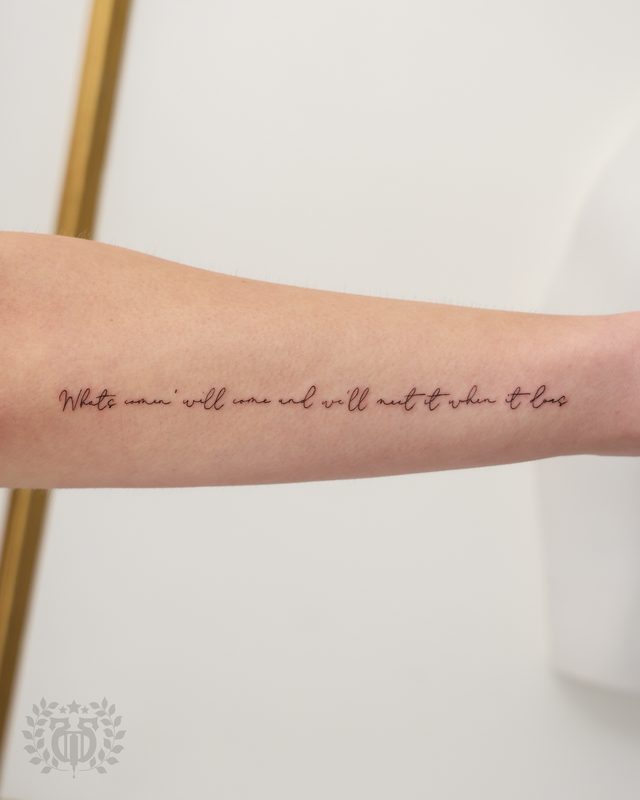
- Inner forearm (classic). The flat plane gives the artist a clean canvas, the skin holds ink beautifully over decades, and the wearer can read their own tattoo. A 4–6 inch horizontal run works here with zero compromise.
- Inner wrist. Handles short words and dates. Flat enough for crisp lines, though the thin skin requires lighter hands and careful aftercare. Touch-up cycle shorter than forearm placement.
- Inner bicep. Hides script when needed and displays it when desired. The skin here ages gracefully. Strong choice for names and short phrases.
- Ribs (longer passages). Allow long flowing phrases but hurt substantially and swell during healing. The body's curvature supports horizontal script flow naturally.
- Collarbone. Works horizontally but avoid the curve where the bone drops off. Short-to-medium phrases only.
- Behind the ear. Fits single short words only (3–5 letters). Private placement, chosen-reveal piece.
Size against x-height
- Under 1/4 inch letter height. The floor for any cursive work. Below this, the thin upstrokes close up and the loops fill in as the tattoo ages. Discouraged except on the largest, flattest canvases.
- 1/4 – 1/2 inch letter height. Working range for most wrist, inner forearm, and inner bicep pieces. Single words, short phrases, names. Touch-up cycle around 7–10 years.
- 1/2 – 3/4 inch letter height. Preferred for ornate scripts with hairline flourishes. Lets Copperplate and Spencerian work read properly. Forearm, ribs, thigh placements.
- 3/4 inch and larger. Statement-scale script. Long phrases, quotes, Bible passages. Ribs or back. Can go 15+ years before any touch-up.
Layouts
Eight layouts that read well.
Layouts the tradition has carried for decades, offered as starting points.
1. Single meaningful word (inner wrist)
One word that defines a chapter: 'breathe,' 'resilient,' 'grace.' Placed on the inner wrist, it becomes a private reminder visible only when the wearer turns their hand. Works best in flowing italic script with modest flourishes. Keep it under 8 letters for the wrist placement.
2. Family member's name (inner forearm)
Parent, child, or sibling name rendered in 3–4 inch script on the inner forearm. Among the most common requests for good reason: the placement is readable, the skin ages well, and the emotional weight suits the permanence. Pair with a small birth date underneath in a complementary font.
3. Short phrase in script (3–5 words)
'Still I rise' or 'this too shall pass' at 4–5 inches on the forearm or ribs. The rhythm of multiple words gives the artist room to vary letter weight and create visual flow. Keep the phrase short enough that each word remains legible from conversational distance.
4. Date in cursive numerals
Birth dates, wedding dates, or memorial dates rendered in script numerals rather than block numbers. A cursive '03.14.2019' on the inner bicep reads as art first, data second. Roman numerals offer an alternative when the client wants something less literal.
5. Loved one's signature (traced)
Scan an actual signature from a letter, card, or document and reproduce it faithfully. Grandparent signatures are the most requested version. Because the handwriting is authentic rather than stylized, it reads as deeply personal. Works best on inner forearm or over the heart.
6. Saying in another language
Latin, French, Italian — the foreign language adds visual mystery and often honors heritage. Verify translation with a fluent speaker, not just an online translator. Misspellings and mistranslations are the most common preventable regrets.
7. Song lyric line
A single lyric line that carries meaning from a song tied to a specific moment. Keep it to one line, not a full verse. 4–6 inches on the forearm or ribs suits most lyrical phrases. Skip if the song is generic — specificity is the whole point.
8. Memorial name with small accent
A lost loved one's name paired with a small accent: a tiny bird, a star, a date. The accent gives the piece visual weight without adding words. Chest, inner forearm, or over the heart.
With imagery
Script alongside imagery.
Cursive rarely carries a piece alone. Pairings give the script context and keep the composition breathing.
Pairing
Cursive + black-and-gray portrait
A portrait with a name or date in script positioned below or beside. The script labels and dates the portrait while the portrait carries the visual weight. The quintessential Chicano-tradition combination.
Pairing
Cursive + fine-line ornament
Delicate ornamental flourishes — vines, dotwork accents, small leaves — framing the script. Suits clients who want decorative complexity without moving into heavier styles.
Pairing
Cursive + traditional banner
Cursive inside a traditional scroll, often with ornamental framing. Memorial pieces, sailor-tradition hearts, and anchor compositions use this pairing most.
Pairing
Cursive + blackletter heading
A blackletter heading (name, year, motto) paired with cursive supporting text (dates, description). Hierarchy carries the composition.
Pairing
Cursive + floral accent
A small rose, peony, or pressed-flower accent at the end of a phrase. The floral gives the piece visual punctuation without overshadowing the letters.
First cursive piece
Eight steps before your appointment.
The preparation that separates a script tattoo you love at year ten from one you laser off at year three.
- Verify every word. Spelling, spacing, translation if foreign. Read it out loud at least three times to three different people before the stencil.
- Hand-draw, don't font-pull. A real letterer draws the piece custom. If your artist is selecting from a Dafont menu, keep looking.
- Match the script to the phrase. Formal Copperplate for wedding dates. Chicano tradition for surnames. Fine-line for a private mantra. Voice matters.
- Pick a flat, protected placement. Inner forearm, inner bicep, inner wrist, over the heart. Save curves for seasoned clients.
- Accept the scale the letterer suggests. First-time script clients consistently underestimate how much room letters need. Your artist has seen their work at year ten; you haven't.
- Plan the touch-up cadence. Fine-line script wants a refresh at year 5–7. Budget for it from the start rather than being surprised later.
- Bring handwriting you love. Grandparent's signature, a loved one's letter, your own journal entry. Authentic hand outperforms any designed font.
- See the stencil on skin before the needle. Hold the stencil in place. Look in the mirror. Walk around. Spend fifteen minutes with it before you commit. This is your last chance to catch issues.
Your hand
Three ways to keep the hand personal.
Cursive's personalization is linguistic, tactile, and compositional.
Authentic handwriting
Tracing a real signature or handwritten note from a loved one is the most personal cursive piece possible. It carries the specific rhythm and imperfection of a real hand.
Language choice
Latin for gravitas, Italian for warmth, French for elegance, your own native language for intimacy. The language signals the style the piece lives in.
Accent elements
A small flower, a tiny bird, a date, a minimal ornament alongside the script. Accents function as punctuation and give the piece visual weight without adding words.
Script slip-ups
Six script habits we redirect.
The failure modes specific to cursive, and the conversations that prevent them.
The cheap letterer trap
Saving modest money on the front end routinely costs significant laser or cover-up fees later. Wonky letter spacing and uneven baselines become impossible to ignore once you see them daily. Reputation does not transfer between disciplines.
Wrong font for the intent
A Victorian copperplate treatment on a punk rock lyric fights itself forever. Match the letterform to the mood of the words. A formal phrase wants a formal hand; a raw statement wants a looser script.
Names longer than the placement
Forces the artist to shrink letters past legibility. Measure the real estate twice, commit once. Shortening or abbreviating is better than microscopic script that will blur.
Going too small
Single most common regret. If the letterer suggests going bigger, trust them. Fine-line script at sub-6-point scale becomes a blur by year 5.
Misspellings
Survive the buzzing of the machine because nobody double-checked the stencil. Read it out loud. Have a friend read it. Read it backward, one letter at a time, before the needle drops. This is the permanent error most clients regret forever.
Using a computer font instead of custom drawing
Downloaded fonts are designed for print, not skin. A letterer draws custom so the piece fits the placement, the curvature, and the overall composition. Pulled-from-font script always looks pulled from a font.
Before the pen
Eight questions before the pen goes down.
A letterer fluent in cursive traditions gives you eight concrete answers.
- Can I see five healed script pieces photographed 12+ months out?
- Will you hand-draw this custom or pull from a font?
- What's the minimum size you'd recommend for this phrase and placement?
- How do you verify spelling and spacing before the stencil?
- How consistent is your slant across long phrases?
- Do you study calligraphy outside of tattooing?
- What does your touch-up cadence look like for script?
- Would you talk me out of this placement?
Vague answers on custom drawing, slant consistency, or minimum sizing are telling you something. Reputation does not transfer between disciplines.
FAQ
Spacing, spelling, and the other cursive worries.
Everything people worry about with handwriting on skin — spelling, spacing, and whether it still reads at year fifteen.
What's the difference between cursive and script?
Script is the umbrella term for any connected or flowing letterform, including copperplate, Spencerian, and modern brush styles. Cursive specifically refers to joined handwriting with flowing connections between letters. All cursive is script, but not all script is cursive. Gothic blackletter, for example, is script but not cursive because each letter stands alone rather than flowing into the next.
How small can I go with cursive?
For single words with simple letterforms, half an inch of letter height is the floor. Below that, the thin upstrokes close up and the loops fill in as the tattoo ages. Ornate scripts with hairline flourishes need three-quarters of an inch minimum. Any letterer who agrees to smaller without hesitation is setting you up for a blurry rework in five years.
Will my cursive tattoo blur over time?
Properly executed cursive holds up beautifully for decades. Blurring happens when ink is packed too densely into thin lines, when the artist rushes connections between letters, or when the placement flexes constantly. Choose a letterer who understands ink migration, pick a stable canvas, and your script will read clearly at 20 years just as it does at 20 days.
Can I get someone's handwriting as a tattoo?
Absolutely, and it's one of the most meaningful tattoos we do. Bring a clear high-resolution scan of the original writing. Your artist will clean the lines without losing the personality, resize it to your placement, and translate the pen strokes into tattoo strokes. Grocery lists, love letters, and signatures of grandparents all become permanent keepsakes.
What's the best placement for a name?
Forearm, inner bicep, and ribs take script beautifully because the skin stays relatively flat and ages predictably. Collarbone works for short names with elegant flow. Avoid fingers, feet, and outer wrists for anything you want to read clearly in a decade. The curve of the body should complement the baseline of the letters, not fight it.
Should I do single-line cursive or multi-line?
Single-line reads faster and ages better because there's less density per square inch. Multi-line works for longer passages but requires careful spacing between baselines so the piece breathes. A skilled letterer will sketch both options at your consultation and let you hold them against the placement before committing to either layout.
Can I get a quote in cursive?
Yes, and longer quotes are where dedicated letterers earn their reputation. Line breaks, word spacing, ascender and descender balance, and the overall shape of the paragraph all matter. A generalist will hand you straight-line text. A letterer will hand you a composed piece where the quote has visual rhythm and reads like poetry on the page.
Does cursive work on every language?
Western cursive traditions translate directly to Romance languages, English, and German. Arabic script, Chinese characters, Hebrew, and Cyrillic each have their own calligraphic traditions that deserve specialists who trained in those forms specifically. Do not ask a Latin-alphabet letterer to freehand Arabic calligraphy. Find someone who studies the specific tradition you want honored.
How long does a cursive session take?
A single name runs 30 to 60 minutes. A short phrase across the forearm books for 90 minutes. A full passage down the ribs takes 2–3 hours. The stencil work and placement dial-in often consume as much chair time as the actual lining. Budget more than you think; rushed script is ruined script.
Can you fix a bad cursive tattoo?
Sometimes. Cover-ups work when the original is thin and there's room to expand into a fuller, darker piece. Reworks strengthen existing strokes without changing the design. Severely blown-out lettering often needs laser fading first, then a fresh piece on top. Bring photos to consultation and the artist will tell you honestly which path fits your situation.
Ready to talk script?
Bring the words, the hand, the placement — we'll draw it custom.
Cursive is specialty lettering work. Bring the phrase, verified for spelling. Bring the tradition you want — Copperplate, Spencerian, Chicano, modern hand. Bring the placement. We will read the phrase aloud, check the spelling against a source you trust, and set the tracking wide enough that it survives the strokes softening.