Lore & Meanings
Medusa Tattoo Meaning
Medusa tattoo meaning runs three ways — the ancient Gorgoneion protection ward, the post-#MeToo survivor reclamation, and the power icon that refuses to be possessed. The myth, the symbolism, and how to choose the reading that's yours.
Book a consultationThe short answer
What does a Medusa tattoo mean?
A Medusa tattoo means protection, survival, and reclaimed power. In its oldest use — the Greek Gorgoneion, from the 7th century BCE — Medusa’s face is a ward: the image that terrifies an enemy is placed on the surface that faces the enemy, so the monster becomes the thing that guards the wearer. In its dominant modern use it marks having survived sexual assault — in Ovid’s telling Medusa was a woman punished for what was done to her, and the tattoo hands the gaze back to her. A third reading, feminist and pop-cultural, takes her as beauty and creative power that refuse to be possessed. Most people wear some combination of the three, and which one leads is the decision that shapes the whole piece.
What is a Medusa tattoo?
A Medusa tattoo is a portrait of Medusa, the Gorgon of Greek myth — a woman’s face with living snakes in place of hair, and a gaze the myth says turns onlookers to stone. Most Medusa tattoos are head-and-snakes only: no body, no background. That composition has a name. It is the Gorgoneion, the same image Greek artisans set on shields, armour, coins and temple doorways for centuries before anyone put it on skin.
Why did Medusa tattoos become so popular?
Two things stacked. Ovid’s version of the myth — assault, then punishment of the person assaulted — reads to a modern audience as a plain injustice, and from 2018 onward the #MeToo moment gave that reading a public vocabulary. Luciano Garbati’s sculpture Medusa with the Head of Perseus, installed across from the New York County Criminal Court in October 2020, gave it a picture. Requests rose sharply and have not come back down.
Is a Medusa tattoo a good idea?
It is, if you can say in one sentence which of the three readings the piece is doing. Medusa is one of the few subjects where the meaning is genuinely contested — strangers will read your tattoo against whichever version they know. That is not a reason to avoid her. It is the reason the consultation starts with the reading rather than the reference image, and the reason this page is organised the way it is.
Meaning map
Every meaning people search for, and where it actually sits.
Medusa gets described a dozen different ways. Almost all of them are one of three readings wearing a different word. Here is the translation.
The three readings
Monster. Survivor. Power.
Medusa tattoo meaning is not one thing. It splits three ways — protection, survival, power — and before the style, before the placement, before the artist, you pick the reading. These are not interchangeable. A piece can carry more than one, but the emphasis has to be chosen, and the emphasis is what the composition will be built around.
The monster reading
Apotropaic · Archaic · the face on the shield
The oldest continuous use of the image. From the 7th century BCE forward, the Greek Gorgoneion — Medusa’s face, bug-eyed, tongue out, fanged — was placed on temple pediments, armor, drinking cups, doorway lintels. The logic is surgical: the thing that terrifies the enemy is placed on the surface that faces the enemy. The paradox is ancient: the monster who petrifies is the ward against harm. Clients choose this reading when they want protection, boundary, warning to trespassers — a face that guards the wearer.
The survivor reading
Ovidian · post-2018 · the gaze that was hers to keep
The reading most modern audiences absorb. Ovid (Metamorphoses IV, c. 8 CE) gives us Medusa as a mortal woman, a priestess of Athena, assaulted by Poseidon in the goddess’s temple and then punished BY Athena — hair to serpents, gaze to weapon. The post-#MeToo wave from 2018 forward, amplified by Luciano Garbati’s 2008 sculpture Medusa with the Head of Perseus (installed across from the NY County Criminal Court in 2020), drove a sharp rise in Medusa tattoo requests from assault survivors. The piece is a visible marker of survival — I was punished for what was done to me, and the gaze that froze them was mine to keep.
The power reading
Cixous · Versace · beauty that refuses to be possessed
Hélène Cixous’s 1975 essay The Laugh of the Medusa named the Western imagination’s habit of calling female creative and erotic power monstrous in order to suppress it — and argued the correct response was to look directly at Medusa and see her as beautiful, laughing, uncontainable. The Versace logo (adopted 1993) reads Medusa as captivation-without-possession. Lady Gaga, Rihanna, Cardi B have all deployed her the same way. Clients choose this reading when they want autonomy, creative sovereignty, a gaze that refuses to be the passive object of anyone else’s looking.
The Hesiodic Medusa is a monster at the edge of the world. The Ovidian Medusa is a woman the world did something to. A tattoo has to decide which one it’s for.
The Gorgoneion — the face on the shield — is the oldest continuous use of this image. Nearly three thousand years of people putting Medusa on a surface to keep something outside of it.
For the client choosing Medusa as a survivor piece, this is not decoration. It is the first image she will see in the mirror every morning for the rest of her life. The composition has to carry that weight.
The myth
Two competing classical sources. Both still in circulation.
Before Medusa was a tattoo, a logo, or a hashtag, she was two competing stories — and the gap between them is where most of the modern confusion lives. Hesiod writes the monster. Ovid, seven centuries later, writes the victim. Tattoos inherit the argument.
The Gorgoneion
The face that terrifies enemies protects the wearer.
From the 7th through the 5th century BCE, Greek artisans placed Medusa’s face — the Gorgoneion — on temple pediments, doorway lintels, drinking cups, coins, body armor, and the shields of soldiers. The logic is surgical: the thing that terrifies the enemy is placed on the surface that faces the enemy. This is the oldest continuous use of the image, and the reason Medusa has endured in ornamental art for nearly three thousand years without interruption.
When Athena fixes Medusa’s severed head to her aegis, the monster becomes the ward. The face of the thing the goddess killed becomes the protection on the shield of the goddess who killed it. That paradox — monster as protector — is the oldest layer of the symbol, and it predates every modern reading by centuries. For the client who chooses the protection reading, this is the lineage they are stepping into.
Art history
Six eras. Six Medusas. All still in active use on skin.
The visual tradition moves through at least six distinct eras, and each one is still a live reference in a 2026 tattoo consultation. Your artist should know all of them. You should know at least two of them before the first sketch.
Archaic Gorgons
7th – 6th century BCE
Grotesque, frontal, circular face. Extended tongue, tusks, bulging eyes. Purely apotropaic. Placed on shields, temple pediments, drinking cups, armor. Ugliness as function — the image whose horror repels harm.
Classical transition
5th century BCE
The face softens. Still terrible, but human proportion begins to return. The tongue retreats. The eyes narrow. This is the hinge point — Medusa becomes legible as a person rather than a pure warding sign.
Hellenistic & Roman
3rd century BCE – 2nd century CE
The Rondanini Medusa (Glyptothek, Munich) — sorrowful beauty, serpents calm, expression closer to grief than rage. Sets the template for the sorrowful-beauty tradition that runs through the Romantics and into most fine-line Medusa portraits done in the 2020s.
Caravaggio · 1597
Uffizi, Florence
Medusa painted on a round shield. Captures the scream at the instant of severing — the head still alive, aware it has been killed. This is the reference every painted Medusa owes something to. The source for the severed-neck survivor-reading compositions in realism work.
Cellini · 1545–1554
Piazza della Signoria, Florence
Perseus with the Head of Medusa, bronze. The heroic reading — the killer with the trophy. This is the composition Garbati inverted in 2008, and the reason the inversion hit so hard: the Cellini bronze was the visual establishment of the hero-kills-monster reading for 450 years.
Shelley · 1819
Romantic period
Percy Bysshe Shelley’s poem On the Medusa of Leonardo da Vinci in the Florentine Gallery establishes the Romantic reading of Medusa as beautiful and dying. The aestheticized-suffering version that still underwrites a significant portion of contemporary fine-line Medusa portraiture.
The modern reclamation
Cixous planted the seed in 1975. #MeToo harvested it.
The modern reclamation reading of Medusa — the one driving a significant percentage of consultations since roughly 2018 — traces a direct line from Ovid through Hélène Cixous’s 1975 essay The Laugh of the Medusa to the post-2017 cultural moment that made survivor stories part of the public record. Luciano Garbati’s 2008 bronze sculpture Medusa with the Head of Perseus — installed across from the NY County Criminal Court in October 2020 near where the Weinstein trial was heard — became the dominant visual shorthand.
The survivor reading is specific. For a meaningful subset of clients, a Medusa tattoo is the visible marker of a survival. The piece has to carry that weight from day one — the composition, the placement, the gaze have to agree with the meaning. For the client choosing this reading, the tattoo isn’t decoration. It’s the first image she will see in the mirror every morning for the rest of her life. The composition has to be worth that. Still weighing symbols? Compare the snake tattoo meaning, browse the full meanings & symbolism library, then book a consultation to build your Medusa around the reading that’s yours.
Six styles
Match the style to the scale to the reading.
Medusa sits in more styles than almost any other mythology subject. Not all of them serve her equally. Below: what each style does, when it’s the right fit, and the one style to treat with caution.
Black & Gray Realism
The dominant style post-2018
Where most serious Medusa work happens now. References Caravaggio, Bernini, Hellenistic sculpture. Photographic portrait rendering, detailed serpents, dimensional shading. Does not survive small — 6 inches is the realistic floor, 8 to 12 inches is where the detail breathes. Multi-session work, priced as portrait work — scope and cost are settled at consultation.
Neo-Traditional
The decorative middle style
Bolder outlines, stylized snakes, expanded palette — lavender and ochre in the skin, deep green and oxblood for the serpents. Decorative instincts suit Medusa: snakes become design elements rather than zoological studies. Sweet spot 4 to 6 inches.
American Traditional
Bert Grimm, Sailor Jerry Gorgon flash
Bold outline, flat color, snakes reduced to stylized curls. Smaller (3 to 5 inches), iconic rather than photorealistic, honest about its own stylization. A clean fit for clients who want the symbol more than the portrait.
Fine Line / Single-Needle
Post-2020 modern delicate
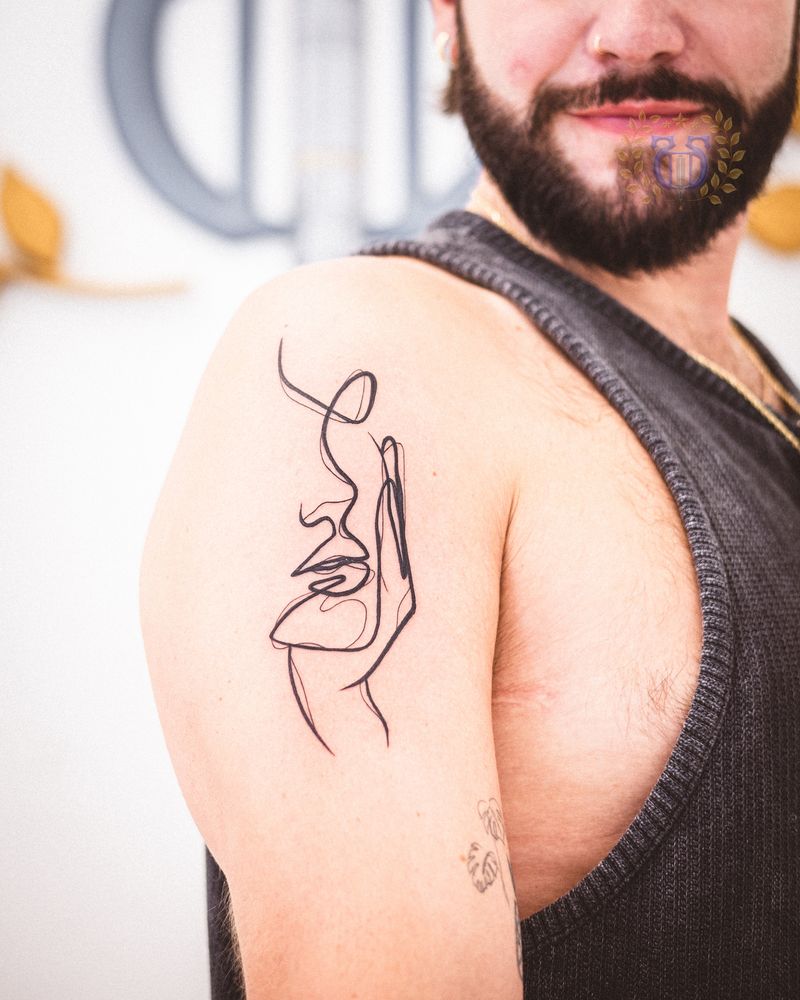
Hairline single-needle, the face rendered almost as drawing rather than sculpture, snakes as linework curls. Usually black and gray. Small to mid-scale. Surprisingly durable on forearms and ribs when placed by someone who understands single-needle healing. Caveat: can sacrifice the eyes in pursuit of delicacy, and a Medusa without eyes is not a Medusa.
Illustrative / Dark Art
Architectural · ornamental · myth-forward
Greek-key and meander borders, symmetrical snake fields, heavy black framing. Plays the mythic reading loud. Sits well in sleeve and chest-piece compositions where the frame is part of the meaning.
Watercolor (cautionary)
Rarely serves Medusa
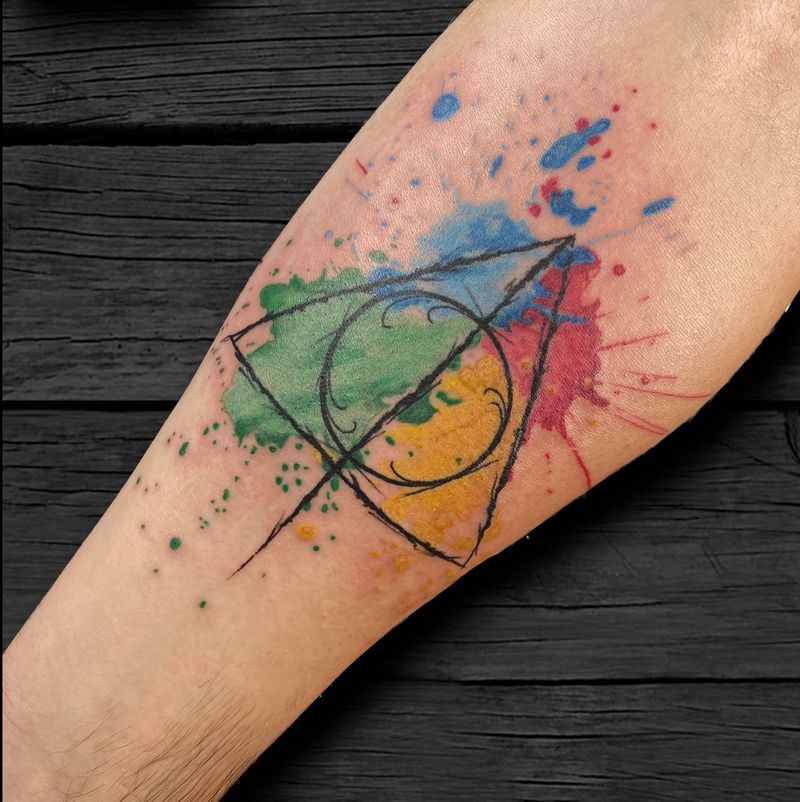
The face needs structure that watercolor refuses to provide. Washes bleed past the facial planes; the eyes soften into atmosphere. Most watercolor Medusas fail quietly. Not a flat rule — a few artists can do it — but a style to interrogate hard before committing.
Who wears her
Do you have to be a survivor — or a woman — to get a Medusa tattoo?
No, and no. Both questions come up in almost every Medusa consultation, usually apologetically. Here is the honest version of each.
Can men get a Medusa tattoo?
Yes. Nothing in the image is gendered toward the person wearing it — the Gorgoneion went on the armour of Greek soldiers and on Athena’s shield alike, and the classical myth-portrait has been a men’s tattoo subject for as long as Greek mythology has been tattoo subject matter. Men most often take the protection reading or the straight myth portrait, frequently at sleeve or chest scale with a Greek-key border. The survivor reading is not off-limits either; plenty of men carry it for someone they love.
Do you have to be a survivor?
No. The survivor reading is one of three, and it is by far the newest — the protection reading predates it by roughly twenty-seven centuries. What is worth knowing before you book: because that reading is now the most widely recognised one, a Medusa on visible skin will be read that way by some strangers whether or not you meant it. That is not a reason to skip the tattoo. It is a reason to decide, before the stencil, whether you are comfortable being asked.
Is it a feminist tattoo?
It can be, and for a lot of wearers it is. That reading has a specific and traceable origin — Hélène Cixous’s 1975 essay The Laugh of the Medusa, which argued that Western culture calls women’s creative and erotic power monstrous in order to suppress it, and that the answer is to look straight at Medusa and find her beautiful. Everything from the Versace mark to the post-2018 wave sits downstream of that argument.
What if someone asks what it means?
You never owe anyone the story. But a Medusa is a face, and faces invite questions in a way a rose does not. If there is a version of this piece you would not want to explain on a bad day, that is real information about placement, not about whether to get it. Put it somewhere a sleeve covers, and it is yours on your own schedule.
Placement
Where should a Medusa tattoo go?
Placement does not change what Medusa means. No body part adds a meaning the image doesn’t already carry, whatever the internet says. What placement decides is how much room the face gets, who sees it, and how well it holds up over twenty years — in that order. Medusa is a portrait, and portraits are unforgiving about all three.
Thigh
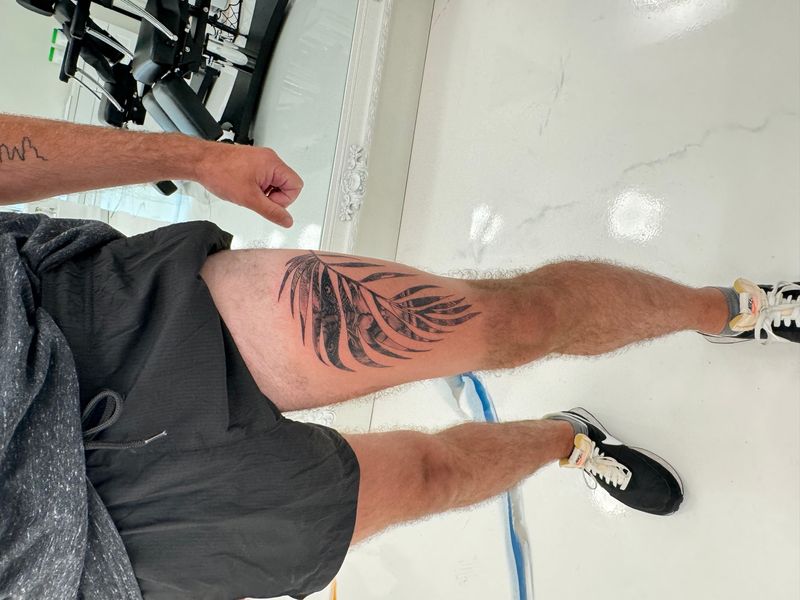
The best canvas Medusa has. Large, flat, low-friction, sun-protected, and easy to cover or show at will. It is where most 8-to-12-inch black and gray realism Medusas end up, and the only common placement with room for a narrative composition without committing to a back piece.
Best for. Realism · survivor-reading portraits · anything above 8 inches
Forearm
The most requested placement, and a sound one. Flat enough that the face doesn’t distort, heals reliably, holds fine detail, and it faces the wearer — which matters if the piece is for you rather than for the room. Practical ceiling is roughly 5 to 7 inches, so plan a reduced snake count rather than a compressed one.
Best for. Fine line · neo-traditional · a piece you want to see yourself
Upper arm & shoulder
Good scale, with one caution: the arm is a cylinder and a face is not. A Medusa placed across the curve reads correctly from one angle and distorts from the others. A careful artist will set the face on the flattest available plane and let the snakes do the wrapping. Sits naturally inside a half sleeve.
Best for. Half sleeves · Greek-key framed compositions · mid-scale portraits
Back & upper back
Unlimited scale and the only realistic home for the full-figure and triple-Gorgon compositions. Multi-session by definition. The trade is that you will almost never see it — which suits a piece meant as armour, and suits a piece meant as a mirror much less.
Best for. 12 inches and up · narrative work · Perseus or Pegasus present
Ribs & sternum
Visually excellent for a vertical, symmetrical Medusa, and one of the more demanding places to sit for the hours a portrait needs. The skin moves with the breath, so this placement ages best with slightly bolder structure than the same design would need on a thigh. Private by default.
Best for. Symmetrical compositions · fine line · pieces meant to stay private
Calf
Underrated. Curves gently rather than sharply, wears well, and gives a tall composition somewhere to go — the face high, the serpents running down. Good for clients who want real scale without a thigh or back commitment.
Best for. Tall compositions · serpents escaping the frame · 6 to 10 inches
Hand, neck & always-visible skin
Possible, and the placement we ask the most questions about. Hands and fingers see the most wear and fade fastest, so expect touch-ups on a schedule. And a Medusa here cannot be covered on a day you don’t want to discuss it. For the survivor reading in particular, that is worth sitting with before the deposit rather than after.
Best for. Clients already committed to visible work · bold, simplified renderings
Over scars
Medusa is one of the strongest cover-up subjects there is. Radiating snakes let the artist route around or across scar tissue, and the composition absorbs asymmetry that most other subjects would expose. Scar tissue takes ink differently and heals differently — ask specifically to see healed scar-coverage work, not fresh photos.
Best for. Cover-ups · survivor-reading pieces tied to a specific event
Composition
Nine compositions. Each one encodes a reading.
The composition you choose tells the viewer which reading your piece is doing — whether you say so or not. Pick the reading first, then let the composition follow.
Head only (Gorgoneion)
Protection reading
The oldest composition. Apotropaic, iconic, simplest. The face and the snakes, nothing else. Works at every scale from 3-inch traditional to 12-inch realism.
Head with severed neck
Survivor reading · myth-forward
Caravaggio lineage. The moment of severing. Blood, scream, aware-of-death expression. Survivor-reading or myth-forward. Usually realism, usually mid-scale and up.
Bust · shoulders · classical portrait
Ovidian · mourning
Softer, classical, sorrowful. Ovidian vulnerability. Rondanini-Medusa style. Reads as mourning more than wrath.
Full figure with body
Narrative · myth-forward
Rare. Almost always back-piece scale. Space for Perseus implied or present, Pegasus emerging from the neck, blood vocabulary, narrative composition. Multi-session work.
Head with mirror
Reclamation reading
Reverse Perseus. The gaze turned back on itself. Shorthand for survivor and reclamation readings. A piece about the wearer’s refusal to be the object of the look.
Serpents escaping the frame
Survivor reading · modern
The snakes expand beyond the hair into surrounding skin — the composition exceeds its borders. Post-2020 fine-line signature. The energy of the piece exceeding its containment.
Head with halo or laurel
Power reading
Reverential. The power reading framed as sanctification. Halos, laurel wreaths, olive branches. Plays up the divinity-misnamed-as-monster reading.
Greek-key / meander border
Classical · Apollo house style
Ties the piece directly to the classical Mediterranean aesthetic and to Apollo’s studio lineage. Works in any style. Turns the ornament into frame.
Triple Medusa (three Gorgons)
Classical · narrative
Stheno, Euryale, Medusa — the three sisters from Hesiod. Two immortal, one mortal. Turns the piece into a study of sisterhood and mortality. Almost always large-scale back or thigh work.
The gaze
The eyes are the load-bearing element.
Medusa’s power — the petrifying stare — lives in the eyes. A Medusa with weak eyes is not a Medusa; it’s a portrait that forgot its own myth. Four gaze choices, four signals. Without the eyes done right, the tattoo fails. This is the specific moment to pick the artist on healed portfolio work, not on fresh photos.
Confrontational. The survivor and power readings most clients arrive wanting. The tattoo looks back at the viewer.
Signal. Protection · reclamation · power
Ovidian vulnerability. Sorrow rather than wrath. The piece acknowledges the harm the myth contains.
Signal. Ovidian · mourning · classical
Memorial. Echoes the Caravaggio tradition of the moment-of-severing aware-of-death gaze. Dormant rather than passive.
Signal. Memorial · Caravaggio
The least confrontational, the most decorative. The piece becomes ornament first and statement second.
Signal. Decorative · neo-traditional
Size, honestly
Medusa is a portrait tattoo. Size her like one.
Size is not a style decision on a Medusa — it’s a legibility decision. The eyes and the snakes both require room. Five tiers cover almost every Medusa choice a client will actually make.
The consultation
Five questions a careful artist will ask.
A thoughtful Medusa consultation is not primarily about style references. It is about meaning clarification. If an artist doesn’t ask some version of these questions before the first sketch, that is information about the artist.
Which reading is this piece doing?
Protection, survival, or power? The three readings compose compatibly, but the emphasis determines the composition. Pick the emphasis before the reference.
Commemorative or protective?
Is this tied to an event that has already happened — marking survival, a chapter closed — or is it protective, meant to carry forward? The first wants a more sorrowful style; the second wants a more confrontational one.
For you, or for the world?
Is the piece meant to be read by strangers, or is it primarily for you to see? Placement and gaze both shift significantly with this answer.
Apotropaic or portrait?
Snakes out, gaze forward, confrontational — or softer, more sorrowful, more Ovidian? These are different compositions, not different executions of the same composition.
Whose Medusa do you want to wear?
Caravaggio’s, Bernini’s, Cellini’s, Garbati’s — or one that does not yet exist because it will be yours? The reference pool determines the tone more than the style does.
Without the eyes done right, the tattoo fails. This is the moment you pick the artist, not the flash.
Count the snakes, then forget the count. What matters is whether they’re pointing at her or away from her.
Medusa is a portrait tattoo. Price it like a portrait, not like flash.
Common mistakes
Six patterns to watch for.
Most disappointing Medusa tattoos fall into one of these six categories. Catching it in the consultation prevents it in the chair.
The “just looks cool” mistake
Picking Medusa without knowing which of the three readings the piece is doing. Result: a tattoo that doesn’t match what the wearer actually means — aesthetic appropriation of a symbol the wearer never committed to. Fix: do the consultation work. Pick a reading before you pick a reference.
The wrong-scale mistake
Trying to fit Medusa at 2 or 3 inches. Face collapses. Snakes become scribbles. Eyes lose structure. Fix: 5 inches minimum, any style. 8 inches and up for realism.
The wrong-style mistake
Watercolor Medusa almost never works — the face needs structure the style refuses. Traditional at small scale — bold lines overwhelm features. Fine line that sacrifices the eyes for delicacy. Fix: match style to scale to reading. Not every style serves every reading.
The Versace mistake
Getting a Medusa that reads as a luxury-brand logo rather than as the myth. Happens when styling overrides substance — when the reference images are all fashion imagery rather than classical or survivor-era work. Fix: widen the reference pool before the consultation. Caravaggio, Bernini, Cellini, Garbati — not perfume ads.
The trend mistake
Post-2020 surge. Some Medusas are being picked because the symbol is in fashion. Those will age as markers of an era, not personal work. Fix: if the only reason you want a Medusa is Instagram, wait six months. If the want remains, the want is real.
The appropriation question
The reclamation reading is owned by survivors. A non-survivor wearing it performatively is doing something the artist can’t police and shouldn’t try to. But a thoughtful client asks themselves: why am I choosing this reading? Fix: know your why. Honesty protects the piece long-term.
When to wait
Four signals the tattoo isn’t ready yet.
The needle is permanent. The decision doesn’t have to be rushed. These are the four moments when a Medusa consultation should go home, think, and come back.
Within 6 months of a precipitating event
Don’t book a survivor-reading Medusa inside 6 months of the event that would drive it. Let the meaning settle before the ink does. A piece made in crisis often doesn’t match the person who comes out the other side.
Still deciding between readings
Consultation is not a decision moment. Go home. Think. Come back. The three readings are genuinely different pieces — if you haven’t picked one, the tattoo isn’t ready.
When the only reason is trend
Post-2020 Medusa went mainstream. Some percentage of new Medusa work won’t age well because the reason was the Instagram grid. Wait until the trend fades. If the want is still there, it’s not the trend — it’s yours.
When the artist hasn’t asked about the reading
If an artist hasn’t asked which of the three readings your piece is doing, that’s information about the artist. Consider a different consultation before the deposit.
Medusa over scars. Radiating snakes are among the strongest cover-up compositions in the survivor- reading catalog. The composition gives the artist flexibility to route around or across scar tissue, and it absorbs asymmetry other subjects would expose. Not every Medusa artist also does scar work well — ask specifically about healed scar-coverage portfolio before booking.
FAQ
The questions every Medusa consultation surfaces.
Eight questions that cover meaning, myth, style, scale, the eyes, the snakes, and whether Medusa can cover scars.
What does a Medusa tattoo actually mean?
Three different things, depending on the reading you pick. The monster reading is the oldest — Medusa as the Gorgoneion, the apotropaic ward placed on shields and temple doorways from the 7th century BCE forward. Protection, boundary, warning. The survivor reading is Ovidian and post-2018 — Medusa as the assaulted priestess punished by Athena for what was done to her, reclaimed by survivors as a marker of righteous anger and survival. The power reading is Cixous, Versace, pop-feminist — Medusa as beauty that refuses to be possessed, a gaze that will not be the passive object of anyone else’s looking. The readings compose compatibly but the emphasis determines the composition. Pick before you book.
Is a Medusa tattoo really about surviving assault?
For a significant percentage of clients since 2018, yes. The survivor reading surged alongside the #MeToo cultural moment and the installation of Luciano Garbati’s Medusa with the Head of Perseus sculpture near the New York courthouse where the Weinstein trial was heard. The reading traces directly to Ovid’s account in the Metamorphoses — Medusa as a priestess assaulted in Athena’s temple, punished BY Athena, hunted and beheaded for the crime of having been harmed. Many clients who choose a Medusa piece now are marking their own survival, or someone they love’s. It is not the only reading, and a non-survivor wearing the survivor reading performatively is doing something the symbol notices. If the reading is yours, it’s yours.
Where does the Medusa myth come from?
Two competing classical sources. Hesiod’s Theogony (c. 700 BCE) gives the oldest account — Medusa as one of three Gorgons, daughter of sea deities Phorcys and Ceto, alone mortal among her sisters, slain by Perseus using Athena’s mirror-shield and Hermes’s sickle. From her severed neck emerge Pegasus and Chrysaor. Hesiod gives her no interior life — she is a monster a hero kills. Ovid’s Metamorphoses (c. 8 CE) adds the twist most modern audiences absorb — the beautiful priestess, the assault in Athena’s temple, the punishment, the serpents, the gaze. Ovid is the literary reworking, not the original. Hesiod is the source. A careful consultation knows which version the client is drawing from.
How big should a Medusa tattoo be?
5 inches minimum for any style. Under 3 inches, the face collapses, the snakes become scribbles, and the eyes — which are the whole point — lose structure. American Traditional and fine line work well at 3–5 inches with a reduced snake count and iconic rendering. Neo-Traditional sits at 4–6 inches. Black and gray realism — the dominant style for serious Medusa work post-2018 — wants 6 inches as a floor and 8–12 inches as the sweet spot. Back pieces and full-thigh narratives start at 12 inches and up. Medusa is a portrait tattoo. Price and scale it like one.
What style works best for a Medusa tattoo?
Depends on the reading. Black and gray realism is the dominant style for survivor and classical readings — Caravaggio, Bernini, Hellenistic references, 8–12 inches, multi-session. Neo-Traditional serves mid-scale decorative Medusas well — expanded palette, stylized snakes, bold outline. American Traditional is the Gorgoneion flash style — smaller, iconic, Sailor Jerry and Bert Grimm lineage. Fine line has surged since 2020 — delicate, botanical, the face rendered as drawing rather than sculpture, with a caveat about the eyes. Illustrative and dark art with Greek-key borders play the classical lineage loud. Watercolor almost never works — the face needs structure the style refuses.
Why are the eyes so important on a Medusa tattoo?
Because the gaze is the entire point. Medusa’s power — the petrifying stare — lives in the eyes. A Medusa with weak eyes is not a Medusa; it’s a portrait that forgot its own myth. A direct forward gaze is confrontational and carries the survivor and power readings most clients arrive wanting. Downcast eyes invoke the Ovidian vulnerability. Closed or sleeping eyes echo the Caravaggio severing moment. Profile or three-quarter is the most decorative and the least confrontational. Without the eyes done right, the tattoo fails. This is the specific moment to pick the artist on healed portfolio work, not on fresh photos.
How many snakes should a Medusa tattoo have?
Traditionally seven. Modern pieces run from five to thirty, and the count is less important than the logic. Direction signals meaning: snakes converging on the face read as threat; snakes radiating outward read as crown. Species matters to the artist — realistic vipers require reference and scale rendering; stylized serpents are honest about being ornament. Scale detail is the element most likely to blow out over a decade; ask your artist what they intentionally undercut. Snake eyes can match the Medusa gaze, or contrast it — a composition choice most clients never think to ask about until they see the stencil.
Can a Medusa tattoo cover scars?
Yes — and it’s one of the strongest cover-up subjects in the survivor-reading catalog. The radiating snakes give the artist flexibility to route around or across scar tissue, and the composition absorbs asymmetry that most other subjects would expose. For clients considering a Medusa over scars from a precipitating event, this is worth naming in the consultation directly. Not every artist who tattoos Medusa also does scar work well — ask specifically about healed scar-coverage portfolio before booking.
What is a Medusa tattoo?
A Medusa tattoo is a portrait of Medusa, the Gorgon of Greek myth — a woman’s face with living snakes in place of hair and a gaze the myth says turns onlookers to stone. Most are head-and-snakes only, with no body and no background; that composition is called a Gorgoneion, and it is the same image Greek artisans set on shields, armour, coins and temple doorways from the 7th century BCE onward. As a tattoo it usually means protection, survival, or reclaimed power, depending on which of the three readings the wearer is doing.
Can men get a Medusa tattoo?
Yes. Nothing in the image is gendered toward the person wearing it — the Gorgoneion went on the armour of Greek soldiers and on Athena’s shield alike. Men most often take the protection reading or the classical myth portrait, frequently at sleeve or chest scale with a Greek-key border. The survivor reading is not off-limits either; plenty of men carry it for someone they love. You do not have to be a survivor, or a woman, to wear Medusa well — you do have to know which reading your piece is doing.
Where is the best place for a Medusa tattoo?
The thigh, for most people. It is large, flat, low-friction and easy to cover or show at will, which makes it the natural home for the 8-to-12-inch black and gray realism work where serious Medusas live. The forearm is the most requested and a sound second choice at 5 to 7 inches. Ribs and sternum suit symmetrical vertical compositions; the back is the only realistic home for full-figure or triple-Gorgon pieces. Placement does not change what Medusa means — it decides how much room the face gets, who sees it, and how well it ages.
Does a Medusa tattoo mean transformation and rebirth?
It can, and the reading is well founded — Ovid tells the story inside a poem literally called the Metamorphoses, and Medusa’s change is its central event. But transformation is not a fourth meaning sitting beside protection, survival and power; it runs through the survivor and power readings rather than replacing them. Medusa is changed against her will, and the modern wearer reads the change as something she came through. If transformation is the word that drew you to the image, the useful next question is: transformed by what, and into what? That answer picks your composition.
Ready to pick the reading?
Bring the reference. Bring the reason. Bring the version of Medusa you want to carry.
Apollo Medusa consultations start with the reading — protection, survival, or sovereignty — and build the composition outward from there. Meaning leads. Artistry serves. Book the consult and walk out with a Medusa whose every element agrees with what the piece is for.