Lore & Meanings
3 Arrow Tattoo Meaning
What a three arrows tattoo really means — six readings pulled apart honestly, from modern friendship and Psalm 127:4 to the Iron Front antifascist lineage, plus styles, sizing, and the matching-tattoo questions worth settling first.
Book a consultationAttribution honestly
Three arrows carries more baggage than most tattoos.
Three arrows looks like a simple tattoo — three straight lines, three fletched tails, three heads pointed somewhere. Clients bring reference images and ask what it means. The honest answer: it depends entirely on which tradition you’re drawing from, and some of the traditions clients name most often are the ones with the shakiest historical footing.
We take meaning seriously at Apollo because a tattoo meaning is a claim you wear on your skin in public. If the claim is wrong, the tattoo is still beautiful, but the story underneath it is borrowed from a source that does not exist. This page is a walk through what the history actually says — which attributions check out and which ones don’t.
Six readings
Pick one primary. Own it honestly.
Three arrows carries six distinct readings. A coherent piece lives inside one of them as primary. A second can sit underneath, but one has to lead.
The friendship reading
Modern · Pinterest-era · legitimate
Three close friends bonded. The most-requested version of this tattoo. Emerged in contemporary tattoo culture roughly 2010–2015 during the fine-line boom — NOT ancient, NOT Indigenous, but real and meaningful. Valid as long as you name it honestly. You don’t need borrowed provenance to justify a tattoo that matters.
The direction / intention reading
Focused purpose · staying the course
Three arrows pointing forward representing focused discipline — the same arrow fired three times. The strongest solo reading because it doesn’t depend on anyone else staying in your life. Stay the course, set intention, pick the path and direction and hold it.
The family reading (Biblical)
Psalm 127:4 · three children · the quiver
Psalm 127:4 — “As arrows in the hand of a mighty man, so are children of the youth. Happy is the man that hath his quiver full of them.” Three arrows for three children. Textually sourced, easy to cite, and one of the cleanest provenances available for a three-arrow piece.
The antifascist reading
Iron Front · Eiserne Front · 1931 Germany
Three downward-pointing arrows. The Iron Front, 1931 German antifascist coalition designed by Sergei Chakhotin and Carlo Mierendorff. Stood against monarchism, Nazism, and Stalinist communism — the three enemies of Social Democracy. Painted over swastikas on walls. Carried into modern antifa iconography. A political commitment piece.
The memorial reading
Three arrows · one broken
Three arrows with one broken, crossed, or rendered lighter — loss of a sibling, friend, partner. Composition choices matter: which arrow is broken, whether it’s still present or removed, black-and-gray vs. fine line. Memorial pieces don’t have retries; consultation is long.
The three-goals reading
Personal · private · contract with yourself
Three arrows representing three specific life ambitions, disciplines, or pursuits. A private contract with yourself — the reading nobody else has to know. Works well when paired with small personal details that mark the three goals distinctly.
Three arrows is one of the most over-attributed symbols in Western tattoo culture — which is exactly why the history is worth getting right.
The modern friendship reading is legitimate. The Indigenous attribution is not. You don’t need borrowed provenance to justify a tattoo that matters.
Three downward arrows painted over a swastika on a Berlin wall in 1932 is the most historically documented use of this symbol anywhere. Most tattoo clients have never heard of it.
The Native American attribution
The reading the internet keeps getting wrong.
If you search three arrows tattoo meaning on any engine, the top results will tell you with complete confidence that three arrows represent friendship in Native American tradition. That claim does not hold up under investigation. Here’s what’s actually documented, what isn’t, and what to do with that.
The online claim
Search three arrows tattoo meaning on any engine and the top results will tell you, with complete confidence, that three arrows represent friendship in “Native American tradition.” Some specify Cherokee. Some say Sioux. Most just say Native American — which is itself a red flag, because there are 570+ federally recognized tribes in the United States, each with distinct languages, cosmologies, and visual vocabularies.
What’s actually documented
Arrows appear across many Indigenous North American material cultures — as functional objects and as symbols — of protection, hunting skill, warriorhood, defense, peace (arrow pointed down), family and lineage. These are tribe-specific and not generalizable. The Iroquois parable of Hiawatha teaches that a single arrow breaks easily but a BUNDLE cannot be broken — a teaching about confederation that later influenced the bundled arrows on the Great Seal of the United States. A bundle is not three arrows specifically, and the teaching is unity, not friendship.
What isn’t documented
The “three arrows = friendship, Native American tradition” claim does not trace to any specific, documented, widespread tribal source. Researchers, Indigenous cultural consultants, and the tribes themselves have been asked. The answer keeps coming back that this is a modern Western invention layered over a generic idea of “Native wisdom.” It’s a form of cultural attribution that borrows authority from a living people without being accountable to them.
What to do with that
If a client has a documented specific tribal connection and a specific tribal elder or tradition behind the meaning they want, honor that. If a client is drawn to the friendship reading without that connection, the tattoo is still legitimate — the reading itself is meaningful — but claim the modern Pinterest-era friendship meaning directly. Don’t borrow provenance you don’t have.
The Iron Front
The reading most clients have never heard of — and the most documented history of this symbol.
If you want a three arrows symbol with unambiguous, dated, verifiable history, you want the Iron Front. Three downward arrows painted over a swastika on a Berlin wall in 1932 is the most historically documented use of this symbol anywhere.
A client asking for three downward-pointing arrows in a stark, graphic, often-red treatment is frequently aware of this lineage and wants it. A client asking for three delicate parallel arrows in fine-line black is almost always somewhere else entirely. The orientation, the weight, and the composition tell you which tradition the tattoo is speaking to.
Biblical & classical readings
Four traditions that check out.
Alongside the Iron Front, four older symbolic traditions feed Western three-arrow iconography. Each has textual or historical sourcing you can point to — cleaner provenance than most tattoo meanings ever get.
Apollo & Artemis
In Greco-Roman myth, arrows belong to Apollo and Artemis. Apollo’s arrows bring both plague and healing — a reminder that precision cuts both ways — the same double-edged logic that runs through snake symbolism. Artemis’s arrows mark her as huntress and protector of the wild. The arrow as directed intention, fate aimed and released. None of these traditions fix on three specifically, but they establish the symbolic grammar.
Psalm 127:4
“As arrows in the hand of a mighty man, so are children of the youth. Happy is the man that hath his quiver full of them.” The warmest reading. Three arrows for three children, or three siblings, or three generations, sits squarely inside this tradition. Unlike the Native American attribution, this one is textually sourced and easy to cite — cleaner provenance than most tattoo meanings ever get.
St. Sebastian
Christian martyrdom. The saint pierced with arrows, later reclaimed in queer art history as a patron of survived suffering. Arrows as the wounds that fail to kill what they pierce — the same mortality register worked in the symbolism of death and ruin. A specific style for survivor or survival pieces that want a Christian iconographic anchor.
Buddhist three poisons
In Buddhist teaching, the three poisons — greed, hatred, and delusion — are sometimes depicted as arrows to be removed from the mind. The reading that turns three arrows into a meditation on what a practitioner is trying to release. Picked by clients with a contemplative or meditation-practice anchor.
The modern readings
Friendship and focus — new, honest, and worth taking seriously.
The reading that three parallel arrows equals “three close friends” or “loyalty between three people” is real, current, and worth taking seriously — as a modern tattoo-culture meaning that emerged in the fine-line boom roughly 2010–2015, not as an inherited ancient tradition.
Three arrows also reads cleanly as tripled intention — the same arrow fired three times, focus as discipline, a reminder to stay the course. This is the reading that shows up most on clients getting the tattoo for themselves rather than for a relationship. Both of these meanings are honest if we call them what they are: contemporary readings from within tattoo culture, not ethnographic artifacts. Tattoo meanings are allowed to be new.
Six styles
Match the style to the style of the reading.
Three arrows is one of the most tattooable symbols in contemporary practice — vector-clean, linear, scales cleanly from one inch to eight. The style you pick determines the style the meaning lives in.
Fine Line / Single-Needle
The dominant modern style
Hairline outlines, minimal interior shading, often no color. Executed with single-needle or three-round-liner at low voltage. 2–5 inches typical. Ages differently than Traditional — thinner lines have less room to spread before reading as fuzzy. A reputable fine-line artist is explicit about this at consult: budget for a touch-up every 4–7 years if you want crisp lines long-term.
Blackwork / Illustrative
Solid-fill weight
Bolder lines, solid black arrowheads, filled-in fletching. Often combined with geometric borders, dot-work shading, or sacred-geometry accents behind the arrows. 3–6 inch sweet spot. Gives the arrows physical weight — they look like objects rather than suggestions of objects. Photographs well and ages predictably. Solid black holds for decades.
Geometric / Sacred Geometry
Arrows plus triangles, mandalas, dot work
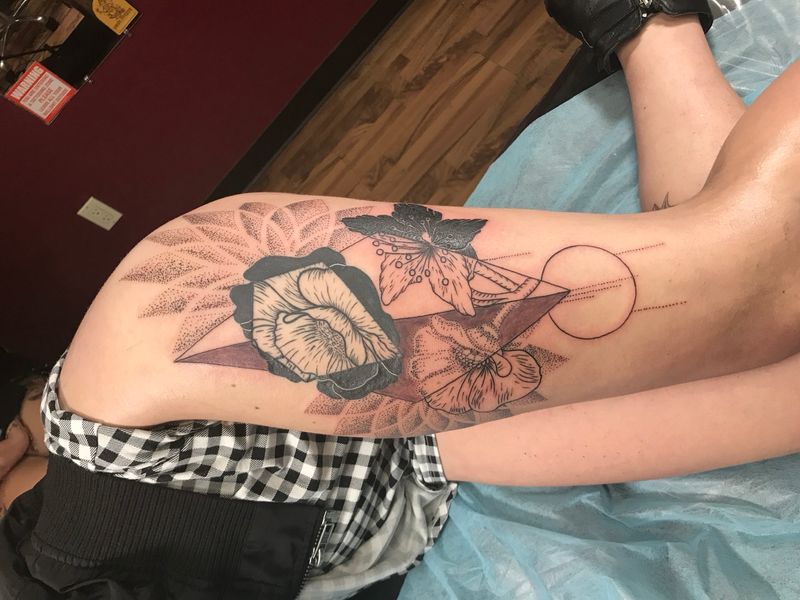
Arrows integrated with geometric framing elements — overlapping triangles, mandala backgrounds, dot-work spheres. A distinct modern style with its own practitioners and audience, typically clients drawn to the symbol for meditative or spiritual reasons rather than decorative ones. 4–7 inches — the surrounding geometry needs room to breathe.
American Traditional
Not canonical — but possible
Traditional Americana doesn’t naturally love the three-arrow composition — Traditional leans toward single-arrow-through-heart imagery or a single bundled quiver. A three-arrow Traditional piece is possible with bold outlines, limited palette, and a banner, but it’s not canonical. Most Traditional artists will steer the client toward a design their style actually supports.
Realism
Actual fletching, wood grain, iron heads
Photorealistic arrows — fletching barbs, hand-carved wood grain on the shafts, iron or obsidian arrowheads. Uncommon as a request but striking when done by a realism-capable artist. 5 inches minimum, ideally more. Anything smaller and the detail collapses into mud. Multi-session work likely.
Dot Work / Stippling
Texture without line weight
Arrows constructed entirely from stippled dots rather than continuous lines. Slower to tattoo, different aging profile. Works well as a hybrid style with fine-line shafts and dot-work fletching. Contemporary style.
Composition variants
The question is never just three arrows — it’s which three.
Same direction, crossed, bundled, or broken. Eight compositions, each one encoding a different reading. Pick the reading first, then let the composition follow.
Three parallel arrows, same direction
The most common version. Reads as same path, tripled intention. The default when a client arrives describing “just three little arrows.” Works in every style.
Three arrows bundled / in a quiver
Contained, gathered, protected. Reads as together. The family and sibling style. Often paired with banners for names.
Three arrows crossing in X or starburst
Unity through intersection. Reads as converging. Architectural, symmetric. Works well on sternum and back compositions.
Three stacked arrows, vertical column
Clean architectural look. Works well on sternum, spine, back of neck. The most columnar of the compositions.
Three arrows with differentiated details
One wooden shaft, one iron, one feathered differently. Used when each arrow represents a distinct person, phase, or value. Narrative composition — requires scale to read.
Three arrows plus banner
Names of three children, three siblings, three friends, three ideas. More narrative. Banner sits below the arrows or curls around the shaft bundle.
Three arrows, one broken
Memorial composition. One arrow broken, cracked, or subtly different — one of the three is gone, but the set is still a set. Black-and-gray style usually serves memorial weight better than fine line.
Three downward arrows (Iron Front)
Three arrows pointing down and to the left. The antifa composition with specific historical lineage. Orientation is the signal — any client requesting this should be walked through the 1931 history at consult.
Placement
Nine positions, each with its own reading.
Placement is half the design. The same three arrows on an inner forearm and on a ribcage aren’t the same tattoo — visibility, intimacy, and daily-reminder value all shift with the position.
Inner forearm
The default fine-line placement. Arrows run vertically up the arm, pointing toward the elbow or wrist. Visible to the wearer daily.
Ribcage
Horizontal, arrows flying sideways across the torso. Reads well but among the more uncomfortable sessions. Private placement.
Back of neck
Vertical stack of three. Visible when hair is up, hidden when down. Popular private-visible placement.
Collarbone
Horizontal, one arrow per collarbone segment, following the bone. The canonical collarbone placement.
Inner / outer bicep
Vertical or horizontal depending on arm geometry. The placement that reads quietly.
Wrist
Small, bracelet-style — a single line of three miniature arrows wrapping partway around. Fine line only at this scale.
Sternum
Vertical column of three running down the center of the chest. Long healing window. High visual impact.
Ankle / foot
Small commemorative placement, often chosen for memorial pieces. Private-visible style.
Spine
Vertical arrows running along the spine. Large scale. Usually paired with additional geometry or framing elements.
Size, honestly
2.5 inches minimum. Larger is almost always better.
Below 2.5 inches, the detail on three parallel shafts, three fletchings, and three arrowheads collapses into three scribbles within 5 years — regardless of how good the artist is fresh. The correct move is to simplify or scale up, not to cram detail into a footprint that won’t hold it.
Matching tattoos
The big consideration.
Three arrows is one of the most-requested matching subjects at American studios. It’s worth slowing down for. Matching tattoos are a logistics project, not just a design project — the design decisions are easier than the coordination.
Relationship stability check
Matching tattoos assume stable relationships. Friendships, partnerships, sibling bonds are real but not guaranteed. The strongest matching three-arrow pieces are the ones designed so each person’s tattoo still reads well on its own. Ask out loud: does this work if the friendship does not? The paired-swallow tradition solved the same problem a century ago — design each piece to stand alone.
Same placement or individual?
Identical placement across all three people (all left inner forearms, all back-of-ankle) reads as the most matching. Varied placement lets each person’s piece live inside their own body map. Both work — decide deliberately.
Identical rendering or variations?
Identical stencils signal unity. Slight variations — one arrow slightly heavier, one fletching tilted — signal individuality inside a shared commitment. Talk about which signal you want before the stencil is drawn, not after.
All three arrows or one each?
Two configurations. Each friend wears one arrow and the three pieces form the set (more interdependent, more fragile — if one person drops out, the set is incomplete). OR each friend wears all three arrows (more resilient, each piece stands alone). Pick deliberately.
Same artist, same day, same stencil
Matching tattoos done across studios, weeks, artists drift — line weight, spacing, angle all shift. The cleanest matching pieces are done together, one artist, same appointment block. If matching across cities is unavoidable, share the exact stencil file and reference photos.
The strongest matching three-arrow pieces are the ones designed so each person’s tattoo still reads well on its own. Matching three-arrow tattoos often outlast the relationships that motivate them. Design yours so it still stands if it has to stand alone.
The chest question
Three arrows on the chest — what the placement adds.
“What do 3 arrows on the chest mean?” is one of the most-searched versions of this question. The short answer: the arrows carry the same six readings — the chest just changes who the tattoo is for.
The chest is the private-declaration placement
Over the heart or centered on the sternum, three arrows sit where the wearer sees them and strangers don’t. It’s the placement people choose when the meaning is theirs first — the three-goals contract, the memorial for a sibling, the Psalm 127:4 family reading for three children. The chest doesn’t add a new meaning; it turns the volume down on the audience and up on the wearer.
Over the heart vs. sternum vs. upper chest
Over the heart (left of the sternum) reads as devotion and memorial — the arrows point toward what you hold. A vertical sternum column reads as centered discipline, the intention reading made structural. Upper-chest and clavicle placement reads more declarative and is the most visible of the three. Same three arrows, three different tones.
“Three arrows in my chest” — the feeling, not just the flesh
Some clients arrive describing a felt sense — three arrows lodged in the chest — and want to externalize it. That reads memorial or survival: what pierced you and stayed. The one-broken-arrow composition and a point-down orientation carry that weight honestly. Name it as survival, not decoration, and the design writes itself.
Scale and pain, honestly
The sternum and center chest are among the more tender sessions — bone-close, long healing. A vertical three-arrow column wants 4–8 inches to let each shaft breathe; a small over-the-heart set holds at 2.5–4. Don’t shrink a chest piece to dodge the pain — simplify the detail instead, or pick a calmer placement.
For guys
Three arrows for guys — the readings men reach for most.
The symbol isn’t gendered, but the searches are — “3 arrow tattoo meaning for guys” is its own question. Here’s what men most often mean by it, and how the design usually shifts.
Direction, discipline, and the three goals
The most common men’s reading is intention — the same arrow fired three times, focus as discipline, staying the course. Close behind is the three-goals contract: three private ambitions marked as a promise to yourself. Both stand alone without depending on anyone else staying in your life, which is exactly why they age well.
Family — Psalm 127:4 and three kids
For fathers, the Biblical family reading lands hardest: “as arrows in the hand of a mighty man, so are children of the youth.” Three arrows for three children, often with a quiver detail or a banner of names. It’s one of the cleanest provenances a men’s piece can claim — textually sourced, easy to stand behind.
Weight over delicacy
Men’s three-arrow pieces skew toward blackwork and bold illustrative over hairline fine line — solid arrowheads, filled fletching, forearm or chest at 4–6 inches. Not a rule, a pattern: heavier line reads the way most guys want the meaning to read, and it survives decades of wear better than thin work.
Know the orientation before you commit
The same caution applies regardless of gender: three arrows pointing down-and-left is the Iron Front / antifa composition. If you want the politics, learn the 1931 history and stand on it. If you don’t, point them forward or up — plenty of guys walk in wanting “tough arrows” and nearly walk out having chosen an orientation they didn’t realize was political.
The consultation
Five questions before the first sketch.
A client who can answer all five cleanly is ready. A client who can’t is usually a consultation, not a tattoo appointment.
Which of the six readings?
Friendship, direction, family, political, memorial, or goals? Pick one primary. Secondary can sit underneath, but one has to lead.
Matching or solo?
Is this a matching tattoo with specific other people? Who? How many? Are they all getting inked together?
Which three specifically?
If family, goals, or memorial — which three people, ambitions, or memories? The answer shapes the composition.
Antifa-aware?
Three downward-left arrows reads as Iron Front / antifa. Do you want that reading, or do you need to avoid it? Orientation is the decision.
Personal or shared?
Is the meaning personal to you, shared inside a group, or visible to strangers? Private, semi-private, or declarative?
The question is never just three arrows. It’s which three arrows. Same direction, crossed, bundled, or broken — those are four different tattoos with four different meanings.
Matching three-arrow tattoos outlast most of the relationships that motivate them. Design yours so it still stands if it has to stand alone.
If you can’t answer “which three” in one sentence, you’re not ready to book. You’re ready to consult.
Common mistakes
Eight patterns to watch for.
Most disappointing three-arrow tattoos fall into one of these eight categories. Catching it in the consultation prevents it in the chair.
The Native American misattribution
Claiming three arrows = ancient Indigenous friendship symbol. It isn’t. No documented tribal tradition assigns this meaning. Wearing it under that claim risks appropriation and, worse, wearing something false. Fix: the modern Pinterest-era friendship reading is legitimate on its own terms — claim it directly.
The accidental antifa piece
Three arrows pointing down-left is the Iron Front. If you don’t intend the politics, you’re wearing a political tattoo by accident. Fix: flip the orientation — forward, upward, or right — and the reading drops. If you DO want the politics, learn the 1931 history first.
Scale collapse
A 1.5-inch three-arrow tattoo turns into three scribbles inside 5 years. Detail on three parallel shafts, three fletchings, three arrowheads needs room. Fix: 2.5 inches minimum. Larger is almost always better.
The matching-tattoo disagreement
Three friends get matching three arrows. Friendship dissolves. Each wears a permanent reference to a friendship that ended. Fix: ask honestly whether the tattoo works without the friendship. If no, pick a different symbol whose primary meaning is personal.
The “just looks nice” default
Three-arrow piece picked purely on aesthetics with no reading attached. Ages into generic flash. Fix: adopt the direction / intention reading at minimum. Even a thin personal story beats none.
The religious misread
Psalm-based memorial piece rendered in fine-line secular style. The reference disappears. No one reading the tattoo, including the wearer five years in, can see the Psalm. Fix: include one visible anchor — verse reference, quiver, Biblical detail, or black-and-gray style that signals weight.
The political-lite mistake
Client likes the antifa aesthetic but has no political commitment behind it. Ends up making a public claim the wearer can’t defend in conversation. Fix: learn the history and stand on it, or pick a different orientation so the piece doesn’t speak politics the wearer didn’t mean.
The wrong-style-for-style mismatch
Memorial piece in airy fine line. Political piece in soft sacred geometry. The style undercuts the meaning. Fix: match style to style — heavier for grief and politics, lighter for friendship and intention.
When to wait
Four signals the tattoo isn’t ready yet.
The needle is permanent. The decision doesn’t have to be rushed. If any of these four signals apply, the consultation should go home, think, and come back.
Friendship under 2 years
Relationships under 24 months aren’t stable enough to anchor a matching tattoo. Let the friendship prove itself before marking it permanently.
Political reading without the history
If you’re drawn to the antifa aesthetic without knowing the Iron Front lineage, read first, book second. A political tattoo needs a political commitment to stand on.
Family still being defined
Three children, three siblings, three grandkids — if the count isn’t settled, the tattoo isn’t ready. Wait until the set is complete before marking it.
Memorial piece inside 6 months of loss
Grief reshapes quickly in the first year. A memorial tattoo made too soon often doesn’t match the person who comes out the other side. Wait. The arrows can still be drawn later.
FAQ
The questions every three-arrow consultation surfaces.
Ten questions covering the Native American attribution, the Iron Front history, the six readings, the chest placement, designs for guys, antifa awareness, scale minimums, matching tattoos, style match, and the Biblical family reading.
Do three arrows really mean friendship in Native American tradition?
No — or at least, not in any documented tribal source. The “three arrows = Native American friendship symbol” claim circulates constantly online but does not trace to any specific, widespread tribal tradition. There are 570+ federally recognized Indigenous tribes in the United States, each with distinct visual vocabularies, and no pan-Indigenous “friendship dictionary” exists. What is documented: arrows in many Indigenous North American traditions carry tribe-specific meanings — protection, hunting, warriorhood, peace, family — but these are specific and not generalizable. The Iroquois Hiawatha parable teaches that a BUNDLE cannot be broken (unity through confederation), later influencing the bundled arrows on the US Great Seal. The modern friendship reading is real and valid as contemporary tattoo culture — just don’t claim Indigenous provenance you don’t have.
What IS the documented history of three arrows as a symbol?
The Iron Front (Eiserne Front), a 1931 German antifascist coalition. Three downward-pointing arrows designed by Russian émigré Sergei Chakhotin and politician Carlo Mierendorff in 1932, stood against monarchism, Nazism, and Stalinist communism — the three political enemies of German Social Democracy. The arrows were painted directly over swastikas on walls across German cities. Revived in the 2010s–2020s antifa iconography. When you see three downward-pointing arrows as a political tattoo today, this is almost always the lineage being cited. Alongside the Iron Front: Psalm 127:4 (children as arrows in a warrior’s quiver), Apollo and Artemis’s arrows of precision, St. Sebastian’s martyrdom arrows, and the Buddhist three poisons. All textually or historically documented.
What does a three arrows tattoo actually mean?
Six primary readings, and you pick one. The friendship reading — three close friends bonded (modern Pinterest-era origin, legitimate). The direction / intention reading — focused purpose, tripled discipline, staying the course. The family reading — Psalm 127:4, three children, the quiver. The antifascist reading — Iron Front 1931, political commitment, downward orientation. The memorial reading — three arrows with one broken, loss marked. The three-goals reading — three specific life ambitions, a private contract with yourself. The readings compose compatibly but the emphasis determines the composition. Pick before you book.
Will my three arrows tattoo read as antifa?
Depends on orientation. Three arrows pointing DOWNWARD AND TO THE LEFT is the historically accurate Iron Front composition and reads as antifascist / antifa to anyone familiar with the history. Three arrows pointing forward (horizontal), upward, or to the right does not carry that reading. If you want the political piece, orient accordingly and know the history. If you want to avoid the political reading, flip the orientation at consultation. The artist should walk you through this before the stencil goes on.
What’s the minimum size for a three arrows tattoo?
2.5 inches. Below that, the detail on three parallel shafts, three fletchings, and three arrowheads collapses into what reads as three scribbles within 5 years — regardless of how good the artist is fresh. Fine line wants 2–5 inches sweet spot. Blackwork wants 3–6. Realism wants 5 inches minimum, ideally more. The correct move when a client wants a composition that’s too small for the detail is either to simplify the design or scale up — NOT to cram detail into a footprint that won’t hold it.
Is three arrows a good matching tattoo for friends?
Yes — with considerations. Three arrows is one of the most-requested matching subjects at American studios. The strongest matching pieces are designed so each person’s tattoo still reads well on its own, because relationships are not guaranteed to outlast tattoos. Key decisions: same placement on all three bodies (reads most matching) or individual placement (allows each person’s piece to live inside their own body map); identical stencils (unity) or slight variations (individuality inside shared commitment); each person wearing all three arrows (resilient — each piece stands alone) or each friend wearing ONE arrow of the set (interdependent, fragile if one drops out). And same artist, same day, same stencil wherever possible — matching done across studios drifts.
Which style works best for three arrows?
Fine line / single-needle is the dominant modern style for three-arrow work — hairline outlines, 2–5 inches, the default for clients getting first or second tattoos. Blackwork / illustrative gives the arrows physical weight — 3–6 inches, solid black fills, good for statement compositions. Sacred geometry integrates the arrows with mandalas and triangles at 4–7 inches — chosen by meditation-practice clients. American Traditional doesn’t naturally carry three-arrow compositions — Traditional leans single-arrow — but is possible with a banner. Realism at 5+ inches gives photographic detail. Pick the style that matches the style of the reading — lighter for friendship and intention, heavier for memorial and political.
What about three arrows for three children (Psalm 127:4)?
One of the cleanest provenances available. Psalm 127:4: “As arrows in the hand of a mighty man, so are children of the youth. Happy is the man that hath his quiver full of them.” Three arrows for three children sits directly inside this Biblical tradition — textually sourced, easy to cite, clear reading. Composition considerations: a quiver detail or banner with the children’s names anchors the Biblical reference; black-and-gray style gives the piece appropriate weight; the arrows can be differentiated (different fletching, different arrowheads) to distinguish each child. If this is the reading, make the Biblical reference visible enough that viewers ten years from now can still read it.
What do 3 arrows on the chest mean?
The same six readings a three-arrow tattoo carries anywhere — friendship, direction, family (Psalm 127:4), the Iron Front antifascist lineage, memorial, or three private goals. The chest placement changes the audience, not the meaning. Over the heart reads as devotion or memorial; a vertical sternum column reads as centered discipline; upper-chest and clavicle placement reads most declarative. Clients who describe “three arrows in my chest” usually mean a survival or memorial reading — what pierced them and stayed — best carried by a point-down orientation or a one-broken-arrow composition. Pick the reading first; the chest decides who sees it, not what it says.
What does a 3 arrow tattoo mean for guys?
The symbol isn’t gendered, but the readings men reach for most are direction and discipline (the same arrow fired three times, staying the course), three private goals marked as a contract with yourself, and — for fathers — the Psalm 127:4 family reading, three arrows for three children. Men’s three-arrow pieces tend toward blackwork and bold illustrative over hairline fine line, forearm or chest at 4–6 inches, with solid arrowheads and filled fletching. One caution regardless of gender: three arrows pointing down and to the left is the Iron Front / antifa composition, so choose the orientation deliberately rather than by accident.
Ready to pick the reading honestly?
Bring the answer to “which three.” Bring the orientation question. Bring the matching-tattoo logistics if relevant.
Apollo three-arrow consultations start with attribution honesty — pick the reading you can stand behind, skip the borrowed provenance. Book the consult and walk out with a piece whose every element agrees with what it’s for.