Lore & Meanings
Amazing Art Behind Swallow Tattoos
A barn swallow will cross an ocean and come back to the same rafter, season after season, for most of its life. The sailor tattoo did not invent that meaning. It borrowed it from people who had been watching the bird arrive on schedule for a very long time, and this guide separates the documented history from the folklore that grew over it.
Book a consultationThe returning bird
Barn swallows come back to the same rafters, across oceans, for twenty seasons running.
Barn swallows — Hirundo rustica, the species whose forked silhouette became the iconography — migrate between Europe and southern Africa, North America and South America, and return each spring to the same nest. Ornithologists have tracked individual birds making the round trip fifteen and twenty seasons running. The swallow is, in the literal biological sense, the animal that always comes home.
For sailors whose profession was leaving — whose partners, children, parents waited on shore for months or years — no other bird carried the meaning so cleanly. The swallow tattoo was a contract with the sea and with the people left behind. The paired composition, one bird before the voyage and one after return, completed the contract on skin. It is one of the few genuinely binding promises the body-art tradition has ever produced.
The six readings
Pick one primary.
The swallow carries six distinct readings under the same silhouette. A good consultation picks one primary — not because the others disappear, but because the piece needs a center of gravity.
The return-home reading
Migratory bird that always comes back. The safest, most universal swallow. If you don’t know which reading fits, this is usually the one underneath the impulse. The contract is with a place, a person, or a version of yourself you intend to return to. Ages well because most lives eventually contain a return of some kind.
The memorial reading
The sailor tradition held that a swallow tattoo would carry your soul to heaven if you drowned at sea — the bird as psychopomp, soul-guide. That lineage now extends to general memorial pieces: swallow with a name, a date, a small object the person loved. Clients who pick this reading usually already know.
The freedom reading
Small bird, untethered, migrating on its own schedule. Personal autonomy, chosen life, the bird that doesn’t stay because it doesn’t have to. Often chosen after a marriage ends, a city is left, a career is closed. The swallow as the one who goes.
The completion reading
Paired swallows — outbound and return — a journey that finished. Anniversaries, sobriety milestones, the illness you came through. The pair is the point; a single swallow doesn’t carry this reading cleanly. The outbound bird said I am leaving. The return bird says I kept my word. For a matching set built for a group rather than a pair, the three arrows tattoo works the same stands-alone logic three ways.
The love-and-return reading
I will come back to you. The tattoo as commitment. Swallow with a name, swallow with a heart, swallow with a key. Closely related to the return-home reading but aimed outward at a specific person rather than a general homecoming.
The tradition reading
Sailor Jerry, American Traditional flash, the swallow as an entry into a specific tattoo lineage. The honest choice when the aesthetic is the reason. A client who says “I love the flash look and I want to wear it” is making a legitimate pick. This reading becomes a problem only when it’s unclaimed.
The 5,000-mile rule is folklore dressed as regulation. What the swallow actually marks is distance — not measured in logbook figures but in the life the sailor came home carrying.
The paired swallow was a contract in ink. The first bird said I am leaving. The second, added after return, said I kept my word.
Sailor Jerry didn’t invent the swallow. He fixed its grammar — two colors, one silhouette, one posture — and that grammar is what the word ‘traditional’ still means when a client asks for the bird.
The sailor history
Folklore fact-checked. Real history restored.
Strip the 5,000-mile myth out of the swallow story and the symbol gets deeper, not thinner. What remains is two hundred years of working sailors marking distance in ink — and the specific Honolulu shop where the modern American Traditional swallow was codified.
Pre-nautical roots
The sailor tradition didn’t invent the meaning. It inherited it.
The sailor reading is roughly three hundred years old. The bird’s symbolic record is older by millennia. Across every major tradition, the constant is return — the bird that leaves and comes back, the psychopomp who knows the route, the sign of summer restored.
Archaic Greek
The swallow as one of the birds of Aphrodite. The Procne and Philomela myth — two sisters transformed after Tereus’s violence into a swallow and a nightingale. The bird is a survivor of assault who keeps her voice in a different throat.
Roman
Funerary stelae show swallows as soul-birds, carved alongside the names of the dead. The direct ancestor of the sailor psychopomp reading — the link is not coincidence but continuity.
Celtic
The swallow as a solar bird whose return opens summer. The sign of the season turning. Reads clearly in the returning-home cluster of meaning.
Chinese
Swallows nesting under a household eave are a blessing on the house. The character Yan (燕) carries associations of loyalty and return. In domestic poetry, the swallow is the bird of the continuing family.
Japanese
Tsubame, the swallow — domesticity, spring, return. Appears in classical poetry and in ukiyo-e bird studies. Same core reading as Chinese: the bird that comes back to the eaves of the same house, season after season.
Sailor Jerry grammar
Collins fixed the grammar. That grammar is still what “traditional” means.
Norman Keith Collins — Sailor Jerry — working out of Hotel Street, Honolulu, through the 1930s and 40s, did not invent the swallow. He fixed its visual grammar. The flash sheets set the scale, the two-color palette, the posture of the wings mid-beat, the way the tail feathers splay into a clean fork.
Cap Coleman out of Norfolk, Virginia, and Bert Grimm working the Long Beach Pike were producing swallow flash in the same period with slightly different line weights and a rougher hand. Together the three port-city shops — Honolulu, Norfolk, Long Beach, all tattooing sailors on shore leave — are where the swallow as we know it was built. When a client today asks for a “traditional swallow,” they are asking, whether they know it or not, for a piece of the Collins–Coleman–Grimm vocabulary.
The literary record
Four writers serious clients will bring into consultation.
The swallow has a long life in English-language poetry. The piece that matters most for the tattoo tradition is Oscar Wilde’s 1888 story The Happy Prince — the swallow as a creature who chooses love and duty over the instinct to return. The text to put in the hand of memorial-reading clients.
Tennyson · 1847
The Princess: “O swallow, swallow, flying south” — the swallow as messenger carrying the speaker’s longing across distance.
Keats
Watches the swallows fly to Africa and marks his own staying-behind against their going. The bird as the creature that goes when the speaker cannot.
Shakespeare
Richard III: “True hope is swift, and flies with swallow’s wings.” The Winter’s Tale uses swallows to announce the turn of the season. Swift, seasonal, a marker of change.
Oscar Wilde · 1888
The Happy Prince. The swallow is the story’s emotional center — the bird who delays his migration to Egypt, stays through the cold, carries the prince’s gold to the city’s poor, and dies at the statue’s feet. Wilde writes the swallow as a creature who chooses love and duty over the instinct to return. The text to put in the hand of memorial-reading clients.
Six styles
The swallow scales cleanly. The style decides what it says.
A one-inch fine-line swallow behind the ear reads the same shape as a six-inch Traditional piece across the clavicle. The grammar is identical; only the interior density changes. No other bird in the tattoo canon does this.
American Traditional
The canonical Sailor Jerry swallow
Bold 1.5mm outline. Cadmium-red breast, cobalt or Prussian-blue wings and head, white belly, minimal interior linework suggesting three to five feather groupings. Flat fills. Black shadow under the wing. No gradient, no stippling. Designed to hold its read for forty years on a forearm. Standard scale 2–4 inches.
Neo-Traditional
Dimensional swallow with depth
Expanded palette — teals, purples, ochres — and dimensional shading under the wing and across the breast. Outline stays bold but the interior earns depth. Pairs readily with roses, crescent moons, open hands, sacred hearts, Art Nouveau script. 3–5 inches.
Fine Line / Single-Needle
The dominant modern small swallow
Minimalist silhouette, hairline outline, often just outline with a single interior feather suggestion. 1–3 inches. The style most clients under thirty arrive asking for by name, whether they know the term or not.
Black & Gray Realism
Actual Hirundo rustica portrait
Scale-accurate feather barbs, mid-flight dynamism, soft atmospheric shading behind the wing. 4–8 inches. Uncommon on swallows specifically because the subject is so tied to the Traditional flash vocabulary — but arresting when executed well by a portrait-capable artist.
Illustrative / Botanical
Vintage ornithology plate meets modern linework
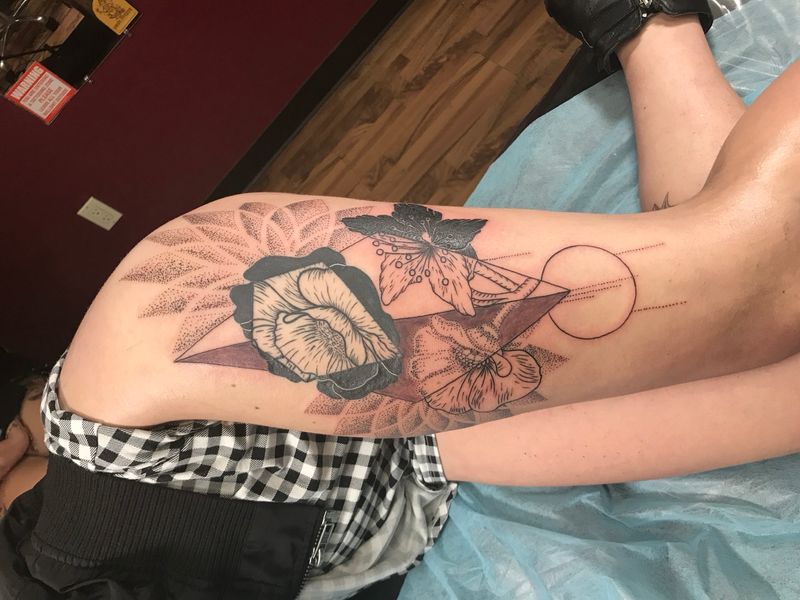
Swallow docked into floral elements in a 19th-century bird-study style. Mid-scale 3–6 inches. Works well on forearm, outer calf, upper thigh. Pairs with peony, wildflower, or herbarium-style specimens.
Watercolor
The style that actually works on swallows
Color splashes trailing behind the wing, motion streaks, pigment wash suggesting speed. Popular in 2020s fine-art-style work. Standard caveat: watercolor ages faster than line-anchored work. A 10-year-old watercolor swallow won’t read as crisply as a 10-year-old Traditional one.
Composition specs
Five details to specify before the stencil stage.
The Traditional swallow is one of the most-stencilled tattoos in American history, and its grammar is codified to a degree most subjects never reach. Specify these details up front and you won’t walk out with a generic bird shape.
Wing position
Swept back for in-flight. Open and cupped for landing. The two poses read as different tattoos. Specify before the stencil stage, not during.
Tail fork
Visible and clearly split. A swallow without a readable forked tail is just a bird. This is the silhouette’s signature — do not let the artist simplify it.
Color assignment
Cadmium-red breast, cobalt-blue (or Prussian-blue) head and wings, white belly. These are the canonical assignments. Every deviation reads as a deviation.
Eye detail
Single black dot, placed high on the head. At small scale this is the difference between alive and taxidermied. Specify that the eye is actually there — not a feather line guessing at where the eye might be.
Feather groupings
Three to five interior line suggestions across the wing, even at 2 inches. The feather linework is what tells the viewer this is a swallow and not a generic dark silhouette.
Placement
Nine canonical positions.
The swallow has been placed on human bodies for three centuries, and nine placements have emerged as canonical. Each one signals something different about the reading.
Clavicle pair
One swallow over each collarbone, facing outward or inward. The canonical Sailor Jerry placement. 2–3 inches each. Reads publicly when the collar is open.
Chest pair
One over each pec, larger scale — often 4–5 inches each. Reads more formally than the clavicle pair. Takes more time in the chair.
Forearm (single or pair)
Swimming up the forearm toward the elbow. Reads as forward motion whenever the arm is at rest. Fits 3–5 inches comfortably.
Hand & fingers
Miniature swallow in flight on the side of the hand or across the webbing. Traditional flash placement. Fades faster — budget for a touch-up in 10 years.
Behind the ear
Modern fine-line placement. 1–1.5 inches. Private-visible: seen when hair is up, hidden when down. Popular 2020s choice.
Ankle & foot
Commemorative small piece. Fine line or small Traditional. The placement that reads as quietly chosen — not performative.
Back of neck
Single swallow, 2–3 inches, centered on the spine. The placement for a piece the wearer almost never sees but others always do.
Ribcage pair
Two swallows flying toward each other across the ribs. Common for reunion pieces, long-distance relationships that closed, completed journeys. Painful. Worth it.
Sternum
Single vertical swallow in flight, head up or head down depending on intended read. Head up = ascending, hopeful. Head down = memorial style.
Composition pairings
Ten classical pairings.
The swallow is one of the most compositionally generous subjects in the tattoo vocabulary. Ten classical pairings, each landing the bird in a different category.
Swallow + banner
Mom, Dad, a memorial name, a date. The canonical Traditional composition. Banner sits below the bird or curled around its body, never above.
Swallow + rose
Beauty and freedom, or love carried home. The most-requested Traditional pairing. Works across all six readings.
Swallow + anchor
The sea and the return. Sailor symbolism stacked into a single piece. The composition for clients claiming the sailor lineage explicitly.
Swallow + heart
Love and return — the heart is what the swallow is flying toward. Love-and-return reading made literal.
Swallow + ship
The voyage narrative. Usually larger — forearm or calf piece. 4+ inches for the ship to read properly.
Swallow + key
The swallow carries the key. Home, the return to a door that’s still yours. Quiet, specific composition.
Swallow + letter in beak
Message, homecoming, news from the other side of the water. The literary swallow — Tennyson’s, Wilde’s.
Swallow pair + infinity
Coming and going as a single continuous loop. The completion reading rendered as eternal return.
Swallow + dagger
The voyage and its violence. Darker Traditional pairing. For clients whose journey wasn’t gentle.
Swallow + second bird
Mixed bird compositions (sparrow, eagle, robin). Usually mid-to-large scale. Each bird carries its own reading; let them talk to each other.
The paired swallow
Four specs for the composition that reads as completion.
Two swallows facing each other across the body’s midline is its own category — treat the pair as a single composition, not as two singles that happen to sit near each other.
Spacing
The swallows should face each other without their beaks or wing tips colliding. A finger’s width of negative space between them usually reads right; less than that, and the eye merges them into one cluttered shape.
Scale
Both swallows should be exactly the same size. Any scale difference reads as a mistake rather than intention. Paired swallows are surprisingly hard — only book with an artist who has matched pairs in healed portfolio.
Placement logic
Clavicle, chest, or ribcage. On the ribcage they fly toward each other across the sternum, which carries the strongest symbolic charge — completion, the outbound and return, two journeys finally closed into one.
Reading choice
The pair reads as completion, symmetry, or reunion. A single swallow cannot carry these readings cleanly. If the meaning is a finished journey, budget for the pair.
Size, honestly
Four tiers cover almost every swallow choice.
Size on a swallow is a legibility decision, not a style one. The style you’ve picked determines which tier works.
The consultation
Five questions before the first sketch.
A swallow consultation should land these five before any sketch goes to paper. If any are unclear on the day of the appointment, the right move is to reschedule.
Which reading is this?
Return, memorial, freedom, completion, love, or tradition? Pick one primary. The others don’t disappear — the piece just needs a center of gravity.
Commemorative or forward-looking?
Memorial and completion look back. Return, freedom, and love-and-return look forward. Tradition sits outside the axis. Know which direction the piece is pointing.
Single or paired?
A single swallow reads as return, freedom, love, or tradition. A pair reads as completion or commitment. Don’t drift between them late in the process.
Visible or hidden?
Forearm, neck, and collarbone speak publicly. Ribcage, chest over the heart, and inner bicep stay private. The reading often chooses the placement — let it.
Sailor reference or general bird?
Both are valid. The sailor frame invites anchors, banners, and red/blue Traditional palette. The general frame opens fine line, black-and-gray, and contemporary composition.
The swallow is the only bird in the tattoo canon that reads correctly at one inch. Every other bird needs scale to survive.
Forked tail and pointed wings — swallow. Rounded tail, plump body — sparrow. Round body with blue — bluebird. Confirm the bird out loud.
A consultation that skips the reading is a consultation that isn’t finished.
Common mistakes
Eight patterns to watch for.
Most disappointing swallow tattoos fall into one of these eight categories. Catching it in the consultation prevents it in the chair.
The “just looks cute” mistake
Small Traditional swallow picked for the aesthetic with no reading claimed. Ages into a generic flash tattoo that the wearer no longer feels connected to. Fix: honestly claim the tradition reading. If you’re choosing the Sailor Jerry lineage because you love how it looks on a body, say so, and the piece becomes legitimate again.
The wrong-size mistake
1-inch Traditional swallow. Looks sharp on the healed photo and collapses within two to three years. Bold-line Traditional needs 2 inches minimum to hold detail. Fine line goes smaller, but that’s a different style decision, not a size workaround.
The partner’s-name mistake
Swallow with a partner’s name, early in the relationship, visible placement. When the relationship ends, cover-up is hard because the name sits inside the composition. Fix: compose so the piece works without the name. No locking date. No banner that becomes nonsense alone.
The imbalanced pair
One swallow larger than the other, or placed at uneven distances from the centerline. The eye reads asymmetry instantly. Fix: only book paired swallows with an artist who has matched pairs in their healed portfolio.
The sparrow / swallow confusion
Clients frequently say sparrow and mean swallow, or vice versa. Forked tail and pointed wings — swallow. Rounded tail, plump body — sparrow. Round body with blue — bluebird. Fix: confirm the bird out loud at consultation.
The prison-symbolism surprise
In Russian criminal tattoo tradition, swallows carry specific meanings (completed prison term, among others). Rarely intersects with American work, but worth a sentence of awareness for larger chest or neck pieces so a client isn’t surprised by an internet rabbit hole.
The “too many symbols” stack
Swallow + anchor + heart + rose + banner + ship all inside a 4-inch piece. Result: visual noise, not lineage. Fix: one primary symbol, one secondary at most. If more elements are wanted, scale the piece up or split into two sessions.
The artist-style mismatch
Traditional has a specific look. A fine-line artist can render a Traditional swallow, but it won’t read the same. Fix: match the artist to the style the reference is drawn in. Healed portfolio, not fresh photos.
First-tattoo notes
The swallow is one of the best first tattoos. Four things to know.
Small, meaningful, visible if wanted, sits inside a recognizable tradition. If this is your first tattoo, four things to know before booking.
Pain expectation
Clavicle and ribcage are moderately painful — the two most-requested swallow placements. Forearm and outer shoulder are easier. Budget for the placement the meaning wants, not the placement the pain tolerance picks.
Healing window
Visible placements heal in front of the world. Plan sleeves, sun exposure, and workouts for two weeks. Clavicle pairs sit under bra straps and shirt collars — dress for healing, not for show.
Artist selection
Traditional swallows look wrong when drawn by fine-line artists. Fine-line swallows look wrong when drawn by Traditional artists. Match the artist’s portfolio to the style you want, and look at healed work, not fresh photos.
The common-tattoo caveat
Swallow is among the most-stencilled tattoos in American history. That’s the point — you’re entering a lineage, not inventing one. Embrace the tradition, don’t try to hide inside a unique variation that fights the vocabulary.
When to wait
Four signals the tattoo isn’t ready yet.
The needle is permanent. The decision doesn’t have to be rushed. If any of these four signals apply, the consultation should go home, think, and come back.
Undecided on single vs. pair
A single swallow reads as return or freedom. A pair reads as completion. These are different pieces. If you don’t know which, consultation isn’t finished.
Inside 3 months of a transition
The return-home reading wants the transition to have landed before the ink does. Recovery pieces, relocation pieces, end-of-relationship pieces — let the thing complete before you mark it.
The artist didn’t ask about meaning
A consultation that skips the reading is a consultation that isn’t finished. If no version of “what does this swallow mean to you” came up in the chair, keep shopping.
When trend is the only driver
Swallows surged on social media post-2020. Some are being picked because they’re in the feed, not because they fit. Wait six months. If the want is still there, the want is real.
FAQ
The questions every swallow consultation surfaces.
Eight questions covering the 5,000-mile myth, meaning, Sailor Jerry’s codification, bird identification, scale honesty, placement, the paired swallow, and first-tattoo considerations.
Did sailors really get a swallow tattoo after 5,000 nautical miles?
The 5,000-nautical-mile rule is tattoo folklore, not documented regulation. No Admiralty order, no US Navy rule, no ship’s log produces the number — it hardened into repeated fact somewhere in the mid-20th century and has been restated uncorrected in every listicle since. What IS documented: from the late 1700s forward, sailors marked long voyages, equator crossings, Cape Horn roundings, and safe returns with swallow tattoos. The paired swallow — one before the voyage, one after — was a completed journey on skin. The meaning was real, the 5,000-mile threshold wasn’t.
What does a swallow tattoo actually mean?
Six primary readings. The return-home reading — migratory bird that always comes back, the safest and most universal. The memorial reading — the sailor tradition held the bird would carry your soul to heaven if you drowned. The freedom reading — small bird, untethered, migrating on its own schedule. The completion reading — paired swallows marking a finished journey. The love-and-return reading — “I will come back to you,” the tattoo as commitment. The tradition reading — Sailor Jerry, American Traditional flash, entering a specific tattoo lineage without needing deeper personal meaning. A good consultation picks one primary reading so the piece has a center of gravity.
Who codified the American Traditional swallow tattoo?
Norman Keith Collins — Sailor Jerry — working out of his Hotel Street shop in Honolulu’s Chinatown through the 1930s and 40s. Collins didn’t invent the swallow; he fixed its grammar. His flash sheets set the scale, the two-color palette (cadmium-red breast, cobalt-blue wings and head, white belly), the posture of the wings mid-beat, and the way the tail feathers splay into a clean fork. Cap Coleman out of Norfolk and Bert Grimm on the Long Beach Pike were producing swallow flash in the same period with slightly different line weights. Together the three port-city shops built the swallow as we know it. When a client asks for a “traditional swallow” today, they’re asking for a piece of the Collins-Coleman-Grimm vocabulary whether they know it or not.
How do I tell a swallow from a sparrow or bluebird?
Forked tail and pointed, swept-back wings — swallow (Hirundo rustica). Rounded tail, plump body, shorter wings — sparrow. Round body with blue coloring — bluebird (a separate Traditional motif). Clients frequently say one and mean another, which is why a good consultation confirms the bird out loud before the stencil stage. The forked tail is the load-bearing detail. Without it, your swallow reads as a generic bird. With it, even a one-inch silhouette is unambiguous.
Can a swallow tattoo really work at one inch?
Yes — in fine line silhouette only. The swallow is the only bird in the tattoo canon that reads correctly at one inch. The forked tail and swept wings create three visual axes the eye resolves as “bird in flight” before it processes interior detail. Traditional work needs 2 inches minimum because the bold outline and interior feather groupings require room to hold. Below 2 inches, Traditional collapses; below 1 inch, even fine line gets imprecise. If you want sub-inch, commit to fine line and understand that the piece will read as a silhouette, not as a portrait.
Where should I put a swallow tattoo?
Depends on how you want it read. Clavicle pair — the canonical Sailor Jerry placement, one over each collarbone, 2–3 inches each. Chest pair — one over each pec, larger scale, more formal style. Forearm single or pair — swimming up toward the elbow, reads as forward motion whenever the arm is at rest. Hand/fingers — miniature Traditional flash. Behind the ear — modern fine-line, 1–1.5 inches. Ankle/foot — commemorative small piece, quiet placement. Back of neck — single swallow 2–3 inches. Ribcage pair — flying toward each other across the sternum, the strongest symbolic charge for completion or reunion pieces. Sternum — single vertical bird in flight.
What does a paired swallow tattoo mean?
Completion. Symmetry. The outbound and the return. In sailor tradition, the first bird was tattooed before a long voyage and the second after safe return — a contract in ink that said I am leaving, then I kept my word. The pair carries readings that a single swallow can’t: anniversaries, sobriety milestones, the illness you came through, long-distance relationships that closed. Three compositional notes: spacing needs a finger’s width of negative space between the beaks; both swallows must be exactly the same size; and only book the pair with an artist who has matched pairs in their healed portfolio. Asymmetry reads as mistake, not as intention.
Is a swallow tattoo a good first tattoo?
One of the best, actually. The swallow is small, meaningful, visible if wanted, and sits inside a recognizable tradition — you’re entering a lineage rather than inventing one. Specific first-tattoo considerations: clavicle and ribcage are moderately painful; forearm and outer shoulder are easier. Visible placements heal in front of the world — plan sleeves, sun exposure, and workout schedules for two weeks. Traditional has a specific look; match the artist’s portfolio to the style you want. Look at healed work, not fresh photos — fresh tattoos lie about how they’ll age. And embrace the tradition. Swallows are among the most-stencilled tattoos in American history because the grammar works, not because the wearer failed to be unique.
Ready to enter the lineage?
Bring the reason. Bring the reading. Bring the specs — forked tail, eye dot, red breast, blue wings.
Apollo swallow consultations start with which of the six readings your piece is doing — return, memorial, freedom, completion, love, or tradition — and then fix the composition spec before the stencil goes on. Book the consult and walk out with a swallow whose grammar agrees with its meaning.