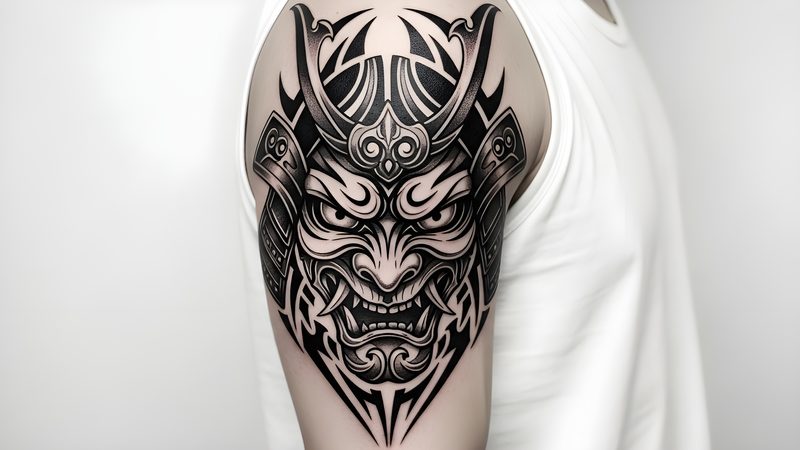
Tattoo Styles
Japanese Modern
Same grammar, new vocabulary. Contemporary irezumi keeps the wind bars, the flow and the seasonal logic intact, then rebuilds the surface with modern pigment and machine work. Horiyoshi III through Shige, and where the tradition still draws a hard line.
Book a consultationWhat carries over
What the modern form keeps, and what it changes.
Japanese Modern is contemporary machine work executed inside the compositional and symbolic grammar of traditional Irezumi. The framework stays intact. The tools and palette update.
Bold black outline is the non-negotiable foundation. Lines are confident, weighted, and long — drawn with the body's movement rather than against it. A dragon wraps the arm because the arm bends; a koi climbs the calf because the calf rises. Imagery is never 'stuck' in place. Nothing looks pasted on.
Color is saturated and opaque. Deep reds, Prussian and cobalt blues, forest and jade greens, rich blacks, warm ochres and golds. The palette is traditionally earthen, though modern artists expand it cautiously. Shading is smooth and committed, with hard black shadows giving the piece its weight.
Negative space is connective tissue, not decoration. Wind bars, water, clouds, and cherry blossoms are what make a sleeve or back piece read as one unified image. A Japanese-style piece without a proper background is half-finished. The background carries motion, season, and atmosphere — it's the grammar that turns subjects into sentences.
How it arrived
How the contemporary form arrived.
The contemporary style has deep Edo-period roots and a clear modern transmission. The names and cities matter.
Edo period (1603–1868)
The grammar is set
Japanese tattooing traces back centuries, with the Edo period shaping most of what we recognize as Irezumi today — the full-body compositions, the mythological subjects, and the visual grammar of wind, water, and cherry blossom. Master-apprentice lineages formed the professional transmission system that survives today.
Late 20th century
Horiyoshi III & the Yokohama school
Horiyoshi III of Yokohama became the purist reference for contemporary Irezumi. Every Japanese-tradition artist measures themselves against his tebori back pieces. His studio, teaching lineage, and published reference books shape the field globally.
Late 20th – early 21st century
Filip Leu & Shige
Filip Leu in Lausanne bridged Japanese and Western worlds, training or influencing a generation of large-scale Japanese workers globally. Shige in Yokohama represents the technical apex of modern machine-work Japanese — saturated color and flawless composition at a level that has reset international expectations.
2000s – present
American transmission
Chris Garver brought serious Japanese work into American consciousness through the reality-TV era and years of committed practice. Chris Trevino built a Texas studio entirely around the tradition. A generation of American artists now commit to deep Japanese study — the contemporary international style.
Asking your artist about lineage — who they've apprenticed under, traveled to learn from, or spent time studying with — is one of the fastest ways to read whether they belong in this tradition. Serious Japanese artists talk about lineage openly because the tradition is built on it.
Subject vocabulary
Eight subjects the tradition carries.
The core Japanese subject library. Each carries specific symbolism, traditional pairings, and placement conventions. Mixing is the standard rather than the exception.
Dragon (ryu)
Japanese tattooing's signature subject — serpentine with whiskers, claws, flowing mane. Typically three toes (Japanese convention), winding through clouds or water. Back pieces allow full body articulation; sleeves let the head dominate the shoulder with the tail terminating at the wrist. Often paired with a tama (sacred pearl) representing wisdom.
Koi fish
Koi ascending a waterfall reference the legend of the carp becoming a dragon — perseverance transforming into power. Typically rendered mid-leap against turbulent water, with maple leaves or cherry blossoms drifting in the current. Works beautifully as a thigh piece or half-sleeve.
Hannya mask
A woman consumed by jealousy and transformed into a vengeful spirit — horns, fangs, anguished expression. A powerful standalone subject for upper arms, calves, or thigh panels. Often surrounded by snakes, maple leaves, or flames. The expression carries the piece; linework around the eyes is where skilled artists distinguish themselves.
Tiger (tora)
Japan's adopted tiger symbolizes raw strength and protection against misfortune. Prowling through bamboo with wind bars suggesting motion. Sleeves and thigh pieces suit this composition, with the tiger's body following the limb's contour.
Phoenix (hou-ou)
The Japanese phoenix differs from its Western counterpart — ornate plumage, paradise-bird influences, associated with the empress and imperial family. A dramatic back-piece subject with tail feathers cascading toward the lumbar. Often paired with paulownia flowers.
Peony cluster (botan)
The 'king of flowers,' symbolizing wealth, honor, and masculine strength. Peonies are structural anchors in Japanese compositions — heavy blossoms that ground sleeves and provide chromatic focal points. Often paired with lions or snakes; rarely rendered alone but magnificent when they are.
Snake with flowers (hebi)
Represents transformation, protection, and good fortune. Coiled compositions work on calves, thighs, or as sleeve filler winding between larger subjects. Almost always paired with peonies or chrysanthemums; the contrast between scaled muscle and soft petals is the point.
Foo dog (komainu)
Temple guardian lions, typically rendered in pairs — one with mouth open, one closed (ah and un). Sleeves or thigh pieces accommodate single guardians; chest panels can host the pair. Ornate manes and flame-like tails provide strong decorative structure.
Where panels sit
Where Japanese Modern lives.
The tradition was designed for whole-body compositions. These five styles suit the grammar; small isolated placements don't.
Placements that honor the tradition
- Full sleeves. The most common entry point. Shoulder cap to wrist — a dragon coils around the bicep and spills down the forearm. Full compositional canvas, respects body movement.
- Back pieces. The ultimate expression. Scapula to lumbar, sometimes extending into a full bodysuit that continues onto chest panels, ribs, and thighs.
- Ribs-to-hip wraps. Suit flowing subjects like koi ascending through waves, where the curve of the torso dictates the current's direction.
- Thigh pieces. Work beautifully for peony clusters or hannya compositions that benefit from the large, relatively flat canvas.
- Calves. Accommodate standalone subjects like tigers or foo dogs. Strong vertical canvas for single-subject compositions.
Panels that do not sit well here
- Small and isolated on a forearm or shoulder blade — the tradition demands room to breathe.
- Placements without body flow — Japanese work is designed for the whole body.
- Cramped footprints that force cherry blossoms or wind bars out of the composition.
- Anywhere you can't commit to negative-space connective tissue around the main subject.
Four scopes
Four scopes, from patch to sleeve.
Japanese Modern scales from half-sleeve entries to multi-year bodysuits. Each tier has its own subject fits and session logic.
Entry-level Japanese canvas. One main subject — koi, tiger, hannya — with wind bars and supporting flora filling the remaining space.
The canonical Japanese style. Allows a main subject to wrap the limb with proper compositional flow. Most serious collectors start here.
Scapula to lumbar. The style's most expressive format. Dragons, phoenixes, full scenes with multiple subjects and seasonal atmosphere.
Multi-session, multi-year build covering back, chest, arms, and thighs. The ultimate Japanese commitment. Matching style elements link separate panels into a coherent whole.
Where it mixes
Where the tradition mixes.
Japanese is a complete system. It pairs with other styles carefully — some compatibilities, some honest mismatches.
Japanese + Japanese
The tradition is a complete language; mixing elements within it (dragons and koi, peonies and snakes) is the standard.
Japanese + American traditional
Works thoughtfully — both traditions share bold linework and limited palettes. Leave generous negative space.
Japanese floral vocabulary
Cherry blossom, peony, chrysanthemum occupy their own chapter in the broader floral style guide.
Japanese + blackwork
Heavy black fills anchor Japanese compositions — solid shapes against saturated color work.
Japanese + neo-traditional
Contemporary Western adaptation — parallel evolution from American roots. Hybrid carefully.
Avoid: fine-line minimalism
Scales are incompatible. A delicate subject adjacent to a full-bodysuit composition reads as an afterthought.
Lineage questions
Eight questions about lineage and pacing.
A Japanese specialist answers with specificity about lineage, motif pairings, background grammar, and color style. Deflection is a signal.
- How has your color held on Japanese pieces from the past two years?
- Who are you studying under, have you traveled to Japan, and which masters inform your work?
- How do you think about background — wind bars, water, clouds — for a piece this size?
- What do you plan for my main subject, and which supporting motifs pair with it traditionally?
- Machine only, or do you work in tebori at all for specific passages?
- What's a realistic session plan and calendar for a sleeve or back piece at this scope?
- Have you ever declined a Japanese piece because the subject wasn't suited to the tradition?
- What's your approach to color palette — full traditional, adapted, black-and-gray?
Pricing for Japanese work is discussed at consultation once subject, scope, and calendar are locked.
Pacing mistakes
Seven pacing mistakes.
The recurring missteps first-time Japanese clients make, framed so the piece honors the tradition rather than flattening it.
Treating it as costume
A Japanese Modern artist who does not study the old masters is producing costume, not tradition. The vocabulary only works when the grammar is understood. Ask about lineage.
Rushing the timeline
Rushing a Japanese sleeve is how you end up with a sleeve that reads as rushed for the rest of your life. The pacing is part of the tradition — give it the calendar it needs.
Cramming into too-small placements
A koi stuck on a shoulder blade without room for water, wind, or cherry blossoms reads as incomplete. Japanese demands body flow and connective tissue. Honor the scale.
Mixing styles that don't meet
Fine-line script directly adjacent to a full-color hannya reads as afterthought. If you want hybrid, find an artist who genuinely crosses styles rather than retrofitting one onto the other.
Treating background as filler
Wind bars, clouds, water, and cherry blossoms are structural. Skipping them to save time produces a Japanese piece that isn't Japanese. The background is the language.
Ignoring seasonal logic
Cherry blossoms mean spring, maple leaves mean autumn, snow means winter. Random mixing of seasonal markers breaks traditional grammar. Talk through season with your artist.
Sun exposure after completion
Japanese work depends on saturated color holding for decades. Unprotected sun exposure is the fastest way to degrade the piece. Broad-spectrum SPF 30+ once healed is part of ownership.
First Japanese guide
Getting a first panel booked.
The working path Apollo artists walk new Japanese clients through, from subject selection to multi-year planning.
Dragon, koi, hannya, tiger, phoenix, peony, snake, or foo dog. The main subject shapes everything — placement, scale, color, supporting motifs. Don't pick an artist before picking a subject.
Japanese work resists small placement. Half-sleeve minimum for most subjects; full-sleeve or back for dragons and phoenixes. Honor the canvas the tradition demands.
Look for collectors who've committed to the tradition specifically, not artists who occasionally borrow a koi or hannya into an otherwise mixed book. Japanese is a lifelong study.
Ask specifically for 5 and 10-year healed photos. Japanese tattoos are built to settle into the skin over years. An artist who understands that will show you those photos without hesitation.
Wind bars, clouds, water, cherry blossoms. The connective tissue isn't filler; it's the grammar that makes the piece read as Japanese. Discuss at consultation, not session.
Traditional saturated palette, adapted palette, or black-and-gray. All three are valid contemporary choices. Your subject, skin tone, and placement shape the decision.
A sleeve runs 40–80 hours across 12–24 months. A back piece runs longer. The pacing lets each stage heal and lets the whole piece breathe. Cost is agreed before the first sitting.
Japanese color depends on deep saturation holding. Sun protection, careful aftercare during settling, and patience across healing cycles are part of ownership.
Where you decide
Three places your input matters.
Beyond subject choice, these three decisions shape how a Japanese piece specifically carries meaning for the collector wearing it.
Subject pairing & seasonal story
Dragons + clouds, koi + water, tiger + bamboo, hannya + snakes + maple leaves. Classical pairings tell a complete story; your artist will help you pick the combination that resonates.
Color style
Full traditional palette vs adapted contemporary vs black-and-gray. Each carries different connotations and ages differently. Decide early rather than discovering on the skin.
Machine vs tebori passages
Very few Western artists practice authentic tebori, but some incorporate hand-poke passages into largely machine-driven work. Ask whether this is on the table for your piece.
FAQ
Modern irezumi, question by question.
What people ask when they want the grammar of the tradition without committing to a full bodysuit.
What's the difference between modern and traditional Japanese?
Traditional Japanese (Irezumi) follows strict Edo-period conventions handed down through master lineages: fixed motif pairings, dictated backgrounds, often hand-poked tebori application. Modern Japanese honors those rules but incorporates machine work, contemporary color palettes, bolder saturation, and occasional subject expansion. The framework stays intact. The execution updates. Evolution, not reinvention.
Can non-Japanese people get Japanese tattoos?
Yes. Japanese tattooing has been collected worldwide for over a century, and many of the most respected practitioners today work outside Japan. What matters is respect: studying the meaning behind the motifs, working with an artist who understands the tradition, and treating it as the serious art form it is rather than as aesthetic decoration.
Is there cultural concern with Japanese tattoos?
It's a fair question. The tradition has deep cultural weight, and thoughtless borrowing happens. The antidote is education. Learn what kirin, koi, hannya, and peonies actually mean. Work with an artist who treats the style seriously. Done respectfully, collecting Japanese tattoos is participating in a living international tradition, not appropriating it.
Do I have to commit to a full sleeve?
No. Smaller Japanese pieces work beautifully, and many collectors start with a single panel, half-sleeve, or back piece before expanding. That said, Japanese design language is built around body architecture and flowing composition, so your artist will likely plan even a smaller piece with future expansion in mind. It keeps options open.
How long does a full sleeve take?
Expect 40–80 hours of tattoo time, spread across many sessions over 12–24 months depending on complexity and healing pace. Back pieces run longer. The timeline isn't a bug — the pacing lets each stage heal, lets your artist refine the next section, and lets the whole piece breathe as a finished composition. Cost is agreed before the first sitting.
What does my dragon mean?
Japanese dragons are benevolent water spirits associated with wisdom, protection, and transformation. Unlike Western dragons, they're not destructive forces. They're guardians. Specific forms and poses carry additional meaning — ascending versus descending, clutching a pearl or orb, paired with clouds or waves. Your artist can walk you through the options so the symbolism fits your intent.
Should I get color or black and gray?
Color is historically dominant — the saturated reds, teals, yellows, and purples are part of the tradition's visual signature. Black and gray Japanese is a valid modern adaptation, especially for collectors who prefer a quieter palette or have color sensitivity. Both read beautifully. Your artist will recommend based on your subject, skin tone, and the larger composition.
Why do the designs flow so much?
Because Japanese tattooing was designed for the whole body. The wind bars, water, clouds, and cherry blossom fillers aren't decoration — they're connective tissue that moves the eye across the piece and wraps design around muscle and joint. That intentional flow is what makes a well-executed Japanese tattoo age so gracefully.
Can I mix Japanese with other styles?
Fusion work exists and can be striking, but pure Japanese is a complete system — changing one element affects the whole. Most serious Japanese artists will either commit fully to the tradition or decline the mix. If you want a hybrid, find an artist who genuinely crosses styles rather than retrofitting one onto the other.
What is tebori?
Tebori is the traditional hand-poked application method, performed with a nomi — a wooden or metal rod tipped with grouped needles. It creates a distinct gradient and softer color saturation that machine work can't replicate. Very few Western artists practice authentic tebori. Most modern Japanese work is machine-applied, which is widely accepted within the contemporary tradition.
Scoping the work
Subject, placement, and — the part people forget — the calendar.
Japanese Modern is the style where lineage, grammar, and calendar matter most. Share the motif, the artists whose work you have been studying, and the region you want to commit. Then we set the pacing, because panels drawn in isolation almost never join up cleanly later. Scope and cost are agreed before the first sitting.