Lore & Meanings
Rose Tattoo Meaning: Love, Loss & Beauty Defended
What a rose tattoo means, from a working studio — the three core meanings of love, grief, and beauty defended, their real provenance, and how thorn, color, and composition shift the symbolism.
Book a consultationThe short answer
What does a rose tattoo mean?
A rose tattoo carries three core meanings — love and devotion, grief and memorial, and beauty defended. These are three separate traditions with real provenance that converge on one flower — which is why the same rose can hold love and loss at once. Which meaning a specific rose says is set by three things: its color, its thorn, and anything it is paired with.
The fastest route to a rose that means something: name the person, the chapter, or the feeling in one sentence, then choose color, style, and design to fit it. Meaning first, aesthetics second. Everything below is the long version — where each meaning comes from, how the modifiers shift it, and how to make the rose read as yours instead of generic.
Why the rose
The flower that reads as tattoo.
Before it means anything else, the rose means tattoo. It is the one botanical subject a stranger can identify at arm’s length, in flash on a studio wall, in an old photograph, in a prison drawing, and still read correctly. The peony outranks it in Japanese tradition. The chrysanthemum carries more weight in imperial iconography. But no flower has been inked across as many styles, decades, and countries as the rose.
That legibility is not an accident. It’s the end result of roughly two millennia of Western symbolic compression, funneled through a narrow window of American working-class tattoo practice, and then exported back to the rest of the world as the default flash flower. When a client says “a rose, somewhere,” they’re invoking a vocabulary that predates the needle by about 1,900 years.
The three meanings
Love. Loss. Defense.
Ask five tattooers what a rose means and you’ll hear three answers in different orders. These aren’t vibes. They’re three distinct traditions that converge on one image, and each one has a provenance worth naming.
Love & devotion
The oldest continuous literary thread. The Greco-Roman tradition tied the red rose to Aphrodite — born, in later versions of the myth, from the blood she spilled running to her dying lover Adonis. Roman Venus inherited the flower wholesale. From there the rose travels through medieval courtly love poetry (the 13th-century Roman de la Rose is a 22,000-line allegory where the beloved IS a rose), and into Victorian floriography — the 19th-century English codification that fixed red = romantic love so firmly into English-speaking culture that Valentine’s Day florists still sell the same equation.
Grief & memorial
Nearly as old, on a separate track: funerary practice. Roses have been laid on European graves for at least three hundred documented years. Victorian mourning custom used the white rose specifically for the death of a young person — a convention that still surfaces in funeral arrangement today. The black rose, more recently, carries mourning and completion, with a second life in goth and punk reclamation. The same flower carries love and loss — that’s the feature, not a contradiction.
Beauty defended
The reading the thorn does all the work for. The thorn isn’t decoration. It’s the semantic anchor — softness with a boundary, beauty that will draw blood if handled without care. In medieval Christian iconography the thorn gets folded into the Passion (crown of thorns, blood on petals); in Victorian symbolism it becomes a warning against approach; in modern tattoo practice it becomes the detail that separates a rose chosen on purpose from a rose chosen by reflex. It is the same logic that drives the power reading of a Medusa tattoo — beauty that declines to be handled, with the defence built into the image rather than added to it.
Meaning modifiers
Four details that fine-tune the meaning.
Once the core meaning is chosen, four small choices tune it. Each shifts the sentence without changing the flower — and each is worth deciding on purpose rather than by default. Color is the fifth and largest lever — see the full rose color meanings guide for what red, white, black, yellow, pink, and blue each say.
Thorns present
The default reading: beauty with a boundary — love that also has a cost, softness that will draw blood if handled carelessly. Keeping the thorns says the meaning includes the difficulty, not just the bloom.
Thornless rose
A rose without thorns is an older symbol of love at first sight, or of a love given freely without fear of harm. In Christian symbolism the thornless rose is tied to Mary and to paradise before the fall. A deliberate choice, not an omission.
Wilting or dead rose
A drooping, falling-petal, or blackened rose reads as loss, the end of something, or a love that has passed — grief made explicit. Often chosen for memorial work where the point is the ending, not the bloom. Powerful, and worth confirming you want the permanence of it.
Bud, bloom & count
A closed bud reads as youth, potential, or a love just beginning; a full bloom as love in its prime. Number matters too: a single rose is focus and devotion, two roses mutual love, three a spoken “I love you,” a cluster or bouquet a family or a set of years.
Religious & spiritual lineages
Four traditions. Four different Beloved.
The rose gets borrowed by every religious tradition that reached for a flower to hold divine love. These aren’t interchangeable. A rose chosen with one in mind shouldn’t be sold under another.
Christian
Rosa Mystica — Mystical Rose — is a title for the Virgin Mary recorded in the Litany of Loreto by the 16th century. The rosary is named for the rose; its 15th-century origin story frames each prayer as a flower offered to Mary. Roses at the feet of saints in Renaissance painting signal martyrdom (blood) and purity (petals) at once.
Islamic & Sufi
In the work of the 13th-century Persian poet Rumi and the broader Sufi poetic line, the rose is the Beloved — divine love approached through the vocabulary of human love. The Persian and Turkish floral tradition that fed European gardening from the 16th century onward carried those associations with it.
Hindu & Vedic
Links the rose to Lakshmi and to devotional offering — less formally codified than the Christian or Sufi traditions, but a real lineage. The rose appears in bhakti devotional practice and in temple offering.
Pagan & Wiccan
Reads the rose through Venus — love magic, protection, the flower of the morning star. These are real lineages. They aren’t interchangeable, and a rose chosen with one in mind shouldn’t be sold under another.
The literary rose
Writers reach for the rose when they need a symbol that doesn’t need explaining.
Shakespeare’s Romeo and Juliet — “a rose by any other name would smell as sweet” — uses the flower as proof that meaning isn’t the name. Dante’s Paradiso, in its final cantos, arranges all of heaven’s souls into a celestial white rose. Robert Burns’s “My love is like a red, red rose” (1794) is still quoted at weddings. Yeats, Eliot, H.D., Rilke, Stein (“a rose is a rose is a rose”). The 20th century spent a great deal of ink on a flower that had already been working overtime for six hundred years.
The tattoo rose is downstream of all of this. That is why a rose on a forearm doesn’t need a caption. Readers — tattooed and non-tattooed — recognize the symbol because the symbol has been doing its work in the background of Western reading for twenty generations.
How it became the tattoo flower
Sailor Jerry compressed a thousand years into a stencil.
American Traditional tattooing — the Sailor Jerry / Bert Grimm / Cap Coleman line from the 1930s and 40s — is the specific window where the rose became the default tattoo flower rather than a tattoo flower. Sailor Jerry Collins’s flash sheets codified the bold-outline, limited-palette, flat-fill rose that still anchors every traditional flash wall in America.
The visual template is narrow on purpose: thick black line, red-and-green fill, high contrast, built to hold up for fifty years under skin. Neo-Traditional expanded the palette in the 1990s and 2000s. Fine Line refined it down to a single botanical outline in the 2010s. The template persists across all three because Sailor Jerry’s compression of the flower was already very close to optimal for skin.
The rose is not the default because it is simple. It is the default because it has done more symbolic labor than any other flower in the Western canon.
A rose can mean love and it can mean loss, and the reason it can mean both is that love and loss are the same appointment running in two directions.
Sailor Jerry didn’t invent the rose. He compressed a thousand years of Western symbolism into a stencil that would still read at arm’s length when the wearer was 70.
Six styles
The style is the first real decision.
A rose is not one image. It’s a family of images, and the style you pick is the first real decision — before placement, before size, before what it sits next to. Every style below works. None are wrong. They say different things, and they live differently across decades.
American Traditional
The rose everyone pictures
Bold black outline, flat red or pink fill, solid green leaves. The Sailor Jerry archetype codified in the 1940s. A thick outline holds the shape as skin ages; flat saturated color resists the softening that takes fine detail down over 20–30 years. A traditional rose at 2–3 inches on a forearm will still read clearly at 65.
Neo-Traditional
The rose with depth
Keeps the bold linework of its parent style but opens the palette — peach, mustard, lavender, rust, ochre — and adds dimensional shading and Art Nouveau framing. The rose stops being a symbol of a rose and starts being a portrait of one.
Fine Line / Single-Needle
The modern LA rose
Hairline single-needle work, sketch-quality botanical, often in black and gray, often small. Dr. Woo lineage. A beautiful style with a specific caveat: fine line is a long-term maintenance decision. Hairline work softens; under 2 inches it risks losing legibility earlier than traditional. Sized honestly (3 inches and up for a standalone rose), it’s one of the strongest modern rose styles available.
Black & Gray / Realism
When the specific rose matters
For when the rose is a specific rose — a flower from a garden, a funeral arrangement, a photograph someone kept. Most at home in memorial work and in pieces where botanical accuracy is doing emotional work. Not a style for small scale: 5 inches and up, color or black-and-gray, with reference material the artist has actually seen.
Japanese (Irezumi)
Usually a peony — sometimes a rose
The flower most Western eyes read as “a Japanese rose” is almost always a peony. A true rose inside an irezumi composition is a hybrid move and should be treated as one — designed in conversation with an artist who works in the tradition, with wind-bar and background rules respected. Don’t drop a Western rose into a Japanese sleeve and expect the sleeve to still read as Japanese.
Illustrative / Watercolor
The expressive rose
Trades longevity for mood. Washes and bleeds are expressive; they also soften faster than outlined work, and they tend to want more aftercare and more touch-ups. A good choice when the painterly quality is the point; a poor choice when the goal is “I want this exact look in 30 years.”
Placement
Four styles. One honest test.
Apollo doesn’t call placements “feminine” or “masculine.” Bodies and ribs and shoulders do what they do regardless of gender. But placement conventions shape how a rose reads to a stranger — and a useful test: do you want the tattoo to be a thing you show, a thing you carry, or a thing you live inside?
Reads as classical / soft
Upper back · shoulder blade · hip · inner thigh · ankle
Placements that emphasize curve and fold. The rose sits as ornament against the body’s line.
Reads as bold / declarative
Bicep · chest over the heart · outer forearm · calf
The rose here reads as a statement, not a flourish. First-tattoo traditional roses often land in this category.
Reads as modern / neutral
Inner forearm · ribcage · sternum · wrist · back of upper arm
Placements where a rose simply reads as a tattoo of a rose, without style-era shorthand.
Statement placements
Full back · sleeve anchor · dual chest · full thigh
Not “where do I put a rose” decisions — “I am building a piece around a rose” decisions. Design as such from the first consultation.
Composition
A rose alone is one sentence. A rose with another element is a compound sentence.
The pairing changes the meaning more than size or color does. Seven classical pairings deepen the rose into something more specific than itself.
Rose + name / banner
The memorial rose. Traditional flash tradition, usually chest or bicep, usually bold enough to last. Apollo’s most-requested memorial composition.
Rose + skull
Memento mori. Beauty against mortality. An American Traditional classic. Doesn’t need to be edgy to work — it needs to be designed as a single composition, not two tattoos touching.
Rose + dagger / sword
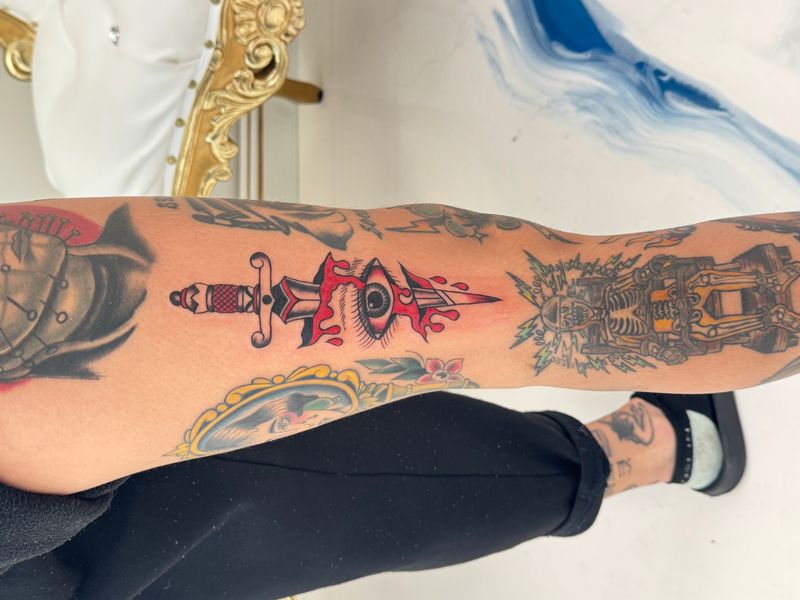
Love and conflict, boundary and cost. A narrative pairing that rewards scale and placement planning. Traditional Americana vocabulary.
Rose + snake
Temptation, knowledge, Eden. Cross-cultural imagery. Wants room — half-sleeve minimum, ideally. Often reads as biblical on American bodies and as Japanese on wider compositions.
Rose + clock / hourglass
Time against love or loss. A philosophical composition. Usually larger, usually chest or thigh.
Rose wrapped around
A ring finger, a wrist, an ankle. Binding and commitment. Works in fine line at scale, or in traditional if the ring is bold enough to stay legible.
Multiple roses / bouquet
Family, generations, a set of people. Each rose is a person or an era. Almost always memorial or tribute pieces; plan as one composition, not accumulated flower by flower.
Size, honestly
Legibility is what separates a tattoo from a tattoo you can read.
Size is not a style decision. It’s a legibility decision. Four tiers cover almost every rose choice a client will actually make.
Make it yours
The three-layer personalization framework.
Most generic rose tattoos fail at one layer. The ones that land work all three. 90% of the meaningfulness lives in Layer 2 — the specific.
The base rose
The rendering decision. Traditional with a bold keyline. Fine line and delicate. Black-and-gray realism. Neo-traditional with saturated color. The container — style, size, placement, palette. Layer 1 is your aesthetic truth: not the trend, not your friend’s tattoo, what you actually want to look at every day.
The personal element
Where the rose stops being A rose and becomes yours. A specific variety (your grandmother’s climber, the desert rose from the trip, the wild rose from the coast). A color tied to meaning. A composition (single stem, paired, three for the children, five for the years). An added element — a handwritten word, a date, a banner, a small bee. 90% of the meaningfulness lives here.
The private meaning
The part nobody else has to know. What this rose marks. Why now. What you want it to mean when you’re 70 and someone asks about it. You don’t have to explain Layer 3 to anyone — you just have to know it.
The specific-rose principle: a rose pulled from a Pinterest board will always read like a Pinterest rose. A rose pulled from your actual life — the variety your grandmother grew, the wild rose from the coast you return to, the color your mother wore — will read as meaningful to anyone who sees it, even before you explain why. Specificity is what separates a pretty tattoo from an heirloom one.
Common mistakes
Four patterns to watch for.
Most disappointing rose tattoos fall into one of these four categories. Catching it in the consultation prevents it in the chair.
The “I just want a rose” walk-in
No reference, no reason, no specificity. You leave with a technically fine but emotionally generic flower. Six months later it feels like decoration instead of meaning. Fix: bring reference photos, know your why. Even a sentence — “it’s for my mom,” “it’s for the year I got sober” — changes the piece entirely.
The wrong-size mistake
Fine line at postage-stamp size blows out within a few years — the detail collapses. Traditional rendered too small loses its boldness. Memorial pieces forced onto a tiny canvas lose their gravity. Fix: let the artist tell you the scale the piece actually needs. If your budget or pain tolerance doesn’t match, wait and save.
The wrong-style mistake
Fine line on a hand or forearm that lives in the sun. Watercolor without a black keyline to hold it. Traditional when you wanted something softer. Realism when you wanted something graphic. Fix: research healed work — not fresh. Fresh tattoos lie. Healed work tells the truth about how a style ages.
The placement-meaning mismatch
A memorial tattoo hidden somewhere you can’t see it, when you wanted it for yourself. A commitment piece somewhere you can’t show the person. Fix: before placement, ask where does this meaning want to live? On me, for me? On me, for the world? Private, semi-private, or fully visible?
Across life stages
The flower doesn’t change. The person holding it does.
The same rose reads differently depending on where you are in the arc. Fifty-year-old traditional roses still read as roses — which is rare in tattooing, and part of why the flower works as a carrier for the things that matter most.
The rose is a vessel. What you put inside it — the memory, the person, the moment — is what makes it hold.
The generic rose reads generic. The specific rose reads meaningful. That’s almost the entire difference.
A rose doesn’t date the grief. It doesn’t date the love. It just holds them, quietly, for as long as you do.
FAQ
The questions every rose consultation surfaces.
Ten questions that cover meaning, history, style, placement, personalization, and the details that fine-tune a rose.
What does a rose tattoo actually mean?
Three meanings, with real provenance. Love and devotion — the Greco-Roman tradition tied the red rose to Aphrodite, carried through medieval courtly love, fixed by Victorian floriography. Grief and memorial — roses on European graves for 300+ years, white for the death of a young person, black for mourning and rebellion. Beauty defended — the thorn is the semantic anchor, softness with a boundary, beauty that draws blood if handled without care. The same flower carries love and loss. That’s the feature, not a contradiction.
Why is the rose the most common tattoo flower?
The rose became the tattoo flower through a specific window of American working-class tattoo practice — Sailor Jerry, Bert Grimm, Cap Coleman — in the 1930s and 40s. Sailor Jerry’s flash sheets codified the bold-outline, limited-palette, flat-fill rose that still anchors every traditional flash wall. The visual template is narrow on purpose: thick black line, red-and-green fill, built to hold up for 50 years under skin. Neo-Traditional expanded the palette, Fine Line refined it down to a single botanical outline, but the template persists because Sailor Jerry’s compression was already very close to optimal for the medium.
What style of rose should I get?
Depends on what you want the piece to do. American Traditional for a tattoo that will look the same in 2055 — bold outline, flat red/pink fill, 2–4 inches, forearm/bicep/chest. Neo-Traditional when the rose is the centerpiece and wants room — dimensional shading, expanded palette, upper arm or thigh. Fine Line / Single-Needle for modern delicate aesthetic — sized honestly (3 inches+) and understood as a piece that may want a touch-up in 15 years. Realism for when the rose is a SPECIFIC rose (memorial, a flower from a garden) — 5 inches and up. Don’t pick the style from Instagram; pick it from healed portfolio work that survived a decade.
Where should I put a rose tattoo?
Depends on how you want it to read. Classical/soft feel: upper back, shoulder blade, hip, inner thigh, ankle. Bold/declarative: bicep, chest over the heart, outer forearm, calf. Modern/neutral: inner forearm, ribcage, sternum, wrist. Statement: full back, sleeve anchor, dual chest, full thigh — these aren’t “where do I put a rose” decisions, they’re “I’m building a piece around a rose” decisions. A useful test: do you want this to be a thing you show, a thing you carry, or a thing you live inside?
How do I make a rose tattoo feel personal instead of generic?
Three layers. Layer 1: the base rose — style, size, placement, palette, what you actually want to look at every day. Layer 2: the personal element — a specific variety (your grandmother’s climber, the wild rose from your hometown), a color choice tied to meaning, a composition (paired, three for the children), an added element (handwriting, a date, a banner). Layer 3: the private meaning — what this rose marks. You don’t have to explain Layer 3 to anyone. 90% of the meaningfulness lives in Layer 2 — the specific. A rose from a garden you actually know reads meaningful to strangers even before you explain why.
Does a rose tattoo look different by color?
Color is a semantic choice, not a stylistic one — swapping the color swaps the sentence. Red: romantic love, the default. White: purity, and in older Victorian custom the death of a young person. Black: grief, rebellion, goth and punk reclamation. Yellow: friendship and platonic devotion. Pink: gratitude, gentleness, admiration. Blue: the impossible rose, mystery, the unattainable. Lavender / purple: enchantment, first love. The full deep-dive lives on the sister page, rose tattoo color meanings.
Is a rose tattoo too generic?
Only if you treat it as generic. The rose has done more symbolic work across more cultures than any other flower in the Western canon — Aphrodite, Mary, the rosary, the celestial rose of Dante, Burns’s red red rose, Sailor Jerry’s flash. That weight is available to you if you choose it. A generic rose reads generic. A specific rose — specific variety, specific color, specific composition, specific meaning — reads as meaningful to anyone who sees it, even before you explain why. The specificity is the whole difference.
What does a rose tattoo without thorns mean?
A rose without thorns is an older symbol of love at first sight, and of a love offered freely without fear of harm. In Christian symbolism the thornless rose is linked to Mary and to paradise before the fall. Removing the thorn is a deliberate meaning choice, not just a cleaner design — it says the love in question comes without a catch.
What does a wilting or dead rose tattoo mean?
A drooping, falling-petal, or blackened rose reads as loss, an ending, or a love that has passed. It makes grief explicit rather than implied, which is why it shows up most in memorial work. Because it is permanent, it is worth confirming you want the ending — not the bloom — marked on you for good.
Does a rose tattoo mean something different for men?
The meaning is the same. A rose reads as love, grief, or beauty defended regardless of who wears it. What changes by convention is style and placement, not symbolism — bolder American Traditional roses on the forearm or chest, softer fine-line or black-and-gray work on the ribs or arm. Apollo designs the rose around the person and the meaning, not a gender template.
Ready to design the specific rose?
Bring the reference. Bring the reason. Bring an open mind on style.
Apollo rose consultations work the three layers — the base rose, the personal element, the private meaning. Book the consult and walk out with a design that isn’t a Pinterest rose. It’s yours.