Lore & Meanings
Symbolism Of Death & Ruin Tattoos
Four objects, one frame, one sentence of moral commentary: a woman, a bottle, a hand of cards and money. The original Man's Ruin framing is misogynistic, and pretending otherwise helps nobody. The interesting question is what a century of American bodies has done with that fact, and what you want yours to say.
Book a consultationThe diamond
Four objects, one composition, one sentence of moral commentary.
A Man’s Ruin is one of the most economical pieces of storytelling in American tattooing. Four objects — a woman, a bottle, a hand of cards, money — arranged in a diamond or pyramid, with the woman at the apex or center, and a skull or banner at the bottom that names the moral. A whole life compressed into ink at arm’s length.
That pedigree is the first reason the design has outlasted a century of tattoo trends. It was engineered to be a tattoo. Bold outline holds shape as the tattoo softens over decades. Flat color blocks stay readable when saturation drops. The diamond composition reads instantly — pin-up, bottle, cards, skull — without the viewer having to decode it. The second reason is narrative density: most Traditional flash tells a single clean idea. Man’s Ruin tells a whole life.
The five readings
Pick one before you pick an artist.
Man’s Ruin is not one tattoo. It’s five tattoos wearing the same costume. The composition reads differently on different bodies — and the reading is not optional. It is the thing you are actually getting. Walking into a consultation without knowing which reading you want is walking into a restaurant without knowing if you want breakfast or dinner.
The cautionary reading
Original · moralist · confessional
The 1930s original. “These are the things that will destroy me, and I’m putting them on my skin so I do not forget.” Assumes the wearer is a man, the vices are external temptations, the tattoo functions as a warning. The most historically accurate reading and, for clients who genuinely resonate with a confessional-moralist style, the cleanest.
The celebratory reading
Defiant · unapologetic · contemporary
“These are mine. I’m not apologizing.” Closer in spirit to a Hold Fast or Death Before Dishonor piece than to the original moralism. The wearer isn’t warning themselves — they’re declaring. The skull, if included, stops being memento mori and becomes ornament. Honest, but changes what the tattoo says.
The ironic reading
Meta · period piece · knowing
“Look at this vintage moralism. Isn’t it something.” The wearer knows the original frame was misogynistic, knows the composition is a period piece, wears it as meta-commentary — the way one might wear a 1950s advertisement on a t-shirt. Requires the wearer to actually know the history. Without the knowledge, irony collapses into the unexamined version.
The reclamation reading
Corrective · women wearing the vice · 2020s
Women wearing Man’s Ruin — or Woman’s Ruin — refusing the feminine-purity assumption baked into the original. The most interesting style in contemporary tattoo culture. Reframes vice iconography as something the wearer owns rather than something that happens to them. Not ironic — corrective.
The tribute / lineage reading
Art-historical · Sailor Jerry homage
“I’m wearing American Traditional history. Sailor Jerry’s flash, Bert Grimm’s hand, the Bowery, the Pike. I honor the lineage without buying the morality.” The style of the client who loves Traditional work for its craft and wants a signature piece of the canon on their body. The vice content is secondary to the art-historical weight.
Four objects, one diamond, one sentence. A Man’s Ruin is the shortest moral essay American tattooing ever wrote, and it has never needed a rewrite.
The tattoo performs a shrug with its whole body. I know what will kill me. I am doing it anyway. The knowing is the point.
The femme fatale on screen, the pin-up on the bicep, and the Victorian cautionary pamphlet are the same woman wearing three different costumes.
The history
A Victorian phrase, a Sailor Jerry flash book, and a century of American bodies.
“Man’s ruin” predates the ink by close to a century. The exact construction shows up in temperance-era American newspapers as early as the 1830s. The visual tattoo emerges in American Traditional flash in the 1920s–40s and settles into its canonical form through Sailor Jerry, Bert Grimm, and Cap Coleman.
The four objects
Four small tattoos sharing a frame.
Each element carries its own sub-history, and good artists treat them as four small tattoos sharing a frame. The specifics matter — the bottle, the gamble, the woman, the money — each with its own vocabulary and its own period context.
The bottle
Spirits, almost never beer or wine
Long-necked bottle of whiskey, rum, or gin. The silhouette matters — American Traditional rewards glanceable silhouettes above all else. The specific bottle is a dialect marker: Jerry’s Pacific sailors got rum, Grimm’s Long Beach clientele got whiskey. Jack Daniel’s and Jameson show up most often in contemporary pieces; Old Crow, Bacardi, and Four Roses are traditional alternates.
The gamble
Cards, dice, or both
Usually a poker hand — aces and eights, the “dead man’s hand” Wild Bill Hickok was holding when he was shot, is the period favorite. Royal flush and four aces are the decorative defaults. Dice show up in roughly a third of period flash; roulette wheels and horseshoes are rarer. The most flexible element, the one most often personalized.
The woman
Pin-up vocabulary · theatrical style
Drawn in the pin-up vocabulary of the era — Gil Elvgren, Alberto Vargas, George Petty, the Esquire and Playboy cheesecake lineage. Usually clothed, rarely nude, posed in the slightly theatrical style of mid-century advertising. The restraint is deliberate — the suggestion is the vice; the explicit would break the joke.
The money (or pipe)
Dollar signs · coins · a fan of bills
Dollar signs, coins, or a fan of bills. After Prohibition lifts in 1933, the opium pipe that had shown up in some early flash sheets gets rarer, the money gets larger. Some compositions layer pills, a cigarette, or (in modern versions) a syringe into this corner. The element most often updated in contemporary Man’s Ruin variants.
The misogyny question, honestly
The original framing is misogynistic. The question is what you do with that fact.
The original Man’s Ruin frames woman as destructive temptation. That is misogynistic by any contemporary standard, and pretending otherwise is not respect for tradition — it is avoidance. A few things worth knowing before you commit.
The original framing is a product of its time — port-town sailor culture, pre-war moralism, a specific American anxiety about who was to blame for men losing themselves. Wearing it unironically replicates that framing on your body, permanently, where everyone who reads tattoos can see it. Aware reclamation is possible and increasingly common — it requires knowing the history well enough to be in dialogue with it rather than an unwitting carrier of it. Some artists will decline to execute unexamined versions on principle. That’s not censorship; it’s judgment about the work they put their name on.
None of this means you can’t get a Man’s Ruin. It means you should know what you’re getting. Clients who want the classic piece unmodified usually frame it as historical preservation or ironic self-portrait. Clients who want the iconography without the gender premise swap the pin-up for a different seductive object — a cigarette, a syringe, a phone — or commission a Woman’s Ruin inversion with gender-swapped vices. Both are honest responses. Neither requires the artist to moralize.
Four styles
Traditional is mandatory. The rest are translations.
American Traditional is the native language of Man’s Ruin — born in this style, every other interpretation is translation. Four styles carry the piece, with varying fidelity to the original authority.
American Traditional
The canonical style · mandatory for authenticity
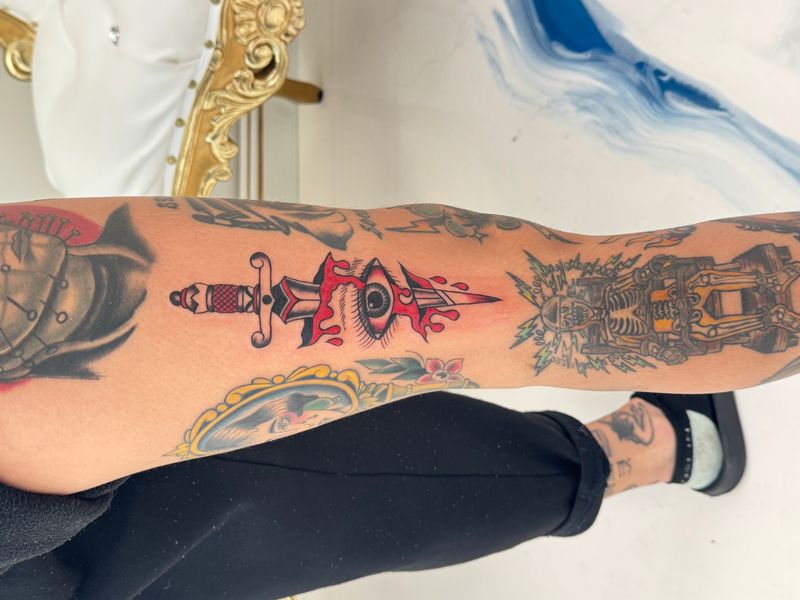
The native language of Man’s Ruin. Born in this style; every other interpretation is translation. Bold 1.5mm outline, restricted palette (red, green, yellow, blue, black), flat interior fills with minimal blending, diamond or pyramid composition. Sailor Jerry pattern book is the reference. Ages beautifully — a well-executed traditional Man’s Ruin at age 20 looks like one at age 50.
Neo-Traditional
The most common modern variant
Expanded palette (purples, teals, peaches), dimensional shading on the pin-up’s face and the bottle’s curvature, softer edges on interior elements while keeping the outline heavy. The pin-up looks more like a person and less like a pictogram. The argument against: some of the original’s authority comes from its flatness. A traditional Man’s Ruin is a warning sign. A neo-trad one is a portrait.
Black & Gray / Illustrative
Memento mori style
Less common, more interesting than it sounds. A single-color Man’s Ruin rendered in black and gray shifts the emotional style entirely — the piece reads as meditation rather than celebration. The skull dominates. The pin-up becomes spectral. The bottle loses its warmth. Lives closer to Chicano fine-line traditions than to Sailor Jerry.
Fine Line / Watercolor / Illustrative (caution)
Not recommended
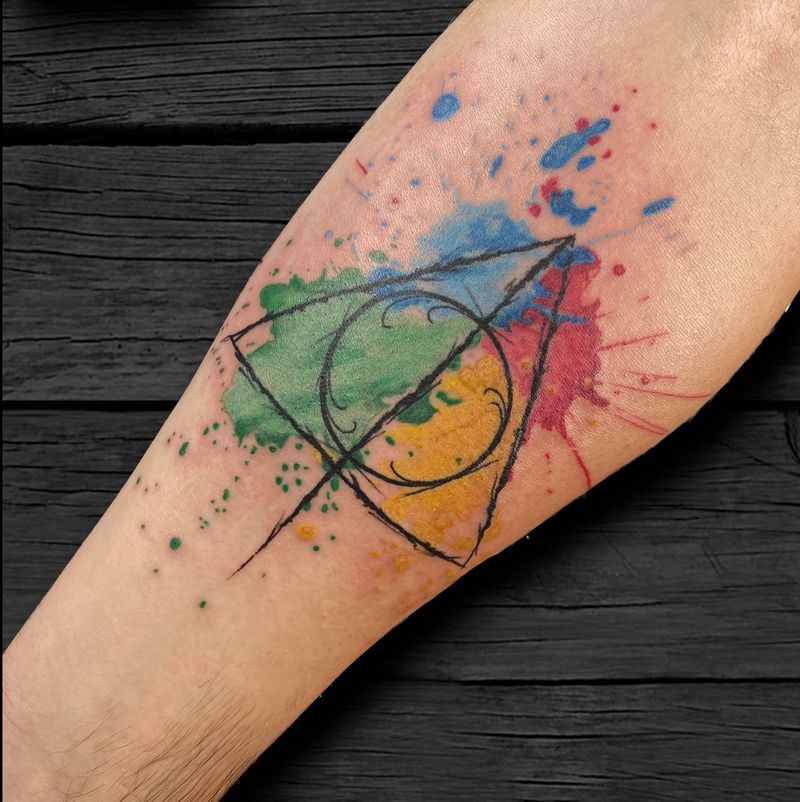
Fine-line Man’s Ruin: composition too dense, elements too small at that weight, ink doesn’t hold structure past a few years. Watercolor: loses what makes the subject work — the authority of the icon depends on hard edges. Illustrative dark art can succeed but requires an artist who understands why the original composition works before deconstructing it.
The composition
Diamond or pyramid. Five positions. One banner.
The canonical Man’s Ruin is organized in a diamond or pyramid with four main elements plus the skull and the banner. Each position has its own conventions and its own role in the composition.
Top / center — the pin-up
The visual anchor. Winking, smiling, beckoning. Hair bobbed, curled, or long-waved. Outfit: lingerie, swimsuit, or showgirl. Vargas-adjacent proportions, Sailor Jerry line weight. Almost always looking at the viewer, not at the other elements. The eye contact is the point.
Left — the bottle
Whiskey, rum, gin. Often a specific label. Pouring or standing. Some artists render the bottle half-empty to reinforce the theme. Long-necked silhouette for glanceable recognition at arm’s length.
Right — the gamble
A poker hand (aces and eights, royal flush, four aces), dice (often loaded — snake eyes or sevens), a stack of cash, or layered together. The most flexible element. The one most often personalized.
Bottom — the skull
Literal skull, coffin, or DEATH banner. The moral. Without this element the piece is a celebration. With it, the piece is a warning. The single most consequential decision in the composition.
Wrapping — the banner
MAN’S RUIN, RUIN, THE LAST CALL, BAD HABITS, or SINNER. Arcing top, cradling bottom, or wrapping diagonally through the middle. Block letters, Old English, or traditional tattoo script with serifs thickened. The banner is where personalization lives without breaking the design — your own phrase on a traditional banner reads as canon.
The skull decision
The single most consequential element in the piece.
With skull, Man’s Ruin is a warning. Without skull, it’s a toast. The skull is the element that names the moral — and deciding whether to include it, and how, is the decision that separates the cautionary reading from the celebratory one.
With skull / death imagery
The moral is named. “These things kill you.” Literal skull, coffin, or DEATH banner at the bottom of the composition. The piece reads as warning. The original 1930s–40s sailor reading.
Without skull
Pure celebration, no cautionary note. The vices without the consequence. Reads as declarative rather than confessional. The contemporary celebratory style.
The kissing skull
Common in Sailor Jerry’s later flash — the skull kissing or winking at the pin-up. Love and death in the same gesture. The middle path: memento mori and celebration at once.
The ornamental skull
Skull present but styled as decoration rather than warning — flowers, tiara, decorative treatment. Shifts the reading toward sugar-skull / celebration style. The skull as accessory.
Modern variants
Six reclamations, inversions, and contemporary swaps.
The image has outgrown the sailor and the shore-leave bar. What survives is the structural joke — four things that will ruin you, worn where everyone can see them — and the joke still lands. Six modern variations on the canonical composition.
Modern Man’s Ruin
The vices update. Cigarettes become vapes. Cards become poker chips or a phone showing a sportsbook app. The bottle becomes a seltzer can (rarely successful — part of the joke is the weight of the original icons). Irony-as-composition, period-accurate to now rather than to 1940.
Woman’s Ruin
Gender-swapped. The husband, the job, the family obligation, the pregnancy test. Historically underdocumented but increasingly common, and genuinely interesting as a composition problem. Works best in Neo-Traditional. The reading: woman naming what’s ruining her life, same composition logic, inverted gender politics.
Personal ruins
Specific-to-wearer vices arranged in the Man’s Ruin composition. Your own four. Requires real conversation with the artist about symbolism, scale, and what reads. Done well, one of the most honest tattoos a person can wear. Done quickly, the personal-ruin trap.
Corporate Ruin
Suit, briefcase, dollar signs, pills. A contemporary Westside specialty. The modern-white-collar version of the original dockworker lament — the things corporate life does to a person arranged in the same Traditional diamond.
Queer Ruin
Composition with the vices as chosen rather than imposed — the wrong desires owned proudly. Can pair with any style. A reclamation of the “ruinous” label that queer culture historically had affixed to it.
Survivor’s Ruin
Memorial variation. The vices marked with crossed-out imagery or subtle indicators they’ve been left behind. A recovery-piece composition that uses the canonical frame without endorsing the vice content. Requires a long consultation. Like the broken-arrow memorial in the three arrows tradition, it marks loss without romanticizing it. Clients weighing this composition often set it beside the survivor reading of the Medusa tattoo, which does comparable work in a different vocabulary.
Size, honestly
6 inches minimum. The composition needs room.
Scale is not negotiable on this piece. The composition is dense and every element needs room to read. Subtract elements to go smaller — don’t shrink them.
The consultation
Five questions before the first sketch.
A good Traditional artist will ask these. If yours doesn’t, ask them anyway. Bring the answers to the consult.
Which of the five readings?
Cautionary, celebratory, ironic, reclamation, or tribute? Any of the five is defensible. None is the default. A client who can’t answer this isn’t ready to book.
Skull or no skull?
With skull, the piece is a warning. Without skull, pure celebration. With a kissing skull, love and death in the same gesture. The single most consequential decision after picking the reading.
Classic four or modern vices?
Traditional-original woman/bottle/cards/money, or modern personal ruins (smartphone, credit cards, pills, corporate icons)? The answer affects every element that follows.
Pin-up figure or vice-only?
Traditional Man’s Ruin requires confronting the gender politics of the pin-up centerpiece. Vice-only compositions drop the figure and let the bottle / cards / money / skull carry the piece alone — a different tattoo, legitimate, less loaded.
Personal or archetypal?
Is this piece reflecting your actual life, or purely referencing the archetype? Personal Man’s Ruins do real biographical work but risk being eclipsed by the canonical public reading. Archetypal versions are cleaner but less specific.
Man’s Ruin is five tattoos wearing the same costume. The reading is not optional — it is the thing you are actually getting.
The question isn’t whether the original framing is misogynistic — it is. The question is what the person under the needle is doing with that fact.
The skull is the element that names the piece’s moral. With it, Man’s Ruin is a warning. Without it, it’s a toast.
Common mistakes
Eight patterns to watch for.
Most disappointing Man’s Ruin tattoos fall into one of these eight categories. Catching it in the consultation prevents it in the chair.
The unexamined misogyny mistake
Client wears Traditional Man’s Ruin with pin-up + bottle + cards, never thinks about the original framing, ends up wearing a sentiment they wouldn’t endorse if asked directly. Fix: own the Traditional style knowingly, reclaim deliberately, or modernize the composition with the pin-up dropped or swapped.
The “just looks cool” default
Picking Man’s Ruin purely for the Sailor Jerry aesthetic without engaging with the meaning. Piece reads loudly to strangers while meaning nothing to the wearer. Fix: pick a reading. Any of the five is legitimate. “It looks cool” is not a reading — it’s a default.
The scale-compression mistake
3–4 inch Man’s Ruin. Elements collapse into unreadable mush. Pin-up’s face loses features, cards become rectangles, skull becomes a blob. Fix: 6 inches minimum for Traditional with all four elements. If you want smaller, subtract elements — don’t shrink them.
The wrong-style mistake
Watercolor Man’s Ruin. Fine-line Man’s Ruin. The subject carries its authority through Traditional weight — bold line, solid black, saturated color. Without that, the piece loses its style. Fix: Traditional or Neo-Traditional. Those are the native languages.
The personal-ruin trap
Client picks Man’s Ruin to represent their own specific struggles (addiction, for example). The personal meaning is strong, but the public reading of “Man’s Ruin” may eclipse the personal. Fix: consider whether a more specific composition would serve the personal meaning better. A bottle-and-scroll memorial may do more than a full Man’s Ruin for a sobriety story.
The artist-mismatch mistake
Man’s Ruin is a Traditional piece. A fine-line artist, however skilled, isn’t the right portfolio. Fix: portfolio-match strictly. Ask to see Traditional work — solid black, clean line weight, saturated fills — and don’t settle.
The recovery dissonance
Client in recovery (from alcohol, for example) gets Man’s Ruin celebrating alcohol. Every time they look at it, there’s a small cognitive ping. Fix: consider Survivor’s Ruin composition, memorial framing, or a different piece entirely.
The unknowing ironic
Client claims the ironic reading without actually knowing the history. Without the knowledge, irony collapses into the unexamined version. Fix: read the history first. If the ironic reading is still where you land, own it. If not, pick a different reading.
When to wait
Four signals the tattoo isn’t ready yet.
None of these are permanent disqualifications — they’re “not today” signals. Man’s Ruin has been on American bodies for a century. It will still be there when you’re ready.
You don’t know the history
Read first. The piece rests on a 100-year lineage of sailor flash and Victorian moralism. Wearing it without knowing what you’re joining is the unexamined path. The lineage isn’t going anywhere — the decision can wait a week.
“It looks cool” is your reason
That’s not a reading — it’s a default. Pick one of the five readings and own it. If none of them fits, the piece isn’t yours yet.
Your scale can’t support the composition
Man’s Ruin needs 6 inches minimum for Traditional with all four elements. If you want smaller, subtract elements — don’t shrink them. If you can’t go bigger, pick a different piece.
Your artist isn’t portfolio-matched
Traditional expertise is mandatory. A fine-line artist, however good, isn’t the right fit. Ask to see healed Traditional work — solid black, saturated color, clean line weight — before booking.
FAQ
The questions every Man’s Ruin consultation surfaces.
Eight questions covering the five readings, the history, the misogyny question, the four vices, style, scale, women wearing the piece, and recovery considerations.
What does a Man’s Ruin tattoo actually mean?
Depends on which of five readings you pick. The cautionary reading — the 1930s original — frames the four vices (woman, bottle, cards, money) as the things that will destroy the wearer, the tattoo as a warning. The celebratory reading owns the vices without apology, skull dropped or styled as ornament. The ironic reading wears the composition as meta-commentary on vintage moralism — requires actually knowing the history. The reclamation reading (especially women wearing it) refuses the feminine-purity assumption baked into the original. The tribute/lineage reading honors Sailor Jerry, Bert Grimm, and the American Traditional canon without buying the morality. Pick a reading before you pick an artist. “It looks cool” is not a reading.
Where does the Man’s Ruin tattoo come from?
The phrase predates the ink by a century — American temperance-era newspapers used “man’s ruin” as early as the 1830s to warn against alcohol, gambling, prostitution, and greed. The visual tattoo emerged in American Traditional flash in the 1920s–40s, drawn by Sailor Jerry Collins in Honolulu, Bert Grimm at the Long Beach Pike, Cap Coleman in Norfolk, and Amund Dietzel in Milwaukee. Jerry’s influence is disproportionate because his Hotel Street shop sat at the mouth of the Pacific Fleet funnel — every sailor on shore leave between 1934 and 1973 walked past his door. His line weight, palette, and compositional discipline became the template the rest of the century measured itself against. When a contemporary artist draws a “classic” Man’s Ruin, they’re usually drawing a Jerry grandchild whether they know it or not.
Isn’t the original Man’s Ruin misogynistic?
Yes. By any contemporary standard, listing “woman” as a vice alongside alcohol and gambling treats a person as an object of consumption. There’s no way to read the 1940s version that cleans this up, and pretending otherwise is bad history. What the modern studio conversation actually sounds like is a negotiation: clients who want the classic piece unmodified usually frame it as historical preservation or ironic self-portrait. Clients who want the iconography without the gender premise swap the pin-up for a different seductive object (cigarette, syringe, phone) or commission a Woman’s Ruin inversion with gender-swapped vices. Both are honest responses. The question isn’t whether the original framing is misogynistic — it is. The question is what the person under the needle is doing with that fact.
What are the four vices in Man’s Ruin?
The canonical four are: the bottle (whiskey, rum, or gin — almost never beer or wine), the gamble (a poker hand, dice, or layered together), the woman (pin-up in the Vargas / Elvgren vocabulary, usually clothed, posed theatrical rather than explicit), and the money (dollar signs, coins, or a fan of bills). Some pre-1933 flash shows an opium pipe in the money position; after Prohibition lifts, the pipe gets rarer and the money gets larger. Many compositions include a fifth element — the skull at the bottom, the memento mori that names the moral. Without the skull the piece reads as celebration; with it, as warning.
What style should a Man’s Ruin tattoo be done in?
American Traditional is the native style — the flash was born in this style, every other interpretation is translation. Bold outline, flat fills in the Traditional palette (red, green, yellow, blue, black), diamond or pyramid composition, Sailor Jerry pattern-book vocabulary. 6–10 inches, ages beautifully over decades. Neo-Traditional is the most common modern variant — expanded palette, dimensional shading, portrait-style pin-up. Black and gray / illustrative shifts the piece toward memento mori meditation. Fine line, watercolor, and most modern delicate styles are NOT recommended — the subject carries its authority through Traditional weight, and without that weight the piece loses its style.
How big should a Man’s Ruin tattoo be?
6 inches minimum for Traditional with all four elements. Below that, the pin-up’s face loses features, the cards become rectangles, the skull becomes a blob, and the whole composition collapses into mud. 5–8 inches works only if you simplify by dropping one element (usually the gamble). 8–12 inches is the full Traditional with banner and all elements — the canonical scale. 12+ inches is statement-piece territory with detailed interior rendering and background elements. The composition needs room to breathe. Don’t shrink it — subtract elements instead.
Can a woman wear a Man’s Ruin tattoo?
Yes, and increasingly women do — as the most interesting style of the symbol in the 2020s. Two common directions. First, women wearing the classic Man’s Ruin composition as reclamation: refusing the feminine-purity assumption baked into the original, owning vice iconography as something they chose rather than something that happens to them. Second, Woman’s Ruin variations: gender-swapped composition with the husband or partner, the job, family obligations, social media, the pregnancy test, etc. Woman’s Ruin is historically underdocumented but genuinely interesting as a composition problem — works best in Neo-Traditional. Both readings have real followings and both are legitimate.
What about Man’s Ruin if I’m in recovery?
Worth thinking carefully about. A classic Man’s Ruin celebrating substances you’ve left behind creates cognitive dissonance — every time you see it, there’s a small ping. A few alternatives: a Survivor’s Ruin composition with the vices marked crossed-out or subtly indicated as left-behind; a memorial-style piece with a single bottle or card and a date; or a different subject entirely that marks survival without depending on depicting the vice. The tattoo canon is not going anywhere — Man’s Ruin will still be available if you decide later it’s the right piece. But a recovery tattoo that undercuts itself every time you look at it is worth a longer consultation.
Ready to pick the reading?
Bring the answer to “which of five.” Bring the skull decision. Bring the honest position on the original framing.
Apollo Man’s Ruin consultations start with which reading your piece is doing — cautionary, celebratory, ironic, reclamation, or tribute — and then fix the skull, the composition, and the style around that choice. Book the consult and walk out with a piece whose every element agrees with what it’s for.